WH-380-F examples, filled in for four families
A son brings you the WH-380-F for his mother, who has dementia, and asks what you are going to write. The form is about your patient, the mother, but the time off is for the son, and that is what makes this form hard to picture until you have seen a finished one.
- Form
- WH-380-F, Certification of Health Care Provider for Family Member’s Serious Health Condition
- Issued by
- U.S. Department of Labor, Wage and Hour Division
- Blank form
- WH-380-F PDF on dol.gov
- Walkthrough
- WH-380-F, certifying for a family member
- Everyone on this page
- fictional
Key points
- These are four fictional families, each with the real WH-380-F filled in.
- Your patient is the family member who is ill, and the employee is the person asking for time off.
- Item 4 of the WH-380-F describes the care your patient needs, not the diagnosis.
- Item 3 asks how long the condition will last, not how much leave the employee needs.
- Time off that comes and goes gets two numbers in item 10, how often and how long.
Before you start: what these four examples are
When a family member brings me a WH-380-F, the question is rarely what a box means. It is what a finished one looks like for a patient like this one. So here are four common patterns, which are a condition that will not improve, a fixed treatment schedule, a hospital stay followed by recovery, and a chronic condition with episodes nobody can predict. Each was filled in by PatientPapers from the answers described below, and the pictures are cropped from the unsigned pages it printed.
Everything on them is made up. The families all have the last name Example, and the employers are invented. The clinician on three of them, Alex Rivera, MD, is a fictional internist, and a fictional pediatrician, Morgan Reyes, MD, appears on the fourth. An MD appears on these, but a nurse practitioner or physician assistant working within their state’s scope of practice can sign this form too. The dates are written as if the forms were being filled in around November 18, 2026.
These pictures show only your part, Section III. Section II belongs to the employee. PatientPapers prints the family member’s name there and leaves the rest alone. All four follow the field-by-field walkthrough. Item 4 describes the care, not the diagnosis, and time off that comes and goes gets two numbers. These are examples of how I would answer, not the only acceptable answers, and your own patient’s history is what should decide yours.
What would I write for a parent with dementia?
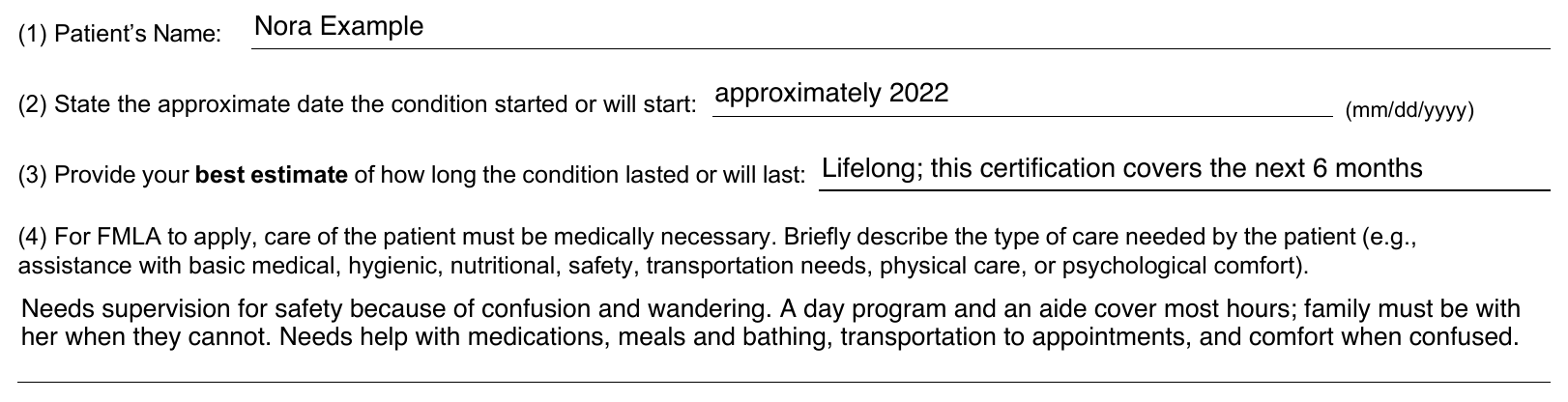
For a parent with moderate Alzheimer’s dementia, I would check the permanent or long-term box, write “Lifelong; this certification covers the next 6 months” in item 3, describe the supervision and help the parent needs in item 4, and put the son’s time off in item 10. Nora Example has been declining since about 2022. A day program and an aide cover most of her week. Her son Dana works at a credit union and is asking for time off to take her to appointments and to be with her when she becomes confused and wanders and the others aren’t there.
Item 4 is the box I would take the most care with here. A sentence like “moderate Alzheimer’s dementia” says what is wrong with Nora, but it does not say why Dana has to be somewhere other than work. So item 4 says she needs supervision for safety because of confusion and wandering, that a day program and an aide cover most hours, that family must be with her when they cannot, and that she needs help with medications, meals and bathing, transportation to appointments, and comfort. Those words follow the form’s own list, which is close to the list Dana sees in Section II.
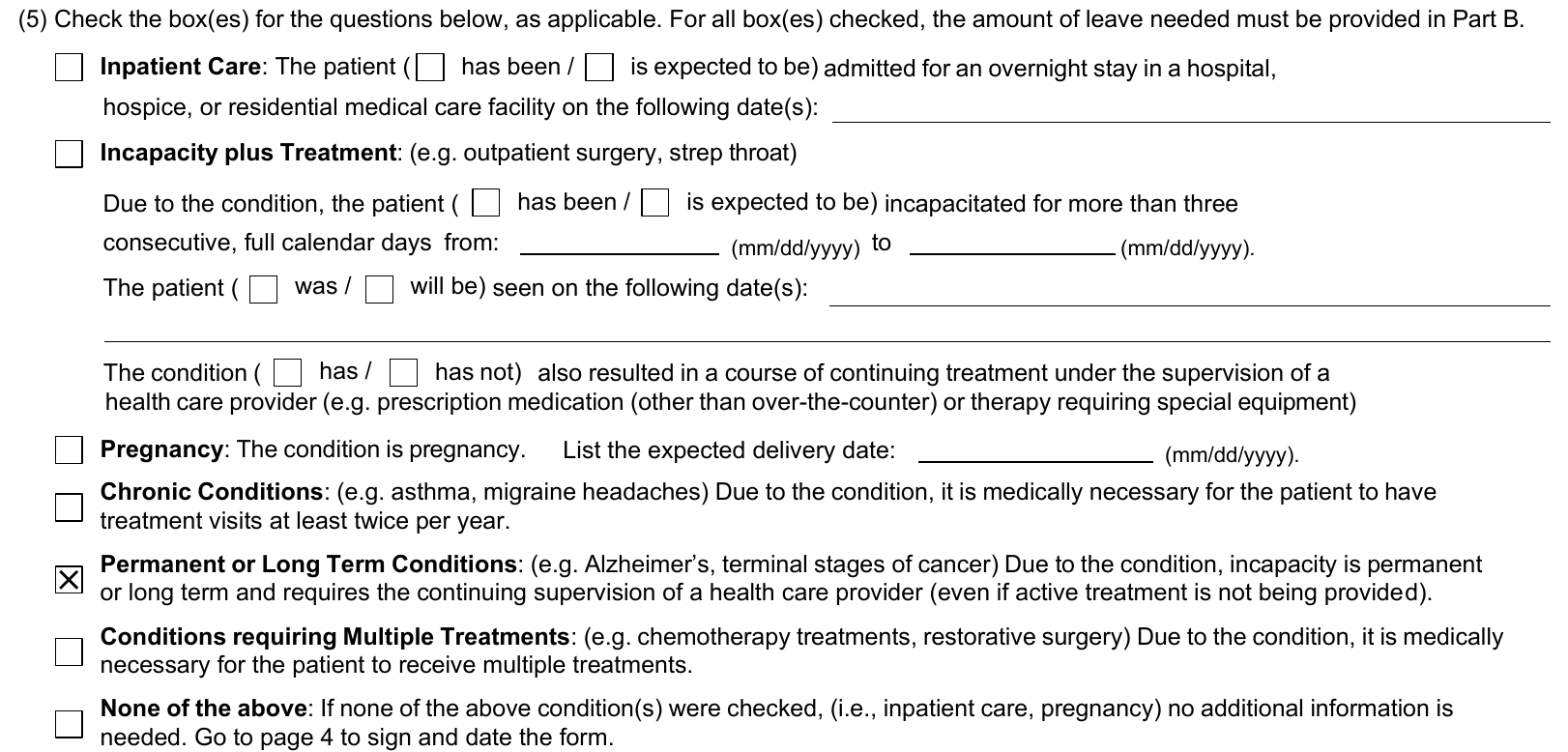
In item 5, I chose the permanent or long-term box because Nora’s condition will not improve and she needs continuing supervision, even though no treatment is going to reverse it. The form happens to use Alzheimer’s as an example, but the diagnosis doesn’t decide the box, and I leave the diagnosis off the form. Item 7 gives her follow-up visits every three months, starting with the next one in January 2027. Item 3 tells the truth about the condition and also gives HR the period I am certifying, because the form warns that “lifetime” alone may not be enough.

Item 10 is where the hours go. I am estimating that Dana will be away about 4 times a month, for about 6 hours each time, over the next six months. Most of those are confusion episodes rather than visits, so I would base the number on what has happened in recent months. This estimate works only because the day program and aide cover Nora otherwise, and without them I would write much more. The form’s second blank offers hours or days, and I would use the one that matches how the absence plays out, so I would ask about the employee’s shift. I would leave item 9 blank for Nora, because she has no block of time with an end date and Dana isn’t asking for one. If Dana needed a continuous block, I would fill it. Any reduced schedule that Dana wants goes in Section II, which is Dana’s own part of the form.
What would I write for a child on chemotherapy?
A child on a fixed chemotherapy schedule fits the multiple treatments box, so I would check that, put the schedule in item 7, put the infusion day and the day after in item 10, and use item 6 for what those two numbers can’t show. Milo Example is a young child who was diagnosed with leukemia in September 2026. His father Sam works for a trucking company and needs to be with Milo on infusion days and at home afterward. In real life I would expect his oncology team to complete this form. A pediatrician who has examined him would need their written plan, and I have shown one here working from that plan.
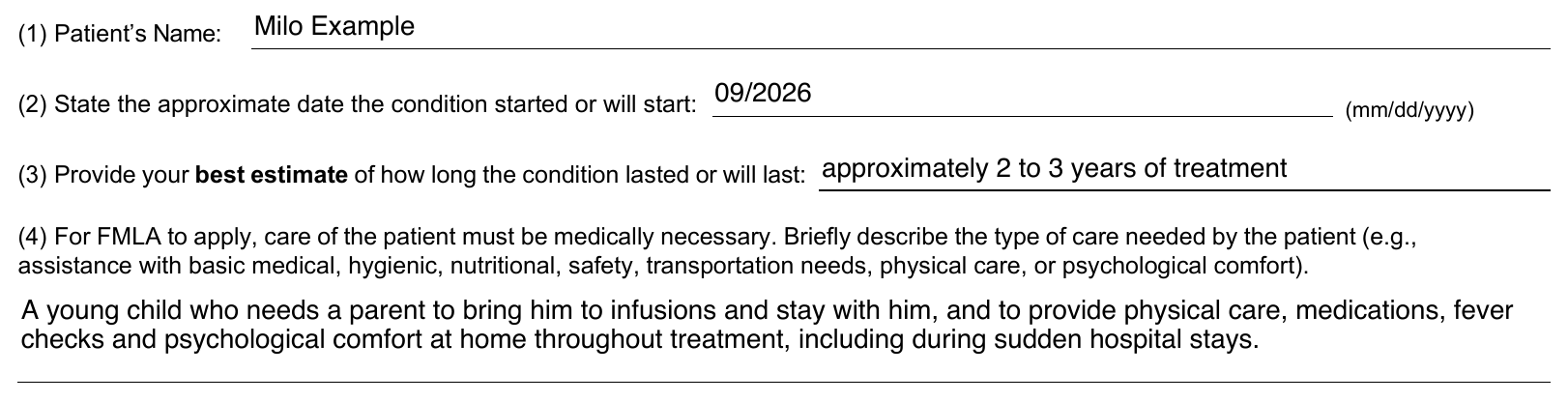
Item 3 asks how long the condition will last, not how much leave Sam needs, so I have written “approximately 2 to 3 years of treatment” and left the time off for Part B. For a young child, item 4 can be short, because a child that age can’t get to an infusion alone. It also says what the parent does at home, which is physical care, medications, fever checks and comfort, throughout treatment and during any sudden hospital stay. I have kept the word oncology out of what I wrote, because my approach is to describe the care rather than the diagnosis, though the printed chemotherapy example next to the checked box and the word infusion may still give it away.
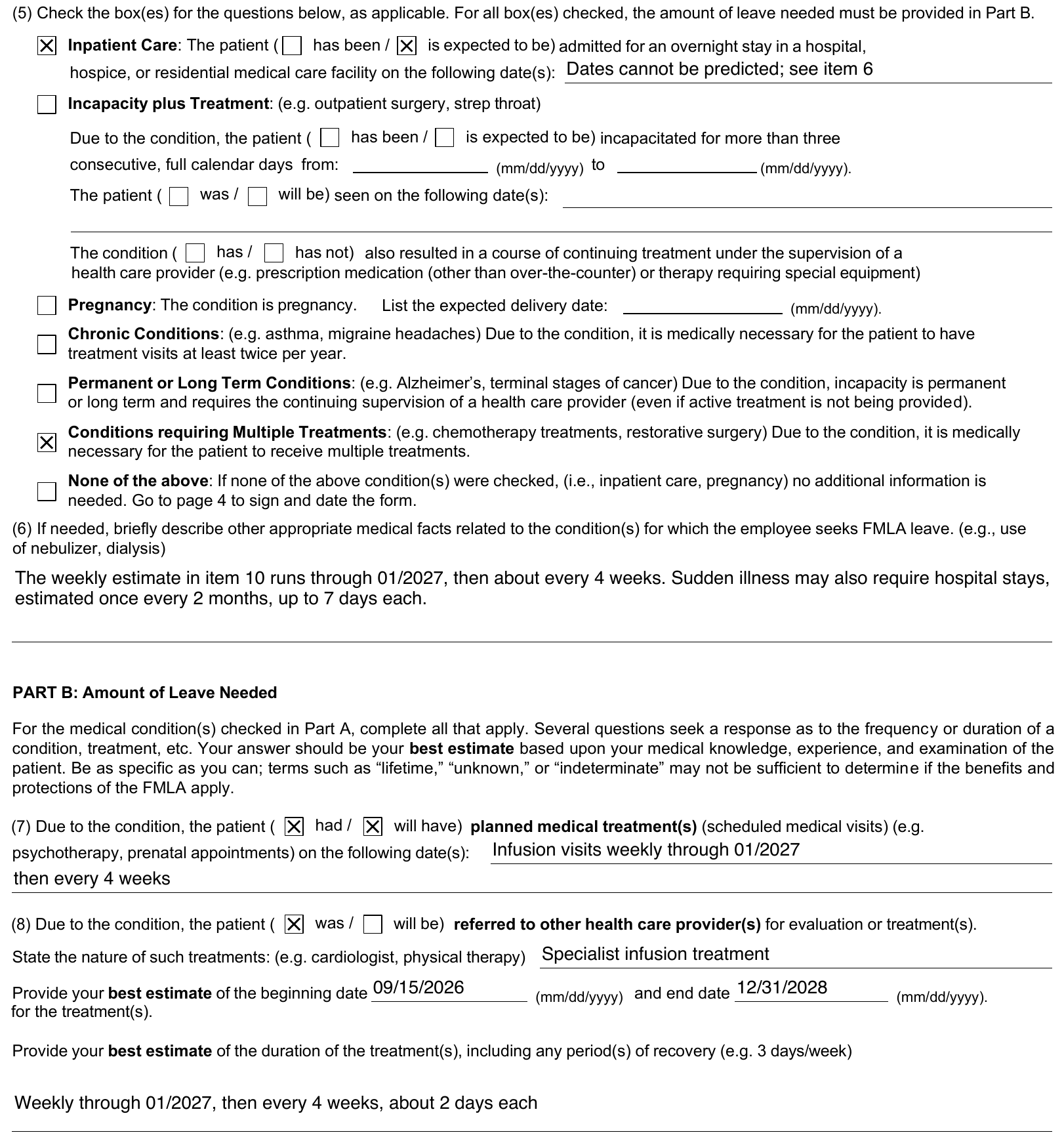
The multiple treatments box in item 5 uses chemotherapy as its own example. I have also checked the inpatient box with “is expected to be”, because I expect hospital stays even though I can’t give dates, and the line says to see item 6. Item 7 asks for dates, and for a long schedule I would describe the pattern rather than try to list every date, weekly through January 2027 and then every 4 weeks. I have checked both had and will have, because the infusions began in September and will continue. A referred treatment goes in item 8, and I repeat it in item 7 only when the visit schedule needs spelling out, as Milo’s does. Item 10 has room for only one pattern, so I would use item 6 to say that sudden illness may require hospital stays, estimated once every 2 months for up to 7 days each. These numbers should come from the treatment team. No source I have found says item 6 settles this, so I would warn the family that a stay longer than the form describes may mean HR asks for a new certification.

In item 10, one time per week and 2 days per episode covers the infusion day and the day after. The form’s blank says “episodes of incapacity”, which doesn’t quite fit a scheduled infusion, but the sentence above it covers absence to provide care on an intermittent basis, so this is the place I would put it. The weekly rate only lasts through January, and item 6 says so. Treatment can get busier again later, so I would follow the team’s plan rather than assume a steady taper.
What would I write for a spouse after a stroke?
For a spouse recovering from a stroke, I would check the inpatient box and the multiple treatments box, list the facility stays and the therapy, give one continuous period of incapacity in item 9, and give the part-time help in item 10. Lee Example had a stroke on October 12, 2026, spent a week in the hospital and four weeks in a skilled nursing facility, and came home on November 16 with outpatient therapy starting the next day. A home health aide gives the other weekday help. Lee’s spouse Pat works at a school.
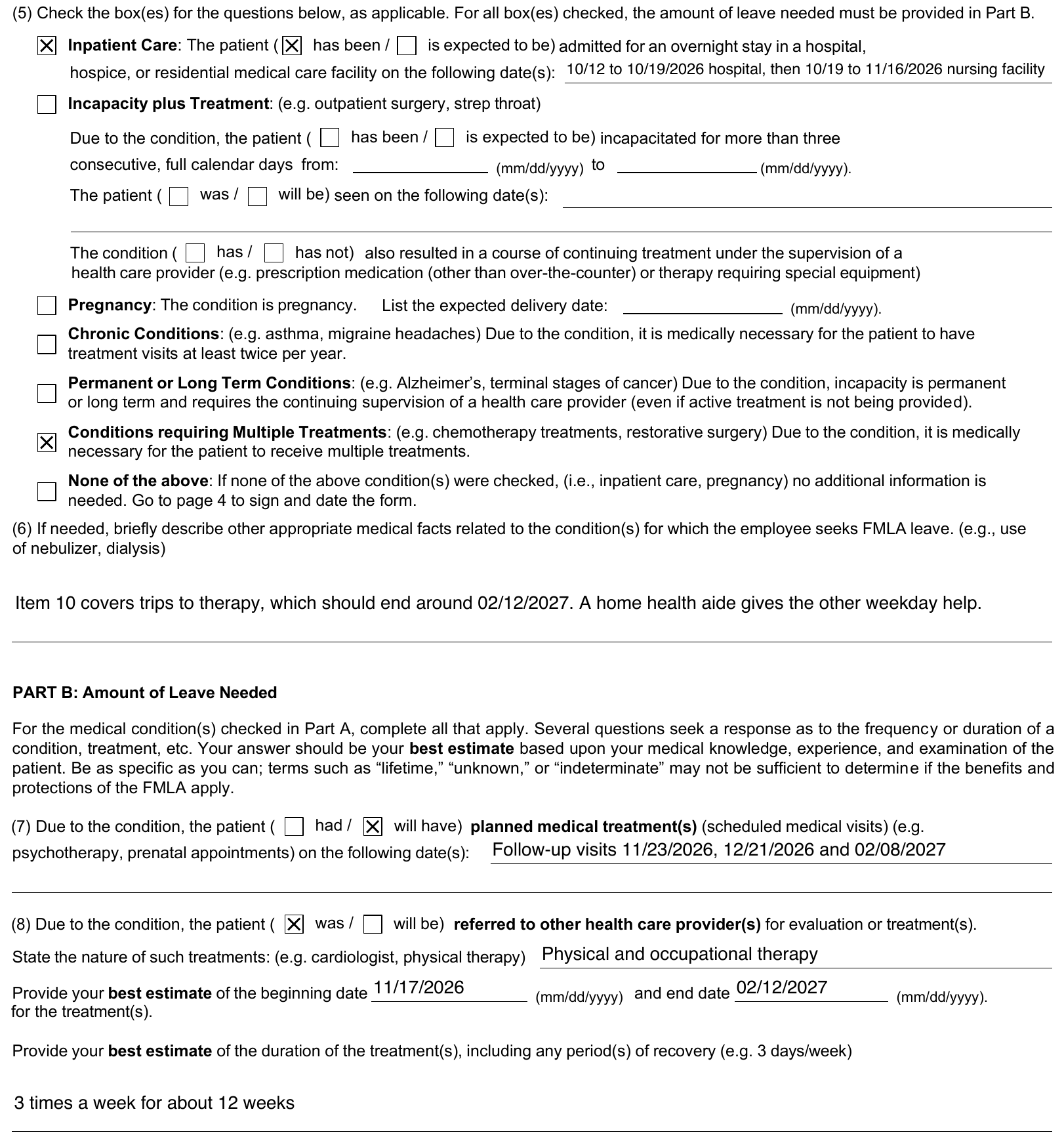
The form’s inpatient line covers “a hospital, hospice, or residential medical care facility”, so I have put both stays on that one line. The inpatient box already covers Lee, so I would not need the incapacity plus treatment box. Its rule, for a patient who does need it, is two in-person visits to a health care provider for treatment within 30 days of the first day of incapacity, unless extenuating circumstances exist, with the first visit within 7 days, or one such visit within 7 days that starts a regimen of continuing treatment. Therapy is a referral, so it goes in item 8, with its dates and “3 times a week for about 12 weeks”, and my own follow-up visits go in item 7. Because Pat has to be away for those trips, that time goes in item 10 as well. I also check multiple treatments for the series of therapy visits. Item 4 lists the help Lee needs, and I would leave out the details of the deficit, because the care is what the employer needs to know.
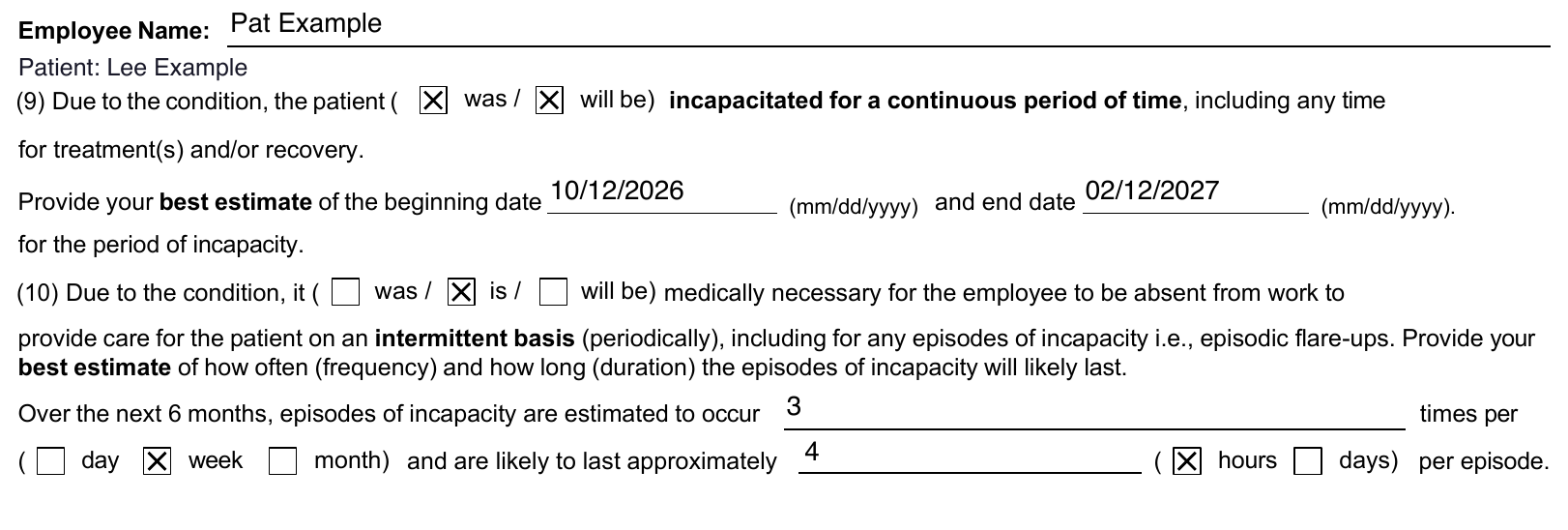
Items 9 and 10 ask different questions, and I think this is where the form is easiest to misread. Item 9 asks how long the patient is incapacitated, so it runs from the day of the stroke to the end date I expect for therapy, 10/12/2026 to 02/12/2027, and I have checked both was and will be because it began in the past and runs into the future. It doesn’t mean Pat needs all of that time off. Item 10 is how often the employee needs to be away to help, and I have estimated 3 times a week for about 4 hours, to get Lee to therapy. I expect those trips to end with the therapy, around 02/12/2027, and item 10’s six-month wording can’t show that, so item 6 says it, along with the aide who gives the other weekday help. HR may ask about the overlap, and I would answer if the employee permits it. Pat’s own plan belongs in Section II, and it should be consistent with what I wrote. Item 3 says “approximately 4 months, then reassess”, to match item 9, and if Lee still needs help after that, the family will need a new certification, and I would complete one.
What would I write for an adult child with diabetes?
With an adult child who has type 1 diabetes and frequent low blood sugar, I would check the chronic conditions box, and most of my thought goes into item 4, which says what the patient can’t do alone, and the estimate of episodes in item 10. Remy Example is 24, has had type 1 diabetes since about 2015, and also has a disability that means Remy can’t manage insulin, meals or a low blood sugar without help. Staff at Remy’s supported apartment give the daily help, and Remy’s parent Jo, who works for a delivery company, comes for the episodes.
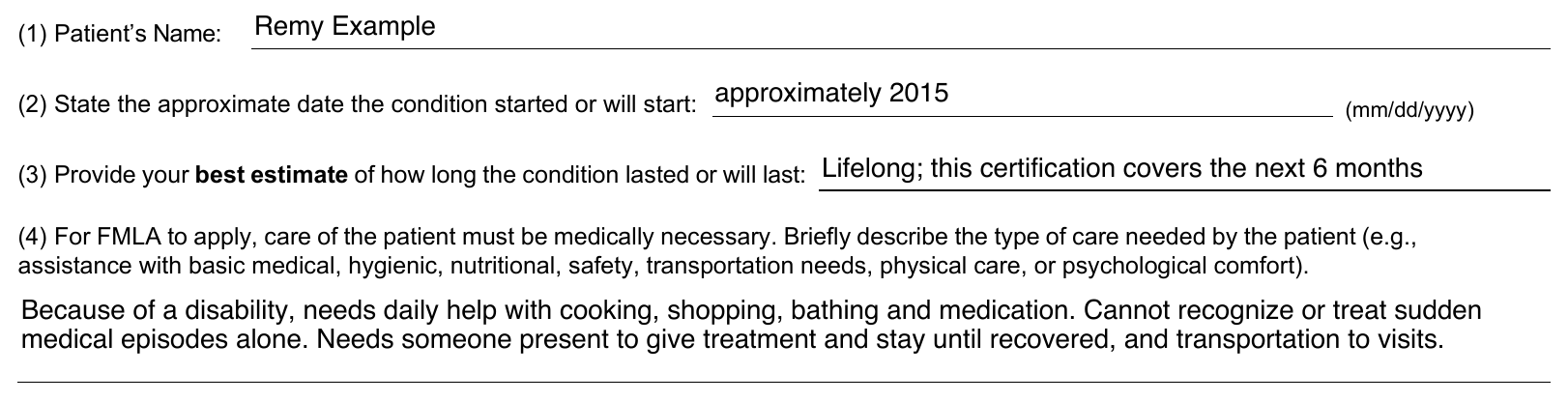
Because Remy is 24, the form treats this differently from the case of a young child. In Section II, the employee’s choices include “Child, age 18 or older and incapable of self-care because of a mental or physical disability”. The box is Jo’s to check, not mine, but my item 4 is what supports it. My understanding is that the FMLA rule defines this as needing active help or supervision with three or more activities of daily living, such as bathing, eating, cooking or shopping. An adult with well-controlled diabetes who manages their own care would probably not fit that description, however worried their parent is. So item 4 says that because of a disability, Remy needs daily help with cooking, shopping, bathing and medication and can’t recognize or treat sudden medical episodes alone, and it leaves out the words diabetes, insulin and glucagon. I would write this only if it is true of the patient in front of me.

The chronic conditions box requires treatment visits at least twice a year, and the definitions on page 4 of the form name diabetes, so item 7 gives Remy’s visits every three months. Item 3 is “Lifelong; this certification covers the next 6 months”, as on Nora’s form. The episodes can’t be predicted, but the form still wants an estimate, so I have looked back at how often this has happened and written 2 times per month, about 1 day per episode. Item 9 stays blank, because the time for a chronic condition like this goes in item 10. I would not write “as needed”, because it gives HR neither number.
What do all four have in common?
In each one I have tried to keep the two people apart. The patient’s name goes in item 1, and the employee’s name goes at the top of pages 2, 3 and 4. I certify what the patient needs, and the employee says what time off they are asking for in Section II. If Section II arrives blank, I would finish my part, leave theirs alone, and warn the family that the employee has to complete and sign it before it goes to the employer, because HR will likely not accept it otherwise.
Each one also answers item 4 with care rather than a diagnosis, answers item 3 with how long the condition will last, and gives Part B the time off that fits. The schedule for an infusion or a course of therapy goes in item 7 or 8, and if the employee has to be away for those trips, that time goes in item 10 too, along with any flare-ups. A stay or a long recovery ends up as two dates in item 9. If what I wrote in item 4 doesn’t match what the employee is asking for, the form may not be accepted, so if Section II has been filled out, it is worth reading before I sign.
The completed form goes back to the patient, not to the Department of Labor. Because the employee is a different person from my patient, I would get authorization from my patient, or from whoever properly speaks for them, before handing it to the employee. That matters on this page, because Nora may not be able to give it and Milo is a child. The walkthrough explains this further.
Questions the office asks
Is there an example of a completed WH-380-F?
Yes. This page shows the clinician’s part of the WH-380-F, Section III, filled in for four fictional families: a parent with dementia, a child on chemotherapy, a spouse after a stroke, and an adult child with diabetes. Each picture is cropped from the unsigned page PatientPapers printed, and each one is explained box by box.
What do I write on the WH-380-F for a parent with dementia?
For a parent with Alzheimer’s dementia, I would check the permanent or long-term box, write “Lifelong; this certification covers the next 6 months” in item 3, and describe the supervision and help the parent needs in item 4 rather than the diagnosis. Item 10 gets two numbers, such as 4 times per month and 6 hours per episode, based on recent months.
How do I fill out the WH-380-F for a child on chemotherapy?
I would check the multiple treatments box, which uses chemotherapy as its own example, describe the schedule in item 7, and put the infusion day and the day after in item 10, such as 1 time per week and 2 days per episode. Item 6 can flag sudden hospital stays, and a stay longer than the form describes may mean a new certification. Item 3 asks how long the condition will last, not how much leave the parent needs.
How are items 9 and 10 different on the WH-380-F?
Item 9 of the WH-380-F asks how long your patient is incapacitated for one continuous stretch, with a start date and an end date. Item 10 asks how often the employee needs to be away from work to provide care, and how long each time. After a stroke, for example, I might complete both, and neither one is the employee’s own leave plan, which goes in Section II.
Can a parent use the WH-380-F for an adult child?
Only if the adult child is incapable of self-care because of a mental or physical disability, which is the wording the WH-380-F prints in Section II for a child age 18 or older, and also has a serious health condition that needs care. The employee checks that box. Item 4 is where the clinician describes what the patient can’t do alone, and I would write that only if it is true of the patient.
PatientPapers filled in the forms on this page
I created PatientPapers to make this paperwork faster and easier, because as a physician I know how much of it lands on us. It is my own product, built through the same company as this site, so weigh this accordingly. The four forms on this page were filled in by PatientPapers from the answers described above, for made-up families and made-up clinicians, and the pictures are cropped from the unsigned pages it printed. It keeps your details on file, asks the questions in plain English, and fills in Section III of the Department of Labor’s own WH-380-F for you to review and sign. It prints the family member’s name in Section II and leaves the rest of that section for the employee. The pricing and the full description are on the PatientPapers site.
Open PatientPapers