Georgia handicap placard form, the doctor’s part of the MV-9D
A woman eleven days out from a total knee replacement comes in for her wound check on a walker, and her husband has the Georgia MV-9D folded in his shirt pocket. They have filled in her name and address and checked temporary. What they need from me is a reason code, a signature, and a decision about how to make it official, because Georgia will not take my signature on its own. Either a notary watches me sign, or I write the same facts on our prescription paper instead.
- Form
- MV-9D, Person with Disability Parking Placard/License Plate Application
- Issued by
- Georgia Department of Revenue, Motor Vehicle Division
- Blank form
- MV-9D PDF on dor.georgia.gov
- Revision
- Revised 05/2025
- Rule
- Official Code of Georgia §§ 40-2-74.1 and 40-6-221
- Temporary
- 180 days at most (red placard)
- Filed with
- the county tag office, by your patient
Key points
- Your part is Section D on page 1. The reason codes are on page 2.
- Write a code number from 1 to 8. There are no boxes to check.
- The walking test is 200 feet without stopping to rest.
- Sign before a notary, or write a statement on security paper.
- Temporary is 180 days at most. Permanent lasts four years.
- A permanent renewal does not come back to you.
Before you start: a code, a signature, and a choice
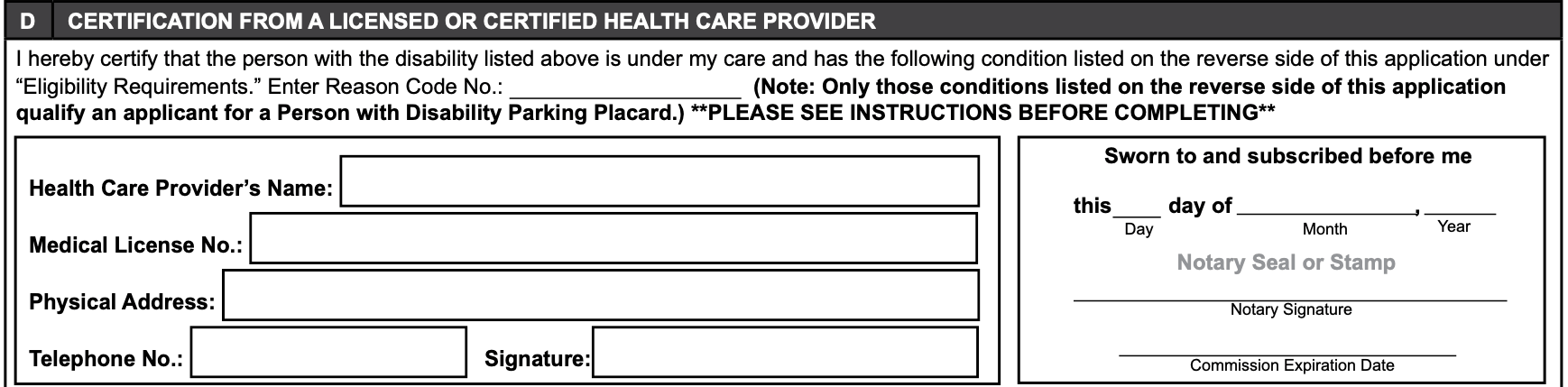
Georgia uses one form, the MV-9D, for the disabled parking placard and the disabled person’s license plate. It has six lettered sections. A and B are the request and your patient’s details, C is for a parent or guardian, E is for an institution or business, and F is your patient’s own signature. Section D is the only one that belongs to you.
Section D asks for less than most states do. There is no list of boxes and no line for permanent or temporary. You enter a reason code, a number that points to one of eight conditions printed on the back of the form, then your name, license number, address, phone number and signature. The part that takes planning is what happens around your signature. Section D is written as a sworn statement with a notary block beside it, and Georgia gives you one way out of the notary, for placards only, which is a signed and dated statement on security paper. I explain both below.
The rule: Official Code of Georgia § 40-2-74.1(a) and (i); Sections A to F and the instructions on page 2 of Form MV-9D.
Who may sign
This is the one place where the paper and the law do not line up, so it is worth a minute. The instructions on the back of the MV-9D begin a sentence on who may certify, naming physicians and then podiatrists by the chapters of the Georgia code that license them, and the printed sentence stops there, mid-list. The Department of Revenue’s own web page gives a fuller list, a licensed doctor of medicine or osteopathic medicine, a podiatrist, an optometrist, or a licensed chiropractor.
My understanding is that the statute itself is wider again. A later amendment to section 40-2-74.1 added a licensed advanced practice registered nurse and a licensed physician assistant, each “acting pursuant to the authority” of a named section of the code (43-34-25 for the nurse, 43-34-103(e.1) for the physician assistant). The same amendment let either of them write the security-paper statement in place of the affidavit. So if you are a nurse practitioner or a physician assistant, my understanding is that the law lets you sign Section D, but the form and the department’s page your patient carries to the counter do not yet say so. What I would do is print your name with your credential after it in the name box, so the clerk can see what kind of license the number belongs to.
The instructions add that “Only licensed health care providers may certify disabilities for temporary placards.” The statute also has a route for military patients. An active duty military physician may sign for a patient who is on active duty and stationed in Georgia, or retired from the military and living in Georgia, whether or not that physician holds a Georgia license, and the affidavit then says which of those the patient is.
The license plate is a separate matter. My understanding is that plates run under a different section, 40-2-74, which that amendment did not touch, so a nurse practitioner or physician assistant who can certify a placard may not be able to certify a plate.
The rule: Official Code of Georgia § 40-2-74.1(a), (b), (c), (h) and (i), as amended in 2024 by House Bill 557; the instructions on page 2 of Form MV-9D; the Department of Revenue’s disabled person’s license plates and parking permits page.
The eight reason codes, in Georgia’s words
The back of the form lists the conditions under the heading Eligibility Requirements, Reason Codes, and Section D says in bold that only those conditions qualify. Here they are as the form prints them.
- Applicant is so ambulatory disabled that he/she cannot walk 200 feet without stopping to rest.
- Applicant cannot walk without the use of assistance from a brace, a cane, a crutch, another person, a prosthetic device, a wheelchair, or other assistive device.
- Applicant is restricted by lung disease to such an extent that his/her forced respiratory volume for one second, when measured by spirometry, is less than one liter, or when at rest his/her arterial oxygen tension is less than 60 millimeters of mercury on room air.
- Applicant uses portable oxygen.
- Applicant has a cardiac condition to the extent that his/her functional limitations are classified in severity as Class III or Class IV according to standards set by the American Heart Association.
- Applicant is severely limited in his/her ability to walk due to an arthritic, neurological, orthopedic condition or complications due to pregnancy.
- Applicant is hearing impaired person pursuant to Georgia Code §24-6-651.
- Applicant is a blind individual whose central visual acuity does not exceed 20/200 in the better eye with correcting lenses or whose visual acuity, if better than 20/200, is accompanied by a limit to the field of vision in the better eye to such a degree that its widest diameter subtends an angle of no greater than 20 degrees.
(I have corrected one typing slip in code 3, where the form spells spirometry with an extra letter.)
The walking test is code 1, 200 feet without stopping to rest, which is roughly the walk from the far side of a supermarket lot to the door. Codes 3 and 5 rest on a number or a class you can find in the chart. Code 4 is met by portable oxygen in use, and code 2 by the walker or cane your patient came in with. Code 6 is the broad one, and it is the only one that names pregnancy. Code 8 is the usual definition of legal blindness.
Code 7 is the odd one out, because it is about hearing rather than walking or sight. The section it cites, in Georgia’s evidence code, describes a person whose hearing is so impaired that they cannot understand ordinary conversation. My understanding is that the definition the placard statute relies on, section 40-6-221, lists only the other seven conditions, and that hearing impairment appears in the license plate statute instead. The department’s web page lists hearing impairment for the placard all the same. If hearing is your patient’s only qualifying condition, the county tag office is the one to say what it will issue, and I would let your patient know that before they make the trip.
More than one code can apply, and I would write every one that does, separated by commas. Neither the form nor its instructions say whether one code or several is expected.
The rule: Official Code of Georgia §§ 40-6-221(4), (5) and (7) and 40-2-74.1; Eligibility Requirements, Reason Codes, on page 2 of Form MV-9D.
Section D, line by line
The certifying sentence. It reads “I hereby certify that the person with the disability listed above is under my care and has the following condition listed on the reverse side of this application.” Two things in that sentence are worth noticing. The person is the one named in Section B, so check that your patient filled it in before you sign. And “under my care” is part of what you swear to, so this is not a form to sign for someone you have never seen.
Enter Reason Code No. The number or numbers from the list above. A number is all the line asks for.
Health Care Provider’s Name. Your name, with your credential if you are not a physician, for the reason in the section on who may sign.
Medical License No. Your license number. The form does not ask which state issued it or what kind of license it is.
Physical Address and Telephone No. Yours, not your patient’s.
Signature. Leave it blank until the notary is in front of you, if you are going the notary route.
Two things Section D does not have a place for. The first is temporary or permanent. Your patient checks that in Section A. The second is an end date. My understanding is that the statute asks the affidavit for a temporary permit to state “a date until which such person is likely to remain disabled,” and that the date printed on the placard is the one the certifier gives, capped at 180 days. Since there is no line for it, what I would do is write “temporary, expected to recover by” and the date next to the reason code, and make sure it matches what your patient checked in Section A.
The rule: Official Code of Georgia § 40-2-74.1(b) and (c); Sections A, B and D of Form MV-9D.
The notary, or a statement on security paper
Next to your signature box sits the line “Sworn to and subscribed before me,” with spaces for the day, month and year, the notary’s seal or stamp, their signature and the date their commission expires. Those words mean you swear to the statement and sign it with the notary present, so a form you signed at your desk the day before does not fit them. If your practice has a notary on staff, this is the easy route.
For a placard, there is another. The back of the form quotes the statute, which says the department “shall accept, in lieu of an affidavit, a signed and dated statement from the doctor which includes the same information as required in an affidavit written upon security paper.” My understanding is that security paper here means the tamper-resistant prescription paper Georgia defines in its pharmacy law. The form shows a sample prescription and lists what the statement must include.
- The specific disability, as described in the MV-9D instructions.
- Whether the disability is permanent or temporary.
- Your stamp or signature.
- The date.
Rather than a bare code number, I would write the condition out in the form’s own words and add the code, so the clerk does not have to match them up. For a temporary disability I would add the expected recovery date, for the reason in the section above. Your patient then takes the statement in with the MV-9D and leaves Section D blank.
The security-paper route is for placards only. The form says plainly that it “cannot be provided on license plate applications,” and the request section adds, beside the plate box, that “Section D must be completed and notarized.” If your patient wants a plate, the notary is the only way.
The rule: Official Code of Georgia § 40-2-74.1(i); Section A, Section D and the Certification instructions on page 2 of Form MV-9D.
Temporary or permanent, and what happens at renewal
My understanding is that Georgia draws the line at 180 days. A disability expected to last more than 180 days is permanent, and one expected to last 180 days or less is temporary. The statute counts a pregnant woman with a sworn affidavit of medical need as temporarily disabled.
A permanent placard is blue and lasts four years. When it runs out, your patient renews it with Sections A, B and F only, and the form says “Notarization is not required.” Nothing comes back to you. That is the reason I would not check permanent lightly on someone’s behalf, and why I would read what your patient checked in Section A before signing.
A temporary placard is red and lasts no more than 180 days, and the form says it “may not be extended.” If your patient needs more time, they start a new MV-9D, and Section D is certified again, with a notary or a new security-paper statement. The knee replacement in the opening paragraph is the usual case. If I were not sure a condition would improve, what I would do is certify it as temporary and see my patient again before the date, since a permanent placard renews every four years without a clinician looking again.
There is also a gold placard, the special permanent placard, for a person who drives a car fitted with hand controls for the brakes and accelerator, or who has lost both arms or the use of them. The form says to follow the permanent placard instructions. Neither condition is one of the eight reason codes, and the form does not say what goes on the reason code line for it, so I won’t guess. If one of the eight codes also applies, I would write that one.
For the front desk, a lost or stolen placard is replaced with Sections A, B and F and the old placard number, with no new certification. The form says each eligible person gets only one placard.
The rule: Official Code of Georgia §§ 40-6-221(4) and (7) and 40-2-74.1(b), (c) and (e); the instructions on page 2 of Form MV-9D; the Department of Revenue’s disabled person’s license plates and parking permits page.
The oath over your signature
Because Section D is sworn before a notary, it is an affidavit, and the statute calls it one. The Department of Revenue’s page, in its section on license plates, lists as a criminal offense a licensed certifier “who knowingly and willfully makes a false or misleading statement in their affidavit stating that an applicant is a disabled person.” Your patient’s own signature in Section F sits under a warning that a knowingly false statement is a misdemeanor. I have not traced which penalty applies to a placard certification as distinct from a plate, so I won’t go further than that.
The practical point does not depend on it. The clerk never sees your patient’s gait, only your code. What I would do is sign only when I can point to the code in my note for that day, and write the observation that supports it, for example “code 1, stopped twice walking from the waiting room.”
The rule: Official Code of Georgia § 40-2-74.1(a) to (c); Sections D and F of Form MV-9D; the Department of Revenue’s disabled person’s license plates and parking permits page.
Where it goes, and what your patient pays
Your patient files the form, not your office. The form tells them to take it to their local county tag office, and the Department of Revenue’s page links to a list of those offices. Your patient does not need to own a car to get a placard.
Placards are free. The statute says the department and the county tag agents “shall not charge or collect any fee” for them, and that covers temporary, permanent and gold. The license plate is different. The form prints a $20.00 plate fee plus any taxes due, and the department’s page describes it as an annual fee.
The rule: Official Code of Georgia § 40-2-74.1(f); Section A and the submitting instructions of Form MV-9D.
What the form says must be there
I have not found a Georgia source that lists the common reasons an MV-9D is not accepted, so I won’t make one up. What the form and the statute do say must be there is short, and it is what I would look over before your patient leaves.
- A reason code from the back of the form. Section D says only those conditions qualify.
- Your signature sworn before a notary, with the notary’s seal or stamp, signature and commission date filled in.
- Or, for a placard only, a signed and dated statement on security paper naming the specific disability and whether it is permanent or temporary.
- A notarized Section D, never the security-paper statement, if your patient is applying for a license plate.
- For a temporary placard, a disability expected to last no more than 180 days, and a date until your patient is likely to remain disabled.
PatientPapers makes completing the Georgia MV-9D faster and easier
I built PatientPapers because this kind of form keeps landing on my desk between patients, and I wanted it to take less of the day. It is my own product, made through the same company as this site, so weigh what I say about it with that in mind. It keeps your name, license number, address and phone number on file, asks whether your patient wants a placard or a plate, which reason codes apply, whether the disability is permanent or temporary, and when a temporary one should end. If you choose the notary, it fills in Section D on Georgia’s own MV-9D, with your patient’s name in Section B, and leaves the notary block and the rest of the form blank. If you choose security paper for a placard, it writes the statement for you to print on your own prescription paper, since it can supply the words but not the paper. The pricing and the full description are on the PatientPapers site.
Open PatientPapers