Washington Activity Prescription Form, box by box
A carpenter cut her hand on a table saw, and she has an open claim with Washington’s Department of Labor and Industries. Along with your chart note, L&I wants one page from you that tells her employer what she can lift, tells the claim manager whether she can work, and certifies her time-loss payments if she cannot.
- Form
- F242-385-000, Activity Prescription Form (APF)
- Issued by
- Washington State Department of Labor and Industries (L&I)
- Blank form
- APF PDF on lni.wa.gov
- Revision
- 10-2018
- Rule
- RCW 51.36.060; WAC 296-20-01002 and 296-20-06101; MARFS Chapter 21
- Goes to
- L&I for State Fund claims, or the self-insured employer or its administrator, with a copy to the worker
Key points
- It goes with the Report of Accident, and again whenever work status or capacities change.
- It certifies time-loss, so objective findings are required unless the worker is back to full duty.
- Capacities apply at home as well as at work, and a blank row means not restricted.
- Fill in the capacities even when the worker is not released to any work.
- L&I pays for it under billing code 1073M, within visit limits.
- Only attending provider types may complete it, and the signer checks Doctor, ARNP or PA-C.
Before you start: one page that several people read
The Activity Prescription Form, which L&I calls the APF, is how a clinician treating an injured worker in Washington tells the Department of Labor and Industries (L&I) what the worker can do. It fits on one page, with guidance on the back, and it is read by more people than most forms you sign. The employer uses it to build modified work, the claim manager uses it to follow the claim and decide on time-loss payments, and vocational counselors use it to plan a return to work.
The back of the form says it will also certify time-loss compensation, if appropriate. Washington’s rules say all time-loss compensation must be certified by the attending provider based on objective findings. So as I read it, the dates you write in the work status section are not just advice to the employer. They are, in most cases, what the claim manager pays your patient against, and the objective findings box next to them is what holds those dates up.
The APF does not replace your chart note. The top of the form reminds you to send chart notes and reports as required. What I would do is write the note first, with the measurements in it, and fill out the form from the note.
The rule: RCW 51.36.060; WAC 296-20-01002 (temporary partial disability); L&I’s Activity Prescription Form page; Form F242-385-000, page 2.
When it is due, and who gets it
The top of the blank says to complete the form only when there are changes in medical status or capacities, or a change in release for work status. L&I’s provider page sets out when the form is required, depending on the worker.
- Released to work without restrictions. With the Report of Accident (or the Provider’s Initial Report for a self-insured claim), and again if you change the worker’s capacities or restrictions, which includes removing them.
- A simple injury with no restrictions, such as a simple eye injury or a laceration without tendon or nerve involvement. Only with the Report of Accident.
- A simple injury with restrictions that do not call for light or modified duty, such as keeping a wound dry. With the Report of Accident, and again if you change the restrictions.
- Restrictions the worker has to follow to do light-duty work. With the Report of Accident, within 4 weeks of the date the claim was established, and whenever the work status or the capacities change, including when restrictions come off.
Washington’s reporting rule wants the Report of Accident within five days of the first visit, so the first APF usually goes with it. L&I’s payment policy also pays for an APF when nothing has changed but you are extending the dates of certification, as long as your chart notes support it. As I read the two together, an APF that only extends time off is fine, and one that repeats the last with no new dates is the kind the blank is telling you not to send.
Where it goes depends on who insures the employer. For a State Fund claim, the blank gives L&I’s claim file fax, 360-902-4567, and PO Box 44291, Olympia WA 98504-4291. L&I also takes it electronically, but only for workers it covers. For a self-insured employer, the form goes to that employer or its third party administrator, and the blank points you to L&I’s list of them. Either way, L&I’s page asks you to give your patient a copy so they can show it to their employer, and to keep APFs and chart notes for at least 5 years.
The rule: WAC 296-20-06101; Medical Aid Rules and Fee Schedules (MARFS), Chapter 21, Activity Prescription Form; L&I’s Activity Prescription Form page; Form F242-385-000, page 1.
Who fills it out, and who signs
The signature line has three boxes for your provider type, Doctor, ARNP and PA-C, and L&I’s page says you must sign, date and indicate your provider type. “Doctor” is wider in Washington’s rules than it sounds. The definition covers physicians, osteopathic physicians, chiropractors, naturopaths, podiatric physicians, dentists, optometrists and psychologists. Washington’s statute lists all of those, plus physician assistants and advanced registered nurse practitioners, as attending providers, with psychologists limited to mental health only claims.
L&I’s payment policy says only attending provider types may complete an APF, acting as the attending provider on the claim, as a concurrent care provider, or as a consultant. A psychologist is paid for one only as the attending provider on a mental health only claim. The back of the form says occupational and physical therapists, office staff and others will not be paid for working on it. Your staff can fill in the name and claim number, but I believe the capacities and the signature have to be yours.
L&I’s payment policy accepts a handwritten signature, a signature stamp or an electronic signature, and wants your name and title and the date on the document even where the form has no field for them. As far as I can tell, attending providers in Washington also have to be enrolled in L&I’s provider network and have a provider account number before treating injured workers, except for an initial office or emergency visit.
The rule: RCW 51.08.200; WAC 296-20-01002 (attending provider, doctor); MARFS, Chapters 3 and 21; Form F242-385-000.
Getting paid for it
Washington pays for this form. The billing code is printed at the top of the form, 1073M. When I looked, L&I’s professional services fee schedule listed 1073M at $62.67, and that figure changes when the fee schedule is updated. The limits are up to 6 APFs per worker within the first 60 days after the initial visit, then up to 4 per 60 days after that, and no more than 1 per provider, per worker, per day. When the insurer asks you for an APF, a properly completed one is paid even if those limits have been reached.
L&I does not pay for an APF completed at the request of an attorney or of an employer covered by L&I, or one sent with an application to reopen a claim. When a self-insured employer or its administrator asks for one, L&I’s page says the employer pays. A phone call that only passes on what the APF says is bundled into 1073M. If your patient has more than one open claim, 1073M is split equally between them, and every claim number goes on the APF, the bill and the chart notes.
The rule: MARFS, Chapters 2, 5 and 21; L&I’s Professional Services Fee Schedule, code 1073M; L&I’s Activity Prescription Form page.
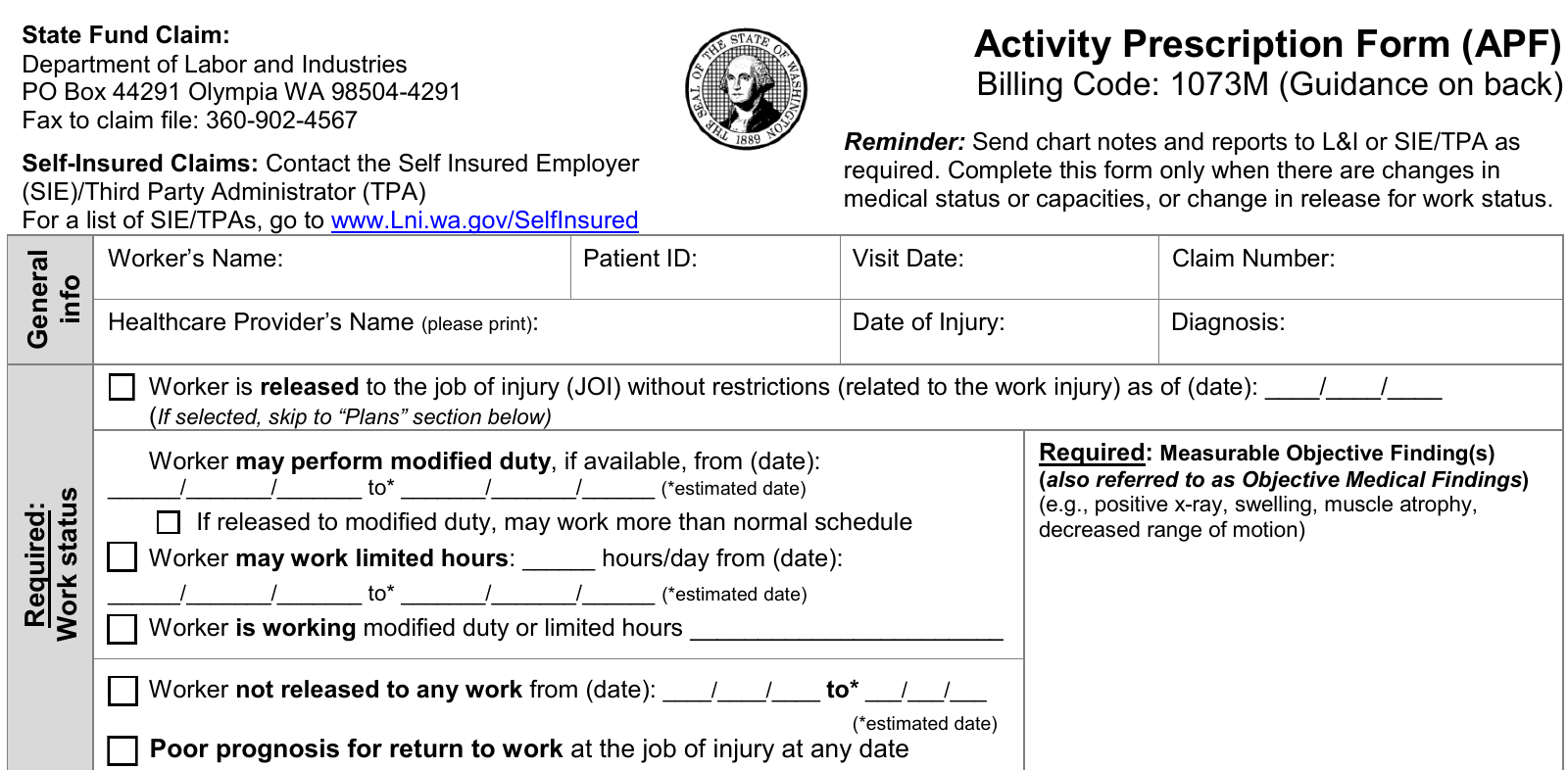
General info: the top of the form
The worker’s name, a patient ID, the visit date, the claim number, your printed name, the date of injury and the diagnosis. L&I’s page says to complete all of these fields, and that patient ID labels may be used. For the diagnosis, it wants the primary diagnosis and the reason for today’s visit, as either ICD codes or written descriptions. If your patient has more than one claim, put every claim number here.
Work status, and the objective findings beside it
This is probably the section your patient and the employer care about most. L&I’s page says one or more selections are required, with no gaps between the dates when you check more than one, and that it is fine to estimate dates.
- Released to the job of injury without restrictions, as of a date. If you check this, the form tells you to skip to the Plans section.
- May perform modified duty, if available, from one date to an estimated end date. Under it is a smaller box, “If released to modified duty, may work more than normal schedule”, which you check only if overtime is safe.
- May work limited hours, so many hours a day, between two dates.
- Is working modified duty or limited hours, with a line to describe it, for a patient who has already gone back on lighter terms.
- Not released to any work, from one date to an estimated end date.
- Poor prognosis for return to work at the job of injury at any date. I would check it only when the chart note says why.
On the right of the same section is a required box for measurable objective findings, which the form also calls objective medical findings. L&I’s page says that if the worker is not able to return to full duty, these must be documented, and that the accompanying chart note must include measurements. Its examples of acceptable findings are X-rays, swelling, muscle atrophy, a change in range of motion and muscle spasm. Its examples of what is not acceptable are pain, tenderness and fatigue. So a note that only says the low back hurts and is tender will probably not hold up a modified duty release, while a measured loss of lumbar flexion, or spasm you can feel, gives the claim manager something to pay against.
The rule: WAC 296-20-01002 (temporary partial disability); L&I’s Activity Prescription Form page.
Estimate what the worker can do
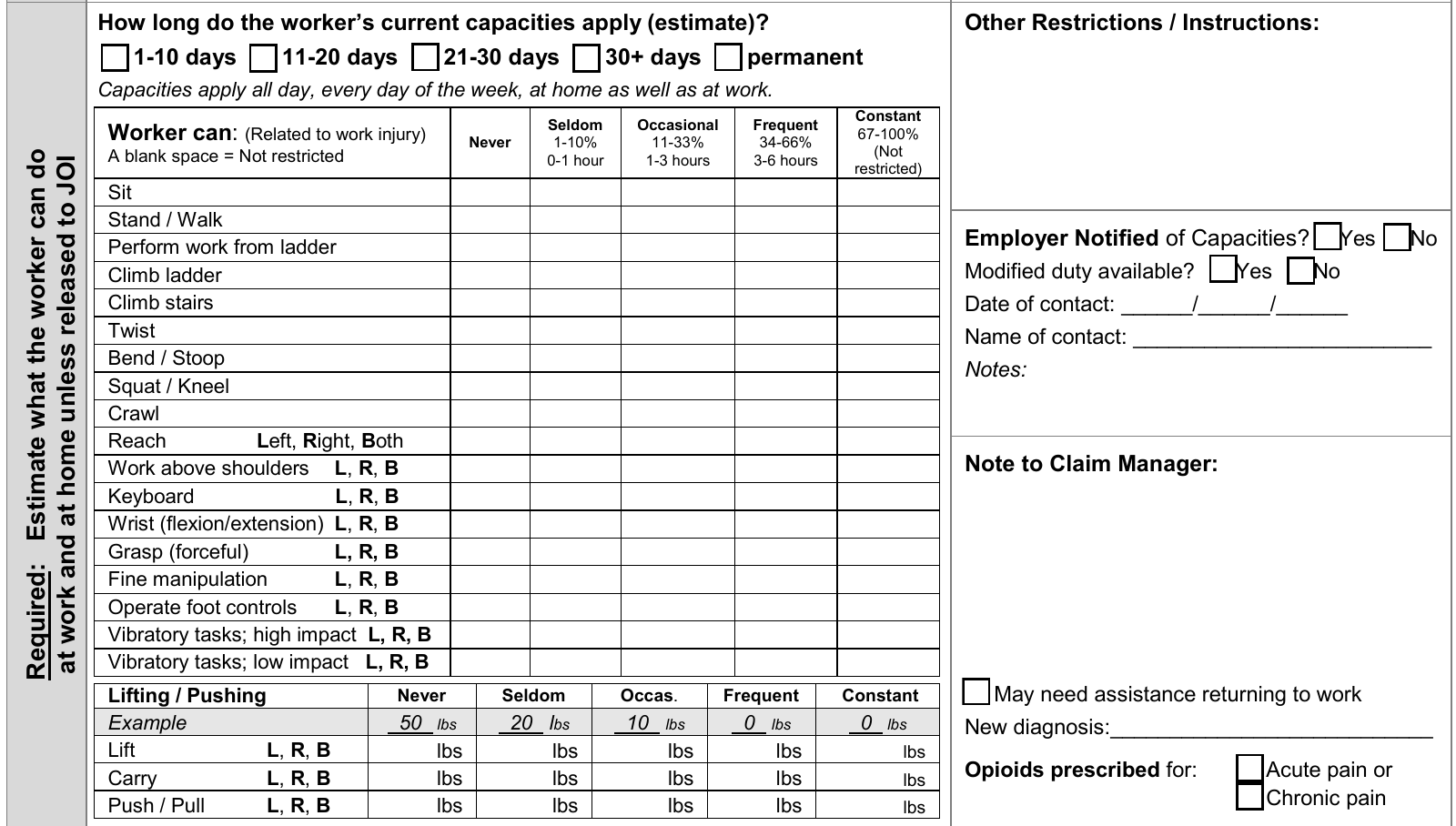
The middle of the form is a table of what your patient can do, related to the work injury. The section is required, and L&I’s page says the capacities must be given even when the patient is not released to any work, because they let the employer find suitable light or modified work. They also have to be supported by the objective findings you documented.
Start with how long the capacities apply, as an estimate. The choices are 1-10 days, 11-20 days, 21-30 days, 30+ days, or permanent. Under that the form prints a line I would read twice, “Capacities apply all day, every day of the week, at home as well as at work.” That is worth telling your patient, because a limit that only holds on the job is not what you are certifying.
Then the table. Each activity, from sitting and standing to keyboarding, grasping and vibratory tasks, has a column for never, seldom, occasional, frequent and constant. The form defines them on the page. Seldom is 1-10% of the day, or up to an hour. Occasional is 11-33%, or 1 to 3 hours. Frequent is 34-66%, or 3 to 6 hours. Constant is 67-100% and is labeled not restricted. The form also says “A blank space = Not restricted”, so a row you leave empty tells the employer there is no limit on that activity. The hand and arm rows ask for left, right or both.
The lifting rows work differently. For lift, carry and push or pull, you write a weight in pounds under each frequency. The form prints its own example row, never 50 pounds, seldom 20, occasionally 10, frequently 0 and constantly 0. As I read it, that example means the worker should never handle 50 pounds, may handle up to 20 pounds now and then, up to 10 pounds for an hour or more of the day, and nothing more often than that. Writing it out this way is much more useful to an employer than the words light duty, which on their own do not tell anyone what the worker can lift.
The rule: L&I’s Activity Prescription Form page; Form F242-385-000, page 1.
The right-hand column: other restrictions, the employer, and the claim manager
Other restrictions and instructions is for limits the table does not cover. L&I’s examples are “Keep hand dry” and “Patient unable to drive due to medication(s)”.
Employer notified of capacities asks whether you or your staff told the employer, whether modified duty is available, the date and name of the contact, and notes. L&I’s page says this part is not required but is recommended, so the claim manager knows the conversation happened.
Note to claim manager is also optional. L&I suggests using it to point at something specific, such as “I am the new Attending Provider (AP)” or “Pending surgical authorization”.
Below those are boxes for a worker who may need help returning to work, a new diagnosis, and opioids prescribed for acute or chronic pain. If you check the opioid box, Washington has separate documentation rules for opioids that continue past the first weeks, and the APF does not replace them.
The rule: L&I’s Activity Prescription Form page; WAC 296-20-06101 (opioid authorization requirement).
Plans
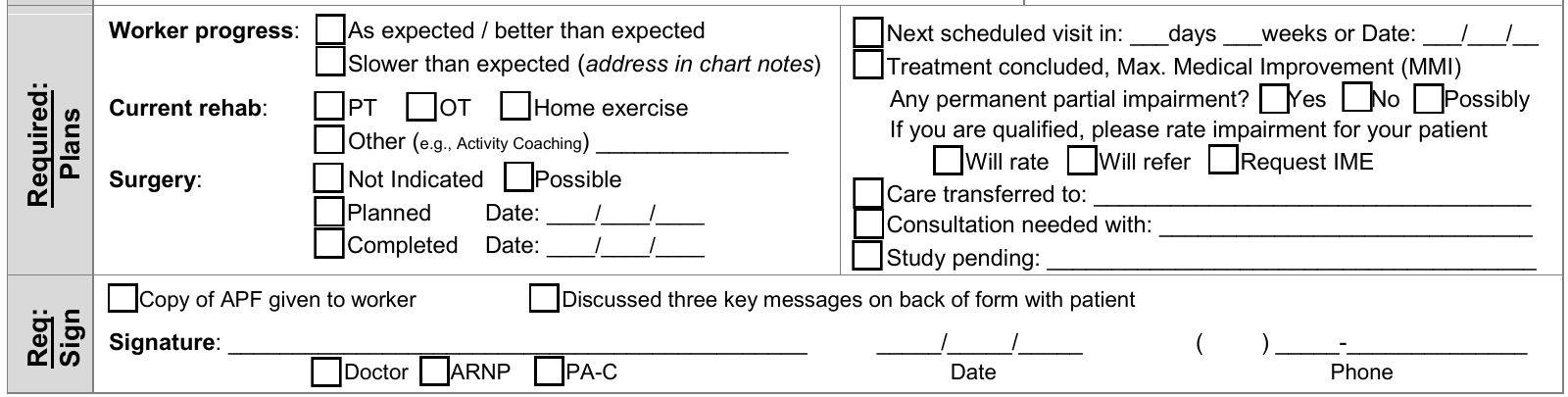
The Plans section is required, and L&I’s instruction is “Please check all that apply, in both columns.”
The left column is about the recovery so far. Worker progress is as expected or better, or slower than expected, which the form asks you to address in the chart notes. Then current rehab, and whether surgery is not indicated, possible, planned or completed, with dates.
The right column is about what happens next. The next scheduled visit is in so many days or weeks, or on a date. L&I’s page says that unless the worker is released to the job of injury without restrictions, the next visit should be no later than the estimated end date you wrote in the work status section.
If treatment is done, check treatment concluded, maximum medical improvement (MMI). Washington’s rules describe MMI as the point when no fundamental or marked change in an accepted condition can be expected, with or without treatment, and say the insurer stops paying for treatment once it is reached. The form then asks whether there is any permanent partial impairment, yes, no or possibly, and whether you will rate it, will refer for a rating, or are asking for an independent medical exam (IME). The last three lines are for care transferred to another provider, a consultation needed, and a study pending.
Only some attending providers may do the rating. The back of the form lists doctors licensed in medicine and surgery, including osteopathic and podiatric physicians, dentists, and chiropractors who are department-approved examiners. L&I’s payment policy does not list ARNPs, physician assistants or naturopaths as eligible to rate. If you cannot rate, “Will refer” is the honest box.
The rule: WAC 296-20-01002 (proper and necessary); MARFS, Chapter 3; L&I’s Activity Prescription Form page; Form F242-385-000, page 2.
Signing, and the back of the form
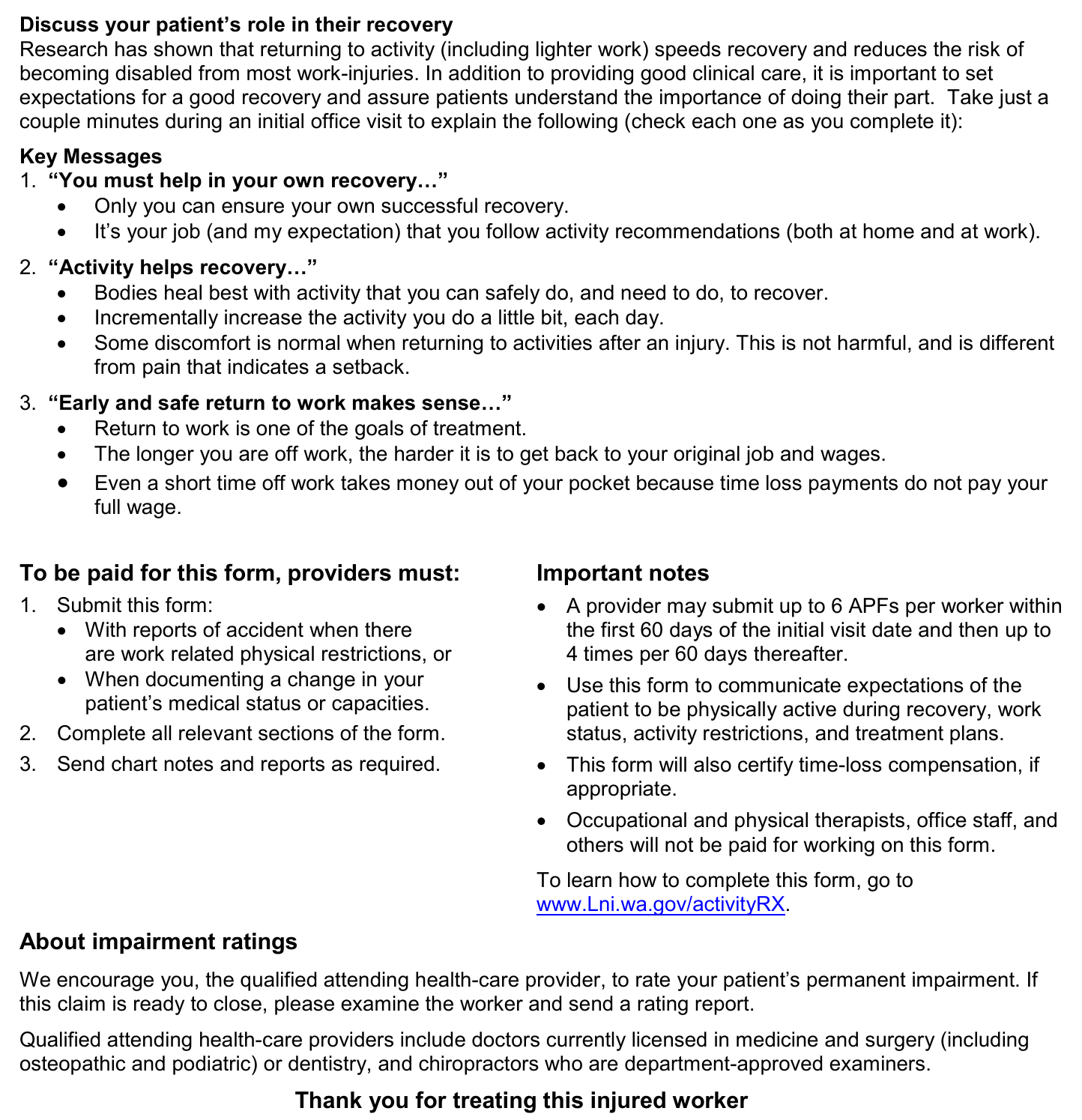
Above the signature are two checkboxes, that a copy of the APF was given to the worker and that you discussed the three key messages on the back with your patient. Then sign, date, check Doctor, ARNP or PA-C, and add a phone number.
The back of the form is written for the clinician, not the patient. It asks you to take a couple of minutes at the first visit to go over three messages, that your patient has to help in their own recovery, that activity helps recovery, and that an early and safe return to work makes sense. I think it is worth the two minutes, because the rest of the form only works if your patient follows the restrictions at home as well as at work.
The sections Washington says must be filled in
I have not seen a Washington source that lists which parts of the APF are most often incomplete, so I won’t guess. What L&I does say is that an APF is paid only when all required sections are complete and legible, and it says which sections those are. Those are the ones I would look at twice before signing.
- General info, every field, including the diagnosis.
- Work status, at least one box, with no gaps between the dates.
- Objective findings, whenever the worker is not back to full duty.
- The capacities table, even when the worker is not released to any work.
- Plans, every box that applies in both columns, with the next visit no later than the end of the certified dates.
- The signature, the date and your provider type.
Questions the office asks
What is the Activity Prescription Form?
The APF is how a clinician treating an injured worker in Washington tells L&I or the self-insured employer what the worker can do. It gives the work status, the capacities and the plan, and it can certify time-loss payments.
Does L&I pay for the APF?
Yes. It is billed with code 1073M, up to 6 per worker within the first 60 days after the initial visit and then up to 4 per 60 days, and it is paid only when all required sections are complete and legible. L&I does not pay for one completed at an attorney’s request, and when a self-insured employer asks for one, the employer pays.
Can a nurse practitioner, PA or chiropractor complete the APF?
Yes. The form’s signature line has boxes for Doctor, ARNP and PA-C, and Washington’s rules count chiropractors and naturopaths as doctors. Only attending provider types may complete it. Rating a permanent impairment is narrower, and the form lists chiropractors only when they are department-approved examiners.
Do I need to see the patient again if L&I asks for an APF?
Not always. L&I’s page says that if you examined the worker within the last 30 days, you can use that visit as the basis for your opinion. If it has been longer, or you are unsure about the worker’s current needs or restrictions, schedule an appointment as soon as possible. If you are no longer treating the worker, tell L&I instead.
PatientPapers makes completing the Washington Activity Prescription Form faster and easier
I created PatientPapers to make this paperwork faster and easier, because as a physician I know how much of it lands on us. It is my own product, built through the same company as this site, so weigh this accordingly. It keeps your name, license number and specialty on file, walks you through the Activity Prescription Form section by section, and fills in L&I’s own form for you to review and sign. The pricing and the full description are on the PatientPapers site.
Open PatientPapers