Ohio MEDCO-14, box by box
A nursing assistant hurt her back moving a resident at a nursing home in Ohio, and she is off work while her claim is open. The weekly payments that replace part of her wages lean on a two-page report from you, and Ohio wants a new one after every visit until she is back at her old job without limits.
- Form
- MEDCO-14 (BWC-3914), Physician’s Report of Work Ability
- Issued by
- Ohio Bureau of Workers’ Compensation
- Blank form
- MEDCO-14 PDF on bwc.ohio.gov
- Revision
- Feb. 18, 2026
- Rule
- Ohio Adm.Code 4123-6-20 and 4123-5-18
- Goes to
- the managed care organization if the employer is state-fund, or the employer if self-insured
Key points
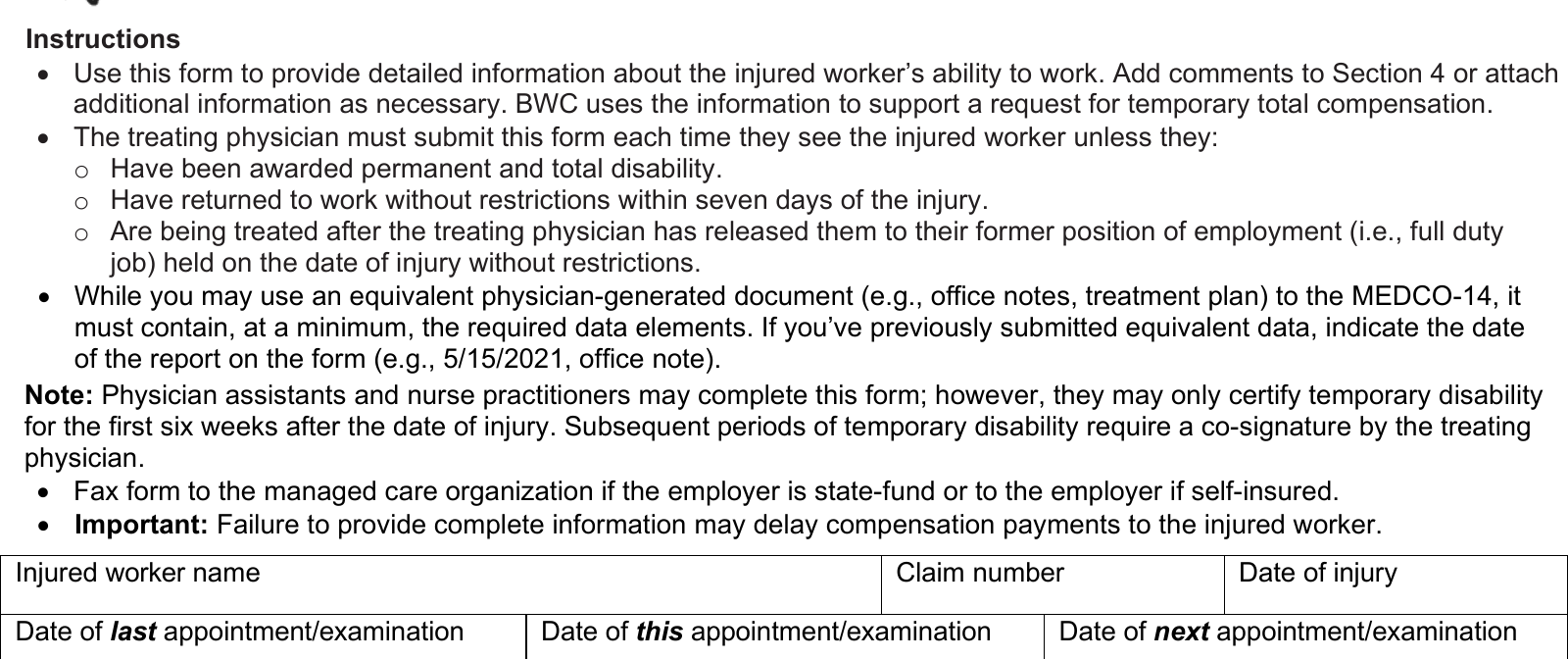
- Ohio wants one after every visit, with three exceptions.
- An office note can stand in if it has the required pieces.
- Fax it to the MCO, or to the employer if self-insured.
- A PA or nurse practitioner can sign alone for the first six weeks. After that a physician co-signs.
- In Section 4 you circle abilities. The right-hand column is for limits only.
- A yes to maximum medical improvement may end wage payments.
Before you start: a work report after every visit
The MEDCO-14 is how the treating physician in Ohio tells the workers’ compensation system what an injured worker can and cannot do at work. The form says plainly what it is for, that “BWC uses the information to support a request for temporary total compensation.” Temporary total compensation is the weekly payment that replaces part of your patient’s wages while the work injury keeps them off the job, so this report is the medical half of whether those payments keep coming. Your patient asks for the payments on a separate form of their own (the C-84), and the MEDCO-14 is what supports that request.
What sets this form apart from a one-time note is that Ohio wants a new one at every visit. As I read the Ohio rule, physicians treating injured workers complete, sign and submit it “upon every injured worker encounter”, with only three exceptions, which I list in the next section.
You do not have to use the form itself. The instructions on the blank say you may use an equivalent document you already write, such as an office note or a treatment plan, as long as it carries the required data elements, and the rule lists those elements. If you already sent that information in an earlier report, the form asks you to write the date and type of that report on it. What I would do is fill out the form anyway, because the boxes make it hard to leave out one of the required pieces, and attach the office note for the findings.
One more rule is worth knowing before the first one goes out. Ohio’s rule says that “Except to correct clerical errors, a previously submitted MEDCO-14 or equivalent cannot be altered” and sent again to support payment. If your opinion changes, I believe the right move is a new report dated for the new visit, not an edited copy of the old one.
The rule: Ohio Adm.Code 4123-6-20(B) and 4123-5-18(D); the instructions on Form MEDCO-14 (BWC-3914).
When it is due, and who gets it
- Every visit. The treating physician submits a MEDCO-14 each time they see the injured worker.
- Except when your patient has been awarded permanent total disability. No more MEDCO-14s are needed.
- Except when your patient went back to work without restrictions within seven days of the injury.
- Except after you have already released your patient to their old job without restrictions. Visits after that release do not need a new one.
- Where it goes. The form says to fax it to the managed care organization (MCO) if the employer is state-fund, or to the employer if the employer is self-insured.
I have not found an Ohio rule that sets a number of days for sending the MEDCO-14 after a visit, so I won’t give you one. There is a separate Ohio rule that a provider report a new injury within one business day of the first visit, to the MCO, to BWC through its website, or to the self-insuring employer. As I read it, that rule is about reporting the injury itself, not about this form, but I would send the first MEDCO-14 at the same time anyway. As I read Ohio’s rules, compensation is not approved unless a physician’s report supports it, so a late first report probably means a late first payment.
The form is also blunt about what happens when it is thin. It says “Failure to provide complete information may delay compensation payments to the injured worker.” Ohio’s rule puts the duty on your patient to make sure these reports reach the system, and says how often they are needed depends on the injury and the degree of disability. So when a MEDCO-14 is late or incomplete, it is usually your patient whose check is late.
I have not found a BWC source that says whether completing the MEDCO-14 is paid on its own, apart from the visit, so I won’t guess. If it matters to your office, I would ask the MCO.
The rule: Ohio Adm.Code 4123-6-20(B)(1), 4123-6-02.8 and 4123-5-18(C) and (D); the instructions on Form MEDCO-14.
Who fills it out, and who signs
The form is written for the treating physician, and Section 6 calls that signature mandatory. For Ohio’s workers’ compensation medical rules, “physician” is wider than MDs and DOs. As far as I can tell from the definition, it also covers podiatrists, chiropractors, psychologists and dentists licensed in Ohio, and a physician licensed under the equivalent law of another state counts too. BWC’s billing manual lists the same kinds of physicians as able to sign this form.
Physician assistants and nurse practitioners can complete it, with a time limit. The note on the form says they “may only certify temporary disability for the first six weeks after the date of injury”, and after that the treating physician has to co-sign. The rule behind that note is a little wider than the form. As I read it, a certified nurse practitioner, clinical nurse specialist or physician assistant who examined your patient can sign alone for no more than the first six weeks of disability. For later periods, a physician has to co-sign after reviewing the documentation of that examination. So if a PA in your office sees an injured worker in week eight, I would plan on the physician reading the note and co-signing the MEDCO-14 before it goes out.
How you sign matters too. BWC’s billing manual says an original or stamped signature is acceptable on medical evidence, and a scanned signature is acceptable, but “an electronic signature is not acceptable.” It also allows an authorized scribe or designee to sign the physician’s name and put their own initials next to it. If your office signs forms inside the electronic record, I would check with the MCO that the result counts before relying on it.
The rule: Ohio Adm.Code 4123-5-18(E) and 4123-6-01(P); BWC Provider Billing and Reimbursement Manual, Chapter 2, Part II.P; the note on Form MEDCO-14.
The top of page 1, and Section 1, the submission type
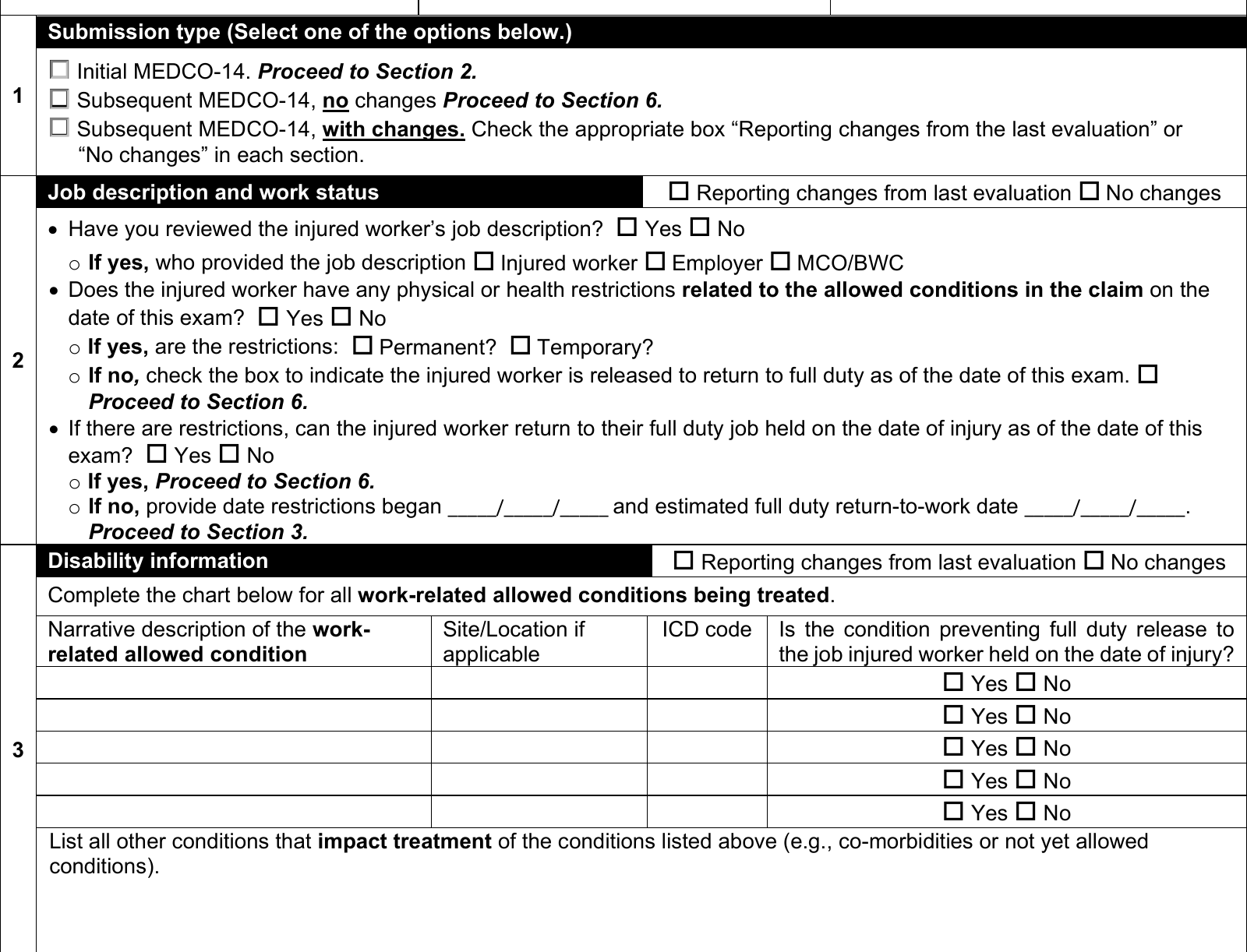
The top asks for your patient’s name, the claim number and the date of injury, then three dates, the last appointment or examination, this one, and the next one. Page 2 repeats the name, claim number and date of injury, so fill those in on both pages in case the pages get separated.
Section 1 is a fork, and it decides how much of the rest you fill in. Check one of three.
- Initial MEDCO-14. Your first report for this patient. Go on to Section 2 and complete everything.
- Subsequent MEDCO-14, no changes. Nothing has changed since your last report. The form sends you straight to Section 6 to sign.
- Subsequent MEDCO-14, with changes. Something has changed. Then each of Sections 2 to 5 has two boxes in its heading, “Reporting changes from last evaluation” and “No changes”, and you check one in every section.
The no-changes shortcut is handy, but I would only use it when it is really true. If your patient’s lifting limit went from 10 pounds to 20, that is a change, and the report that supports their payments should say so.
Section 2, job description and work status
This section is a short decision path, and the answers decide where you go next.
First, have you reviewed your patient’s job description, and if so, who gave it to you, your patient, the employer, or the MCO or BWC. You can answer no, but I think a work-ability opinion is more useful when it is measured against the actual job, so if you have not seen a description, it may be worth asking the employer or the MCO for one.
Next, does your patient have any physical or health restrictions related to the allowed conditions in the claim on the date of this exam. If no, check the box that releases your patient to full duty as of today and go to Section 6. If yes, say whether the restrictions are permanent or temporary.
Last, with those restrictions, can your patient go back to the full-duty job they held on the date of injury, as of today. If yes, go to Section 6. If no, write the date the restrictions began and your estimated date for a return to full duty, then go on to Section 3. Ohio’s rule lists an estimated or actual return-to-work date and the date temporary total disability began among the required pieces, and as far as I can tell these two lines are where the form collects them, so I would not leave either blank. An honest estimate is better than an empty line, and you can change it on the next report.
Section 3, disability information
The table has room for five conditions. For each one you write a narrative description, the site or location if it applies, the ICD code, and whether that condition is preventing a full-duty release to the job your patient held on the date of injury.
The word that matters here is “allowed”. The form asks only about the work-related allowed conditions being treated, meaning the conditions the claim has recognized. Ohio’s rule asks for the ICD codes recognized in the claim, including a primary code, with a narrative naming the condition and the part of the body. If your diagnosis is not one the claim has allowed yet, it does not belong in the main table. If you are not sure which conditions are allowed, I would ask the MCO or the employer rather than guess.
Under the table is a box for other conditions that affect treatment of the allowed ones, and the form gives two kinds as examples, co-morbidities and conditions not yet allowed. Diabetes slowing the healing of a hand wound would go here, and so would a second diagnosis you suspect is work related but that the claim has not recognized.
The rule: Ohio Adm.Code 4123-6-20(B)(2)(c).
Section 4, abilities, findings and recovery
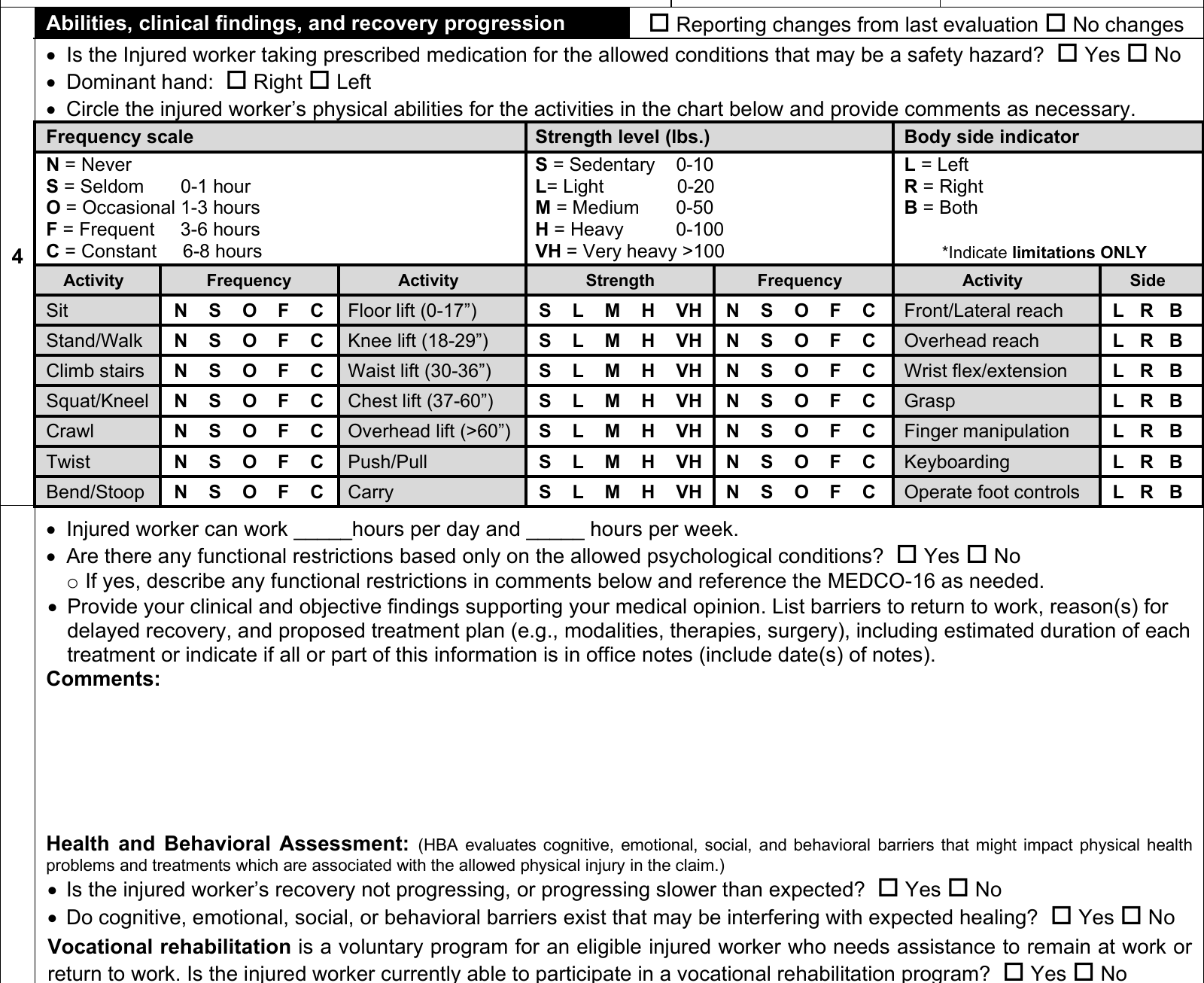
This is the section the employer will read to decide what work they can offer, so it is probably where the detail pays off most.
It opens with two quick questions, whether your patient takes prescribed medication for the allowed conditions that may be a safety hazard, and which hand is dominant. Then comes the chart, and you circle your patient’s abilities rather than writing them in.
- The left column is for postures like sitting, standing and walking, climbing stairs, squatting, crawling, twisting and bending, each with a frequency.
- The middle column is for lifting from the floor, knee, waist, chest and overhead, plus push or pull and carry. For each you circle a strength level and a frequency.
- The right column is for reaching, wrist movement, grasp, finger work, keyboarding and foot controls, with a side, left, right or both. Above that column the form says to indicate limitations only, so I would leave a row alone if that activity is not limited.
The scales are printed above the chart. Frequency runs from never through seldom (0 to 1 hour), occasional (1 to 3 hours), frequent (3 to 6 hours) and constant (6 to 8 hours), which I read as hours in a working day. Strength runs from sedentary (0 to 10 pounds) through light (0 to 20), medium (0 to 50), heavy (0 to 100) and very heavy (over 100). So for a worker with a left shoulder strain, circling L and O on the waist lift row says up to 20 pounds from waist height for 1 to 3 hours a day, and circling L on the overhead reach row flags the left arm. That tells the employer what lighter work could look like far better than writing light duty on its own would.
Below the chart, write how many hours a day and a week your patient can work, and answer whether any functional restrictions come only from allowed psychological conditions. If they do, describe them in the comments, and the form points you to the MEDCO-16 as needed.
Then comes the comments box, and this is where the medical reasoning goes. The form asks for your clinical and objective findings, the barriers to returning to work, the reasons for any delayed recovery, and the treatment plan with the expected length of each treatment. You can instead say that some or all of this is in your office notes and give the dates of those notes. Ohio’s rule on medical proof says objective symptoms are the signs found on examining the patient, as distinguished from what the patient reports, and it weighs whether a reason for the opinion is stated. So a strength grade, a range of motion in degrees or an imaging result supports the restrictions in a way that a note of pain with lifting, on its own, may not.
The section ends with three yes or no questions. Two are a health and behavioral assessment, whether recovery is not progressing or is slower than expected, and whether cognitive, emotional, social or behavioral barriers may be interfering with healing. The third asks whether your patient can take part in vocational rehabilitation, which the form describes as a voluntary program to help an eligible worker stay at work or get back to it.
The rule: Ohio Adm.Code 4123-6-20(B)(2) and 4123-5-18(B).
Section 5, maximum medical improvement
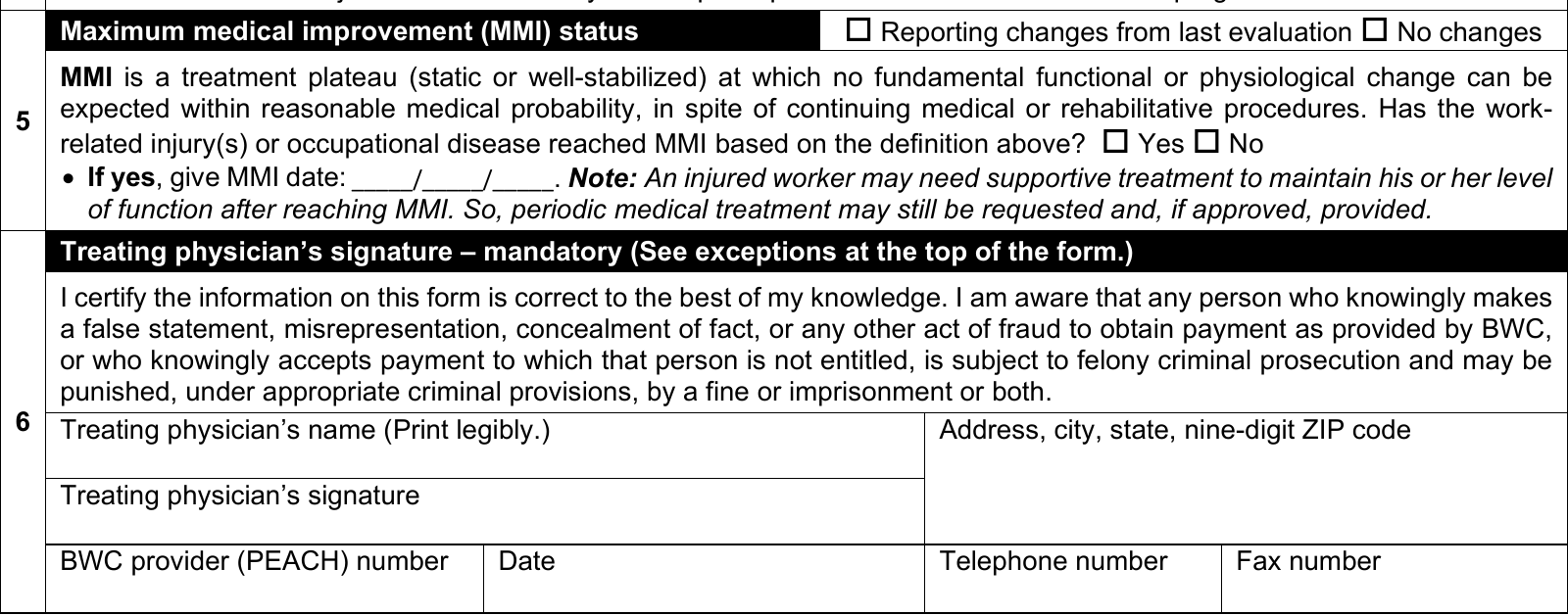
The form prints its own definition. Maximum medical improvement is “a treatment plateau (static or well-stabilized)” at which no fundamental change in function can be expected within reasonable medical probability, even with more treatment. You answer yes or no, and if yes, give the date.
This answer carries weight. As I read section 4123.56 of the Ohio Revised Code, temporary total compensation is not paid for the period after the employee has reached maximum medical improvement. So a yes here may end your patient’s wage payments, and it is worth being sure, and saying in the comments what it is based on.
The form adds a reassurance that I would pass on to your patient. Reaching maximum medical improvement does not mean all care stops, because periodic supportive treatment may still be requested and, if approved, provided.
The rule: section 4123.56(A), Ohio Revised Code; Form MEDCO-14, Section 5.
Section 6, the treating physician’s signature
Every path through the form ends here. By signing, you certify the information is correct to the best of your knowledge, next to a printed warning that knowingly making a false statement to obtain payment from BWC is a felony. Print your name legibly, give your address with the nine-digit ZIP code, sign, and fill in your BWC provider (PEACH) number, the date, and your telephone and fax numbers. The fax number is worth getting right, because it is how the MCO or employer will reach you with questions.
The boxes Ohio says must be filled in
I have not seen an Ohio source that lists why a MEDCO-14 is not accepted or which boxes are most often left blank, so I won’t guess. What Ohio’s rule does say is what every report of work ability must contain at a minimum, and those are the parts I would look at twice before signing.
- The date of the report, and the date of the last examination (the dates at the top).
- The ICD codes recognized in the claim for every condition and body part being treated, with a primary code and a narrative (Section 3).
- The date temporary total disability began, and an estimated or actual return-to-work date (Section 2).
- Your patient’s current physical capabilities (the Section 4 chart and hours).
- Any reasons recovery has been delayed, and the objective and clinical findings behind your opinion (the Section 4 comments).
- Whether vocational rehabilitation is needed (the last question in Section 4).
The rule: Ohio Adm.Code 4123-6-20(B)(2).
Questions the office asks
What is the MEDCO-14 form?
The MEDCO-14 is how the treating physician in Ohio tells the workers’ compensation system what an injured worker can and cannot do at work. BWC uses it to support your patient’s request for temporary total compensation, the weekly payment that replaces part of their wages while they are off.
How often do I have to fill out a MEDCO-14?
At every visit, unless your patient has been awarded permanent total disability, went back to work without restrictions within seven days of the injury, or you have already released them to their old job without restrictions. You may use an equivalent office note instead, as long as it carries the required information.
Can a nurse practitioner or PA sign the MEDCO-14?
Yes, for the first six weeks. The form counts them from the date of injury, and the rule from the start of disability, so I would count from the earlier date to be safe. After that, a physician has to co-sign. I believe a clinical nurse specialist is covered the same way, because the rule names one.
Where do I send the MEDCO-14?
The form says to fax it to the managed care organization if the employer is state-fund, or to the employer if the employer is self-insured.
PatientPapers makes completing the Ohio MEDCO-14 faster and easier
I created PatientPapers to make this paperwork faster and easier, because as a physician I know how much of it lands on us. It is my own product, built through the same company as this site, so weigh this accordingly. It keeps your name, license number and specialty on file, walks you through the MEDCO-14 section by section, and fills in Ohio’s own form for you to review and sign. The pricing and the full description are on the PatientPapers site.
Open PatientPapers