Ohio handicap placard form, and the prescription the BMV 4826 asks you for
A woman on home oxygen for COPD hands the front desk an Ohio BMV 4826 her son printed out. It has boxes for her name, her address and the placard type, and nowhere at all for a doctor to sign. In capitals on page 1 it says a prescription from her health care provider must be submitted with it. That prescription is the part that falls to you.
- Form
- BMV 4826, Application for Removable Windshield Placards
- Issued by
- Ohio Bureau of Motor Vehicles (BMV), Ohio Department of Public Safety
- Blank form
- BMV 4826 PDF on ohio.gov
- Revision
- 3/26
- Rule
- Ohio Revised Code 4503.44; Ohio Administrative Code 4501:1-7-02
- Temporary
- six months or less
- Filed with
- a deputy registrar agency or the BMV by mail, by your patient
Key points
- The BMV 4826 has no section for you. Your part is a prescription.
- It needs the patient’s name, the word placard, your signature and date, and an end date.
- The end date you write decides the placard type and when it expires.
- The walking test is 200 feet without stopping to rest.
- Physicians, PAs, APRNs, chiropractors and optometrists may sign.
- License plates use a different form, the BMV 4834, with its own signature line.
Before you start: in Ohio your part is a prescription
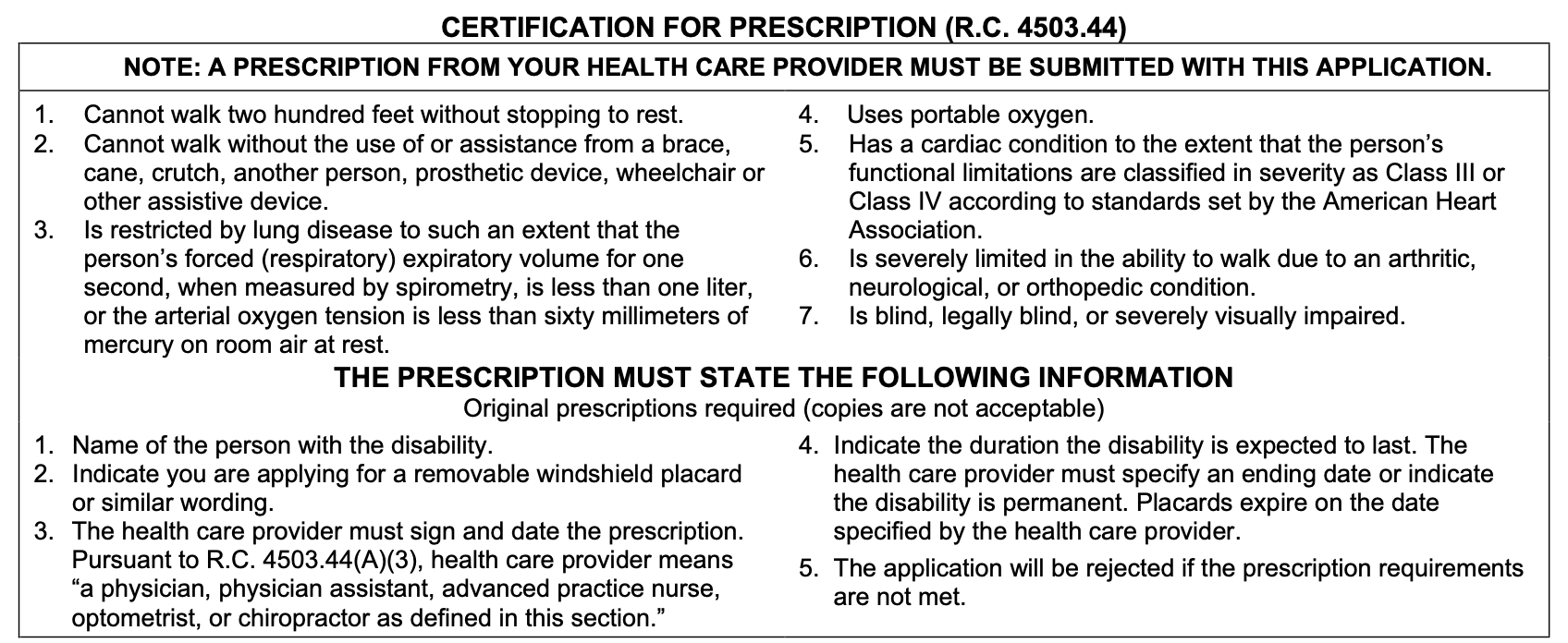
Most states put a box for the clinician somewhere on the placard application. Ohio does not. The BMV 4826 is your patient’s form from top to bottom, and the Bureau of Motor Vehicles (BMV) wants a separate piece of paper from you to travel with it. The form calls that paper a prescription. It gives no template for it, and what matters is what it says, which page 2 of the form spells out.
So when someone hands you the BMV 4826 and asks you to fill it out, there is nothing on it for you to fill out. What I would do is hand the form back to the patient for their own part and write the prescription at the same visit, since the two go to the BMV together.
My understanding is that the prescription is not a formality. The statute says the placard is issued on a prescription “based upon a determination that the person meets at least one of the criteria” it lists, and the date you write on it becomes the placard’s expiry date.
The rule: Ohio Revised Code 4503.44(C)(1) and (C)(2); Ohio Administrative Code 4501:1-7-02(B); Form BMV 4826, pages 1 and 2.
Who may write it
Ohio’s word is health care provider, and the statute gives a closed list of five. A physician (an MD or a DO), a physician assistant, an advanced practice registered nurse, an optometrist or a chiropractor. The nurse category is wider than nurse practitioners. It covers clinical nurse specialists, nurse anesthetists and nurse-midwives too, as long as they hold a certificate of authority from the Ohio Board of Nursing.
There is one limit on that list. An optometrist may only make the determination for the seventh criterion, blindness or severe visual impairment, and not for any of the walking criteria.
My understanding is that each of the five is defined by an Ohio license, the physician by a license under the chapter of the Revised Code that the State Medical Board of Ohio administers, and so on down the list. I did not find any route in the statute for a clinician licensed only in a neighboring state, the way Texas and New Jersey allow. If you practice across a state line and hold only an Indiana or a Pennsylvania license, I would not assume Ohio will take your prescription. The list also does not name podiatrists or physical therapists.
The rule: Ohio Revised Code 4503.44(A)(3) to (A)(8).
What you are certifying, in Ohio’s own words
The statute’s phrase is a “person with a disability that limits or impairs the ability to walk”, and it means someone who, as determined by a health care provider, meets any one of seven criteria. The BMV 4826 prints them on page 2, numbered 1 to 7, in these words.
- Cannot walk two hundred feet without stopping to rest.
- Cannot walk without the use of or assistance from a brace, cane, crutch, another person, prosthetic device, wheelchair or other assistive device.
- Is restricted by lung disease to such an extent that the person’s forced (respiratory) expiratory volume for one second, when measured by spirometry, is less than one liter, or the arterial oxygen tension is less than sixty millimeters of mercury on room air at rest.
- Uses portable oxygen.
- Has a cardiac condition to the extent that the person’s functional limitations are classified in severity as Class III or Class IV according to standards set by the American Heart Association.
- Is severely limited in the ability to walk due to an arthritic, neurological, or orthopedic condition.
- Is blind, legally blind, or severely visually impaired.
The walking test is the first one, 200 feet without stopping to rest. Two hundred feet is roughly the walk from the far side of a supermarket lot to the door, so a patient who has to stop on the way in from the car probably meets it.
Three of the seven need no judgment call. A spirometry or blood gas number settles the third, portable oxygen in use settles the fourth, and a documented Class III or IV settles the fifth. The sixth and the first rest on what you see and what your patient tells you, and the seventh is the only one that is not about walking at all.
The form does not tell you to name the criterion on the prescription, but the statute says the prescription rests on a determination that one of them is met. What I would do is name it, by number and in a few words, something like “meets criterion 4, uses portable oxygen”. It costs one line, and it is the line I would want to be able to point to later.
The rule: Ohio Revised Code 4503.44(A)(1) and (C)(2); Form BMV 4826, page 2.
What the prescription has to say
Page 2 lists what the prescription must state, under a line that says “Original prescriptions required (copies are not acceptable)”. Taking the items in the form’s order, this is what I would put on it.
The patient’s name. Item 1 asks for the name of the person with the disability. I would spell it exactly as your patient wrote it on page 1 of the BMV 4826, since the two are matched up at the counter.
That it is for a placard. Item 2 asks you to indicate the prescription is for a removable windshield placard “or similar wording”. A plain sentence does it, such as “I am prescribing a removable windshield placard for this patient”. Ohio’s own term is removable windshield placard, so I would use it.
Your signature and the date. Item 3 says the health care provider must sign and date the prescription. The form does not ask for your license number. I would add it under your name anyway, with your credential, because it is the quickest way for anyone reading the paper to see that you are on the statute’s list.
How long the disability will last. Item 4 asks for the expected duration, and the form is specific that you either give an ending date or say the disability is permanent. A phrase like “long term” or “indefinite” is neither, and I would not use one. The next section is about choosing the date.
Item 5 is the warning that the application will be rejected if these requirements are not met. With the criterion line I suggested above, that is the whole prescription, and it fits on a prescription blank. The word original matters too, so your patient should leave with the signed paper itself rather than a fax or a scan.
The rule: Ohio Revised Code 4503.44(C)(2); Form BMV 4826, page 2, the Certification for Prescription box.
The end date you write picks the placard
Ohio has three placards, and you do not choose between them directly. The date on your prescription does. My understanding is that the statute sorts them this way. If you expect the disability to last six consecutive months or less, your patient applies for a temporary placard. If you write that it is permanent, a permanent placard. Anything else, an end date more than six months out, is a standard placard, which the form describes as over six months and up to ten years.
The date also becomes the expiry. The form says “Placards expire on the date specified by the health care provider”, and the statute says a standard or temporary placard expires on that date or ten years after it was issued, whichever is earlier. A permanent placard has no expiry at all. One more line from the statute is easy to miss, “In no case shall a removable windshield placard be valid for a period of less than sixty days.” So for a patient I expect to need it for a month after surgery, I would still expect a placard that runs at least sixty days.
The standard placard renews with another prescription. My understanding is that the BMV sends your patient a renewal notice at least thirty days before the date you wrote, and if no new prescription reaches the BMV by then, the placard lapses. A permanent placard never comes back to you in that way, which is why I would write permanent only for something I do not expect to improve. If I could not say whether a condition would get better, I would give a date a year or two out and see my patient again before it arrives.
The front desk may also be asked for a replacement or a second placard. The form says a new prescription is not required for either, that both expire on the same date as the first placard, and that there is a limit of two placards per person.
The rule: Ohio Revised Code 4503.44(C)(2), (C)(3), (C)(6), (C)(7) and (C)(9); Form BMV 4826, pages 1 and 2.
Your signature, and the penalty on page 2
Ohio prints the clinician’s penalty on the patient’s own form, under Fines and Penalties on page 2. It says no health care provider shall furnish a prescription to enable a person to get a placard or plates if they do not meet the criteria, nor a prescription “misrepresenting the expected length of disability”, and that these are first-degree misdemeanors punishable by up to six months in jail, a fine of up to $1,000, or both, along with sanctions by the licensing board.
My understanding is that the physician’s version of this, section 4731.481 of the Revised Code, applies to a prescription written knowing the person does not qualify, and to an end date knowingly misstated to let a person keep a placard longer than a similar practitioner would estimate. I read the second part as the reason not to round the end date up as a courtesy. The date should be your honest estimate, the same one a colleague would give.
If you have not seen your patient for a while, or the condition may have changed, what I would do is see them before writing it rather than work from an old note.
The rule: Ohio Revised Code 4731.481 and 4731.99(F); Form BMV 4826, page 2, Fines and Penalties.
License plates are a different form, the BMV 4834
If your patient wants accessible license plates rather than, or as well as, a placard, the prescription does not carry over. Plates take a form of their own, the BMV 4834, Health Care Provider Certification of Eligibility for Accessible License Plates, and on this one there is a part for you to sign.
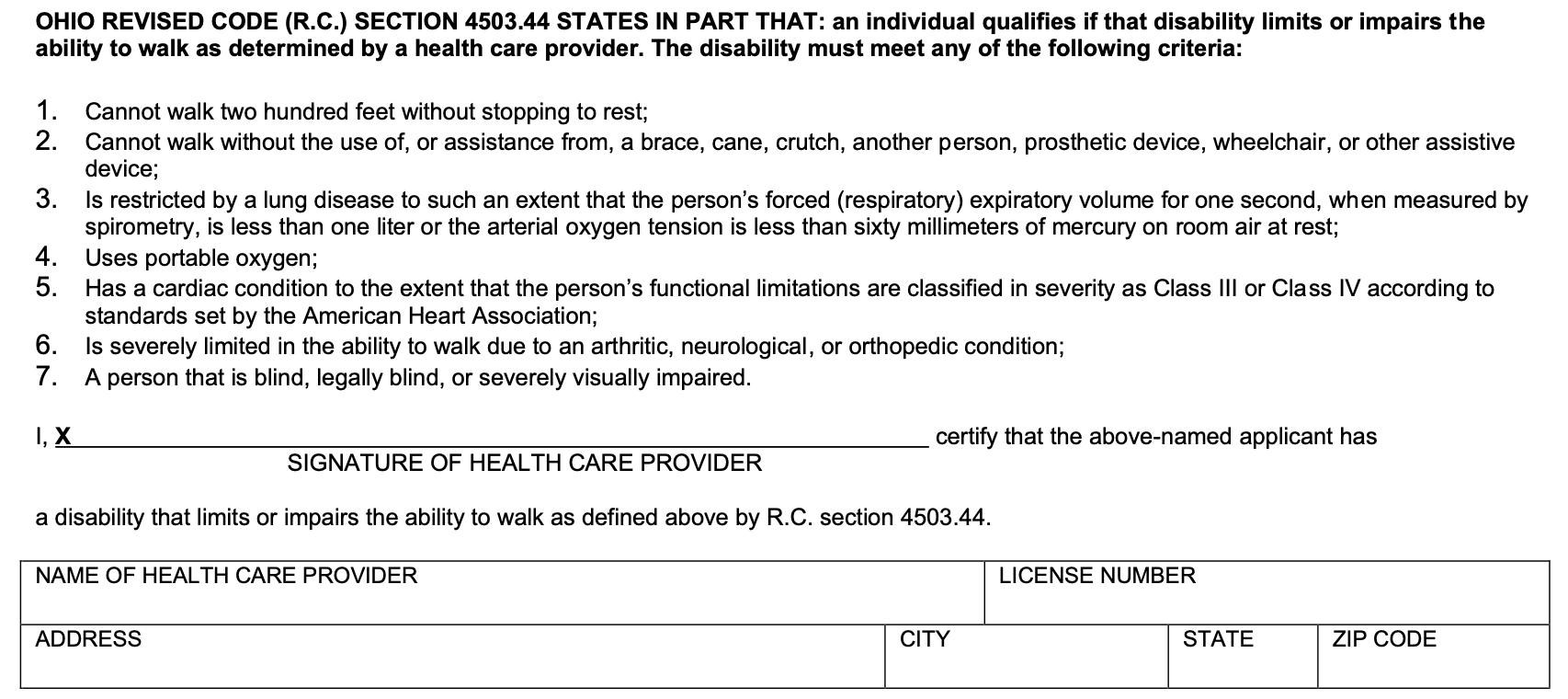
Your part is the sentence that begins “I,” with your signature on the line inside it, and the boxes underneath for your name, license number and address. The applicant’s name, date of birth and address at the top are your patient’s to fill in, and the sentence you sign certifies about “the above-named applicant”, so I would check that the top is filled in before signing. The same seven criteria are printed above your signature, with no box beside each, so the form does not ask you which one applies.
The plate certification differs from the placard prescription in two ways I would keep in mind. My understanding is that the statute asks the plate statement to certify that the disability “is expected to continue for more than six consecutive months”, though the sentence printed on the BMV 4834 does not say so, which means plates are not for a short-term problem and I would only sign one for a patient I expect to stay disabled past six months. And my understanding is that the statute asks for a new signed statement every fifth year, so plates come back to you on a five-year cycle whatever the condition.
Page 2 of the BMV 4834 is an affidavit for an altered or adaptive vehicle, signed by the vehicle’s owner in front of a notary. It is not yours. The BMV says there is no additional fee for accessible plates beyond the normal registration.
The rule: Ohio Revised Code 4503.44(B)(1) and (B)(2); Ohio Administrative Code 4501:1-7-02(B); Form BMV 4834, pages 1 and 2; the BMV’s special plates page.
Where it goes, and what your patient pays
Your patient files it, not your office. The form tells them to take the completed BMV 4826, the original prescription and the fee to any deputy registrar agency, or to mail them to the BMV in Columbus at the address printed on page 2, and to allow 10 to 15 business days by mail. Checks are made out to the Ohio Treasurer of State.
The fees printed on the form are $8 for a temporary or a standard placard, $8 to renew a standard placard, and $15 for a permanent one. The form adds that a standard placard should not be renewed more than 90 days before it expires.
Two other routes are worth knowing about at the front desk. A veteran whose qualifying disability is service-connected applies on a different form, the BMV 4531, and my understanding is that the placard is then issued without a fee, still with a signed statement from the veteran’s health care provider. And my understanding is that an active-duty service member with an illness or injury that limits walking can get a temporary placard without a fee, with a prescription from any health care provider as one of the kinds of evidence the statute accepts. The BMV’s special plates and placards page lists the current forms for both.
The rule: Ohio Revised Code 4503.44(C)(5), (D) and (E); Ohio Administrative Code 4501:1-7-02(B) and (E); Form BMV 4826, pages 1 and 2.
What the form says must be there
Ohio is unusually direct about this. Page 2 of the BMV 4826 says “The application will be rejected if the prescription requirements are not met”, and the requirements are short. I have not seen a BMV source that lists which ones are missed most often, so I won’t guess. These are the things I would look at before your patient leaves with it.
- The original prescription, signed by you, not a copy.
- A date beside your signature.
- Your patient’s name, matching page 1 of the application.
- A sentence saying the prescription is for a removable windshield placard.
- An ending date or the word permanent, never an open phrase.
- A signer who is one of the five on the statute’s list, and for an optometrist, only the vision criterion.
PatientPapers makes writing the Ohio placard prescription faster and easier
I created PatientPapers to make this paperwork faster and easier, because as a physician I know how much of it lands on us. It is my own product, built through the same company as this site, so weigh this accordingly. For an Ohio placard it writes the prescription on your letterhead, with your credential, the date, your patient’s name, the criteria you choose in the statute’s words, and the end date or the word permanent, and it names the application it goes with, the BMV 4826 or the BMV 4531 for a veteran. For plates it fills your patient’s name and your name, license number and address into the BMV 4834 and leaves the rest of the form for your patient. The pricing and the full description are on the PatientPapers site.
Open PatientPapers