FMLA paperwork for doctors, form by form
Three sets of FMLA paperwork are waiting at the front desk, and they are not the same form. One is for a patient’s own back surgery, one is from a son who needs time off to care for his father after a stroke, and one is a form from an insurance company you have never heard of. Before you can fill any of them out correctly, you need to know which one you are holding.
Key points
- The form number is in the footer of every page.
- Employers and insurers may send their own version. The questions are the same.
- Fill in only your part, even when the other parts are blank.
- The diagnosis is optional. Genetic information never goes on the form.
- The 15 days start when HR asks, not when the form reaches you.
- For time off that comes and goes, give how often and how long.
Which form are you holding?
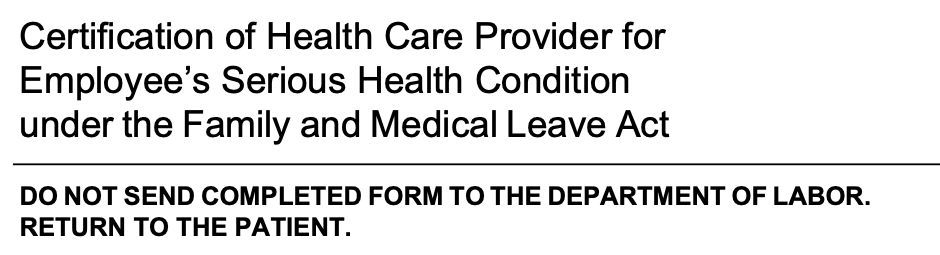
The Department of Labor publishes four FMLA certification forms that come to a clinician. The title at the top of page 1 tells you whose condition the form is about, and the form number is printed in small type at the bottom of every page. All four are the June 2020 revision, and all four say near the top to return the completed form to the patient, not to the Department of Labor.

| Form | Who the leave is for, and who your patient is |
|---|---|
| WH-380-E | The employee’s own serious health condition. Your patient is the employee. |
| WH-380-F | An employee caring for a spouse, parent or child with a serious health condition. Your patient is the family member who is ill, not the employee. |
| WH-385 | An employee caring for a current servicemember with a serious injury or illness. Your patient is the servicemember. |
| WH-385-V | An employee caring for a veteran, discharged within the last five years, with a serious injury or illness. Your patient is the veteran. |
Quite often the form is not the Department of Labor’s at all. Many employers, and the insurance companies and leave administrators that run leave for them, send their own form instead. That is allowed, because the Department of Labor’s forms are optional, but the employer cannot require more information than the regulations allow. In my experience it is the same questions in a different order, so everything on this page still applies.
The two military forms also ask things only military records can answer, such as whether the injury happened in the line of duty. If you cannot answer those, you do not have to guess. The regulation lets you rely on what an authorized government representative has already determined.
The rule: 29 C.F.R. §§ 825.127, 825.306(b), 825.310(b).
Who can fill it out?
The clinician who treats the patient. For the WH-380-F that is the family member’s clinician, so you may never meet the employee who is asking for the leave. Besides physicians, the regulations count nurse practitioners, physician assistants, nurse-midwives, clinical social workers, clinical psychologists, podiatrists, dentists and optometrists, as long as they are working within their scope of practice under state law. Chiropractors count only for one narrow kind of spinal treatment. So a nurse practitioner or physician assistant does not have to send the form on to a physician to sign.
For the two military forms, military and TRICARE providers can complete it too, as well as any of the clinicians above.
The rule: 29 C.F.R. §§ 825.125, 825.310(a).
What do you have to answer, and what can you leave off?
Basically, the regulations allow the form to ask you three things. Who you are, meaning your name, contact details and type of practice. The condition, meaning when it started, how long it will probably last, and enough medical facts to support the leave. And the time off. For the employee’s own condition that means they cannot do at least one core part of their job, and for how long. For a family member it means the family member needs care, and how much time that care takes.
There are also things you do not have to give, and some you should not.
- The diagnosis is optional. The WH-380-E and WH-380-F say you may include it but do not have to, and some state laws may not allow it. I usually describe the symptoms and the time off instead.
- Genetic information, including family history, stays off. This one is not optional, because of the Genetic Information Nondiscrimination Act (GINA).
- Nothing beyond the form. Afterwards the employer may contact you only to confirm you completed it or to ask what an answer means, and never by way of the patient’s direct supervisor.
- No certification to bond with a healthy baby. The WH-380-E and WH-380-F say employers may not ask for one. If you are handed one, I would let your patient know.
The rule: 29 C.F.R. §§ 825.306(a), 825.307(a); 29 C.F.R. § 1635.3 for the genetic information.
How long does the patient have?
The employee usually has 15 calendar days from the day the employer asked, unless that is not practicable despite their diligent, good faith efforts. If Human Resources (HR) finds an answer missing or too vague to use, they have to say in writing what is wrong and allow seven more days to fix it. If the corrected form still falls short, the leave can be denied.
The part that matters for your office is that the 15 days start when HR asks, not when the form reaches you. A form that sits in a tray for a week has used up half the time. That is why I would rather the front desk book a short visit within a couple of days than hold the form for the next routine appointment.
Expect the form to come back again, too. For a long-term condition HR can generally ask for a new one every 30 days in connection with an absence, with some exceptions, and every six months in all cases, as well as once each leave year. Recertification is not allowed for the two military forms.
The rule: 29 C.F.R. §§ 825.305(b), (c) and (e), 825.308, 825.310, 825.313.
Intermittent leave: how often, and how long each time
Intermittent leave is time off in separate blocks for the same reason, rather than one continuous stretch. A migraine that keeps your patient home a day or two at a time is intermittent leave, and so is a weekly infusion, or a son who has to leave work whenever his father falls. The regulations require that taking the leave this way is medically necessary.
This is where most forms run into trouble. The forms ask about planned treatment and unpredictable episodes in separate items. For planned treatment, give the dates or the schedule. For episodes such as flare-ups, the form asks for two estimates over the next six months, how often they are likely to happen and how long each one is likely to last. It needs both numbers. “About twice a month, one to two days each” is a complete answer. “As needed” is not, and in my experience a form with only one of the two numbers is often not accepted.
It is an educated estimate, and nobody expects it to be exact. I settle the numbers with my patient in the room, because an estimate made from the chart alone tends to be lower than what actually happens, and then the form comes back to be changed. On the WH-380-F the numbers describe how often the employee has to be away to give care, which is not always the same as how often your patient is unwell. If your patient needs help every day but a sister shares the care, the employee may only need some of those days.
The rule: 29 C.F.R. §§ 825.124(c), 825.202, 825.306(a)(6) to (8).
The walkthroughs for each form
This page is the overview. The details are on the walkthroughs, which go through every box in the order the form asks it.
- WH-380-E, field by field, for the employee’s own condition.
- WH-380-F, certifying for a family member, including the employee’s section you leave alone.
- Can you charge for FMLA paperwork? Who pays for the certification, and how to set a fee.
PatientPapers makes completing FMLA paperwork faster and easier
I created PatientPapers to make this paperwork faster and easier, because as a physician I know how much of it lands on us. It is my own product, built through the same company as this site, so weigh this accordingly. It fills in the Department of Labor’s WH-380-E, WH-380-F, WH-385 and WH-385-V, asks the questions in plain English, and flags answers that could keep a form from being accepted, such as a leave length written as “unknown”. You review it before you sign. The pricing and the full description are on the PatientPapers site.
Open PatientPapers