North Carolina handicap placard form, the medical provider’s section of the MVR-37A
A patient on portable oxygen hands the front desk an MVR-37A with the applicant section already filled in. The rest of page 1 is yours. There is no notary and no condition to check, just one of three placards and your details, so it takes a couple of minutes. The one thing worth slowing down for is which placard you pick, because it decides whether this form comes back to you in five years.
- Form
- MVR-37A, Medical Certification for Application & Renewal of Disability Parking Placard
- Issued by
- North Carolina Division of Motor Vehicles (NCDMV)
- Blank form
- MVR-37A PDF on ncdot.gov
- Revision
- Rev. 7/26
- Rule
- North Carolina General Statutes §§ 20-37.5 and 20-37.6
- Temporary
- 1 to 6 months, the number you check
- Filed with
- a license plate agency or the NCDMV by mail, by your patient
Key points
- Your part is the Medical Provider’s Section, on page 1.
- You check one of three placards, never a condition.
- The walking test is 200 feet without stopping to rest.
- For a temporary placard, you also check 1 to 6 months.
- No notary. Nurse practitioners and PAs may sign too.
- Only the five-year placard comes back to you at renewal.
Before you start: one page, one choice, no notary
The MVR-37A is a single sheet. Page 1 has the applicant section at the top, which belongs to your patient, and the Medical Provider’s Section below it, which belongs to you. Page 2 is all explanation, the list of who may certify, what each of the three placards means, and the rules for using one. The form’s own instruction to your patient is to “complete and sign only the applicant section,” and to have the medical provider complete and sign the rest.
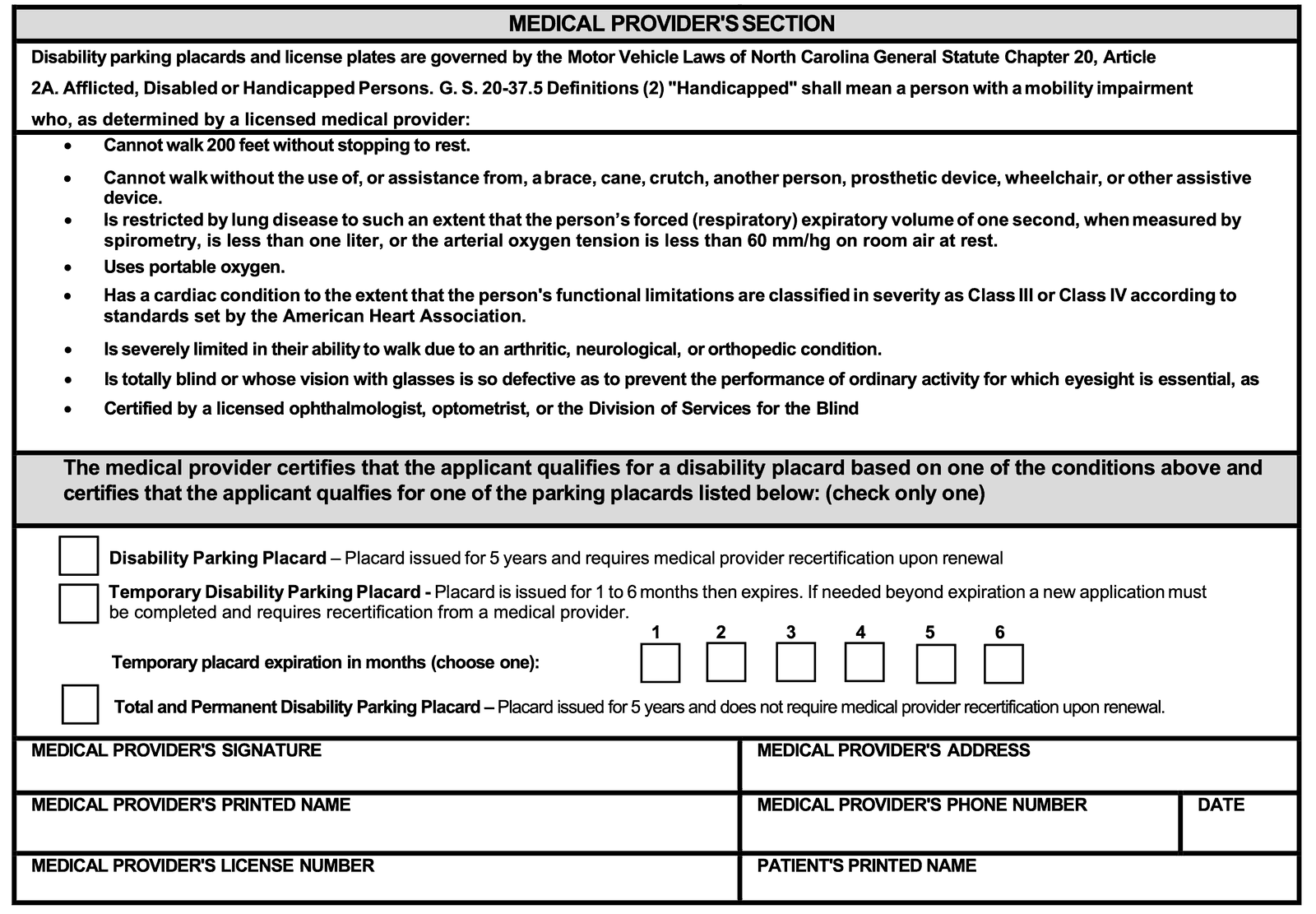
What makes North Carolina’s version quicker than most is that you do not pick a condition. The seven conditions are printed as plain bullets, and the sentence under them says you certify that your patient qualifies “based on one of the conditions above.” Then you check one placard, fill in six boxes about yourself and one with your patient’s name, and sign. Nothing on the form asks for a notary, a diagnosis or a prescription.
The rule: North Carolina General Statutes § 20-37.6(c1); the application instructions and the Medical Provider’s Section on page 1 of Form MVR-37A.
Who may sign
Page 2 of the form lists the authorized medical certifiers, and the list matches the statute. A licensed physician, physician assistant, nurse practitioner, ophthalmologist or optometrist may certify, and so may the Division of Services for the Blind. So if you are a nurse practitioner or a physician assistant, the form is yours to sign, with no supervising physician’s name anywhere on it.
There is one more signer with a narrow lane. My understanding is that a licensed certified nurse midwife may certify only a first application, and only for a temporary placard. That fits the obvious case, a pregnancy late enough that the walk from the far end of the lot is the problem, but a midwife cannot sign a five-year placard or a renewal.
The vision item has its own limit, written into the condition itself. My understanding is that the blindness condition is one that only a licensed ophthalmologist, a licensed optometrist or the Division of Services for the Blind may certify, so a primary care clinician would rely on one of the mobility conditions or leave the vision question to the eye doctor.
The rule: North Carolina General Statutes §§ 20-37.5(2)g and 20-37.6(c1); Authorized Medical Certifiers on page 2 of Form MVR-37A.
The seven conditions, in North Carolina’s own words
The form quotes the definition of “handicapped” from section 20-37.5 of the General Statutes, a person with a mobility impairment who, as determined by a licensed medical provider, meets one of these. They are reproduced here as the form prints them.
- Cannot walk 200 feet without stopping to rest.
- Cannot walk without the use of, or assistance from, a brace, cane, crutch, another person, prosthetic device, wheelchair, or other assistive device.
- Is restricted by lung disease to such an extent that the person’s forced (respiratory) expiratory volume of one second, when measured by spirometry, is less than one liter, or the arterial oxygen tension is less than 60 mm/hg on room air at rest.
- Uses portable oxygen.
- Has a cardiac condition to the extent that the person’s functional limitations are classified in severity as Class III or Class IV according to standards set by the American Heart Association.
- Is severely limited in their ability to walk due to an arthritic, neurological, or orthopedic condition.
- Is totally blind or whose vision with glasses is so defective as to prevent the performance of ordinary activity for which eyesight is essential, as certified by a licensed ophthalmologist, optometrist, or the Division of Services for the Blind.
On the printed form the last condition looks like two bullets, because the phrase starting “Certified by” drops onto a line of its own with a bullet in front of it. It is one condition, and the statute and the renewal form both print it as one.
The walking test is item (a), 200 feet without stopping to rest. That is about 60 meters, so a patient who stops to rest partway down a clinic corridor may well meet it. Items (c), (d) and (e) rest on a number, an oxygen tank or a class you can point to in the chart. Item (f) is the broad one and rests on your judgment of how severe the limit is.
Since the form never asks which condition applies, nothing on the paper records your reasoning. What I would do is write it in my own note, something like “meets (a), stopped twice between the waiting room and the scale.” Notice too that the statute itself says “as determined by a licensed physician” where the form says “licensed medical provider.” My understanding is that the wider list of signers in section 20-37.6 is what lets the other clinicians sign, and the form follows that list.
The rule: North Carolina General Statutes § 20-37.5(2); the Medical Provider’s Section on page 1 of Form MVR-37A.
Three placards: check only one
The shaded line under the conditions says you certify that your patient qualifies “for one of the parking placards listed below: (check only one).” This is the real decision on the form, and the three choices differ mostly in what happens later.
Disability Parking Placard. Issued for five years, and the form says it “requires medical provider recertification upon renewal.” Page 2 adds that your patient will be mailed a renewal application to be recertified by their medical provider, and can renew up to 90 days before the placard expires. This is the box for a condition that will last but might change, and it is the one that brings the form back to you.
Temporary Disability Parking Placard. Issued for one to six months, and then it simply expires. Below it is a row of six boxes, “Temporary placard expiration in months (choose one),” numbered 1 to 6. Check the temporary box and one month. My understanding is that the statute asks the temporary application to carry how long the certifying clinician expects the disability to last, and the months row is where that goes. A temporary placard cannot be renewed. If your patient still needs it when it runs out, the form says a new application must be completed, which means a new MVR-37A from you. A patient two weeks out from a hip replacement, with an expected six to twelve weeks on a walker, is the kind of case this is for. I would pick the month I actually expect rather than the full six, and see the patient again if recovery runs long.
Total and Permanent Disability Parking Placard. Also issued for five years, but it “does not require medical provider recertification upon renewal.” Page 2 says this one certifies that the disability “is of a total and permanent nature.” My understanding is that once a person has been certified as totally and permanently disabled, at the first application or at a renewal, the statute takes the medical recertification away for good.
So the choice between the first and the third is a choice about whether anyone looks again. For a patient with a below-knee amputation, or end-stage lung disease on oxygen, I would check total and permanent and spare everyone the five-year renewal. For a patient whose arthritis might improve after a joint replacement, or whose heart failure might move down a class with treatment, I would check the five-year placard, because a total and permanent placard renews without a clinician ever seeing the patient again.
The rule: North Carolina General Statutes § 20-37.6(c1); the Medical Provider’s Section on page 1, and Disability Parking Placards, Temporary Disability Parking Placards and Total and Permanent Disability Parking Placards on page 2, of Form MVR-37A.
Your details and your signature, box by box
The bottom of the section is a grid of seven boxes.
Medical provider’s signature. Sign it yourself. The form prints no penalty warning over your signature, and I won’t guess at what other law might apply to a false certification. What I would do is sign only when my note says which condition my patient meets.
Address and phone number. These are yours, the practice’s, not your patient’s. Your patient’s address goes in the applicant section above.
Printed name, license number and date. Your name as it appears on your license, the license number, and the date you sign. The form does not ask which state issued the license or what kind it is, so the number is the only identifier you give.
Patient’s printed name. The last box, at bottom right, is easy to miss because it sits in your grid rather than in the applicant section. Print your patient’s name there, spelled the same way as in the applicant section, since the two halves have to be read as one application.
Everything above the Medical Provider’s Section, including the choice of one or two placards, the driver license or ID number and the applicant’s signature, is for your patient. The form says a parent may sign for a minor, and a person signing under a power of attorney needs a certified copy with them.
The rule: the application instructions and the Medical Provider’s Section on page 1 of Form MVR-37A.
Renewal, and the MVR-37AA
When a five-year placard is coming up for renewal, your patient may bring you a different form, the MVR-37AA, Application for Renewal of Disability Parking Placard or Total and Permanent Disability Parking Placard. Its current revision is Rev. 04/26. It is worth knowing before you start, because it does not work the way the MVR-37A does.
At the top of its Medical Provider’s Section are two boxes side by side, “Medical provider’s recertification required” and “Medical provider’s recertification not required.” Recertification is not required in two cases. The form’s own instruction says it is “not required for persons 80 years of age or older at the time of renewal,” and the MVR-37A and the statute say a total and permanent placard is renewed without it. In either case there is nothing for you to sign, and the form can go back to your patient as it is. My understanding is that the statute words the age rule as a placard that expires after the person is 80, which comes to the same patients in practice.
When recertification is required, the conditions on the MVR-37AA are check boxes, with the instruction “(check all that apply).” So at renewal you do mark each condition your patient meets, the same seven conditions as above, and then complete the same grid of signature, address, printed name, phone, date, license number and your patient’s printed name. There is no placard choice on the renewal form.
The NCDMV’s placard page says that permanent placard holders, who need no recertification, can renew online. My understanding is that the statute requires the NCDMV to offer renewal both in person and online.
The rule: North Carolina General Statutes § 20-37.6(c1); the application instructions and Medical Provider’s Section of Form MVR-37AA (Rev. 04/26); page 2 of Form MVR-37A; the NCDMV Disability Placards and Plates page.
Where it goes, and what your patient pays
Your patient files it, not your office. The form says the application and fee can be taken to a local license plate agency for same-day service, or mailed to the NCDMV at the address printed at the top of the form, in which case your patient should allow three to four weeks for the placard to arrive.
The fee is $5.00 for each placard, with a limit of two, so the applicant section offers one placard for $5.00 or two for $10.00. The same $5.00 applies to a temporary placard. My understanding is that a second placard is only for someone who does not also have the disability license plate, which has its own application, the Application for Disability License Plate, linked from the same NCDMV page.
Two notes for the front desk, both from page 2 of the form. Replacing a lost or stolen placard costs $5.00, replacing a lost placard registration card costs $25.50, and a damaged placard is replaced at no fee. The form does not mention a new certification for any of them. The NCDMV’s disability placards and plates page links the current blanks.
The rule: North Carolina General Statutes § 20-37.6(c); the application instructions on page 1 and the placard rules on page 2 of Form MVR-37A; the NCDMV Disability Placards and Plates page.
What the form says must be there
I have not found anything from the NCDMV that lists why an MVR-37A is not accepted, so this is not a list of known rejections. It is what the form itself asks for, and what I would look over before your patient leaves with it.
- Exactly one of the three placard boxes checked.
- For a temporary placard, exactly one month checked, from 1 to 6.
- Your signature, printed name, license number, address, phone number and the date.
- Your patient’s printed name in the last box of your section, spelled as in the applicant section.
- A signer on the form’s list of authorized certifiers, and a nurse midwife only for a first temporary placard.
- The applicant section completed and signed by your patient, with $5.00 for each placard.
PatientPapers makes completing the North Carolina MVR-37A faster and easier
I created PatientPapers to make this paperwork faster and easier, because as a physician I know how much of it lands on us. It is my own product, built through the same company as this site, so weigh this accordingly. It keeps your name, license number, phone number and address on file, asks you to confirm that your patient meets at least one of the printed conditions, asks which of the three placards and, for a temporary one, how many months, and fills in the Medical Provider’s Section on North Carolina’s own MVR-37A, with your patient’s name in the last box and in the applicant’s printed name. It leaves the rest of the applicant section, and the applicant’s signature, for your patient. For a renewal on the MVR-37AA, it first asks whether your patient will be 80 or older or is renewing a total and permanent placard, and only when neither is true does it ask which conditions apply and fill in your section. You review it before you sign. The pricing and the full description are on the PatientPapers site.
Open PatientPapers