California handicap placard application, the doctor’s part of the REG 195
A woman with macular degeneration, who gave up driving last year and now rides with her son, puts the REG 195 on the desk at her annual visit and points to item 1. Her chart shows 20/400 in the better eye, which meets it, but the form says only an eye physician or an optometrist may certify that item, so it goes to her retina specialist instead of to me.
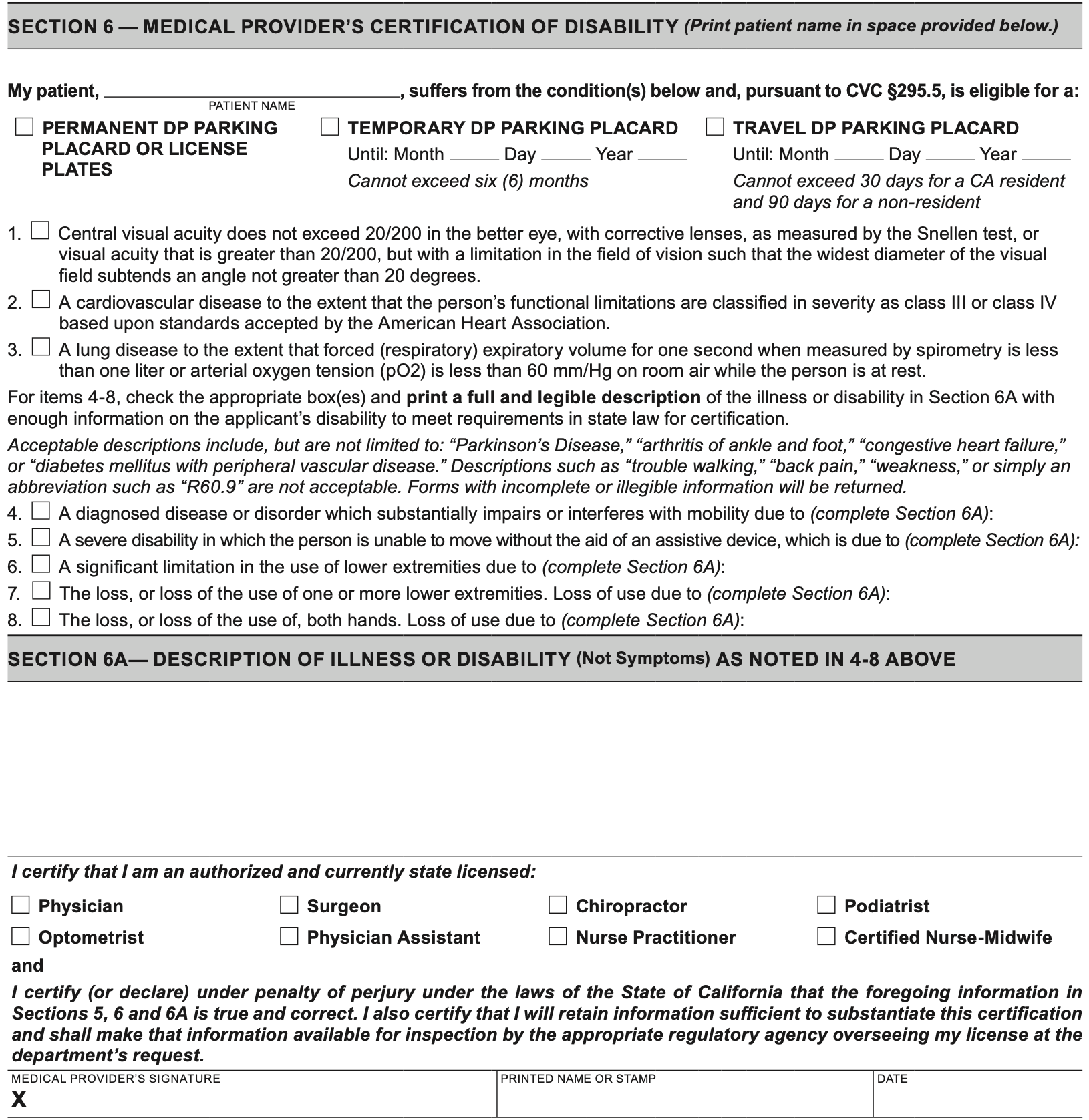
- Form
- REG 195, Application for Disabled Person Placard or Plates
- Issued by
- California Department of Motor Vehicles (DMV)
- Blank form
- REG 195 PDF on dmv.ca.gov
- Revision
- REV. 11/2023
- Rule
- California Vehicle Code §§ 295.5 and 22511.55
- Temporary
- up to 180 days, or your date if sooner
- Filed with
- the DMV, by your patient
Key points
- Your part is Section 5 on page 2 and Sections 6 and 6A on page 3.
- Only an eye physician or an optometrist may certify item 1, the vision item.
- There is no walking distance. Items 4 to 8 need a diagnosis in Section 6A.
- A temporary placard lasts up to 180 days, or until your date if sooner.
- A permanent placard does not need your certification again at renewal.
- Any crossing out or white-out voids the form, so start a clean copy.
Before you start: what you are signing, and who may sign
California’s handicap placard application is a single three-page form, the REG 195, Application for Disabled Person Placard or Plates. Page 1 is instructions. Your patient fills in Sections 1 to 4 on page 2 and signs there, and your part is Section 5 at the bottom of page 2 and Sections 6 and 6A, which fill most of page 3. The DMV acts on your statement that your patient has one of the eight conditions printed on page 3, so the question in front of you is whether your patient fits one of those eight descriptions, not whether a closer space would make life easier.
Who may sign depends on which item you check. My understanding is that page 1 of the form sets it out this way. A physician, surgeon, physician assistant, nurse practitioner or certified nurse-midwife may certify items 2 to 8. A chiropractor may certify items 6 to 8 only, and a podiatrist only a disability related to the foot or ankle. Item 1, the vision item, may be certified only by a physician or surgeon who specializes in diseases of the eye, or by an optometrist. So if your patient’s only qualifying condition is poor vision and you are in primary care, the form belongs with their eye doctor.
My understanding from the DMV’s own procedures manual is that the certifier may be licensed in California or in another state, and that a certification from a provider licensed in another country is accepted only for a travel placard.
My understanding is that two kinds of patient may not need you at all. One already has a permanent California placard or disabled person plates on record, unless the DMV cancelled it, no longer has it on record, or has issued four replacement permanent placards in the two-year renewal period. The other has lost a lower extremity or both hands and applies in person at a DMV office.
The rule: California Vehicle Code §§ 295.5 and 22511.55, as cited on page 1 of the REG 195; REG 195, pages 1 and 2; the DMV’s Vehicle Industry Registration Procedures Manual, section 21.075; the DMV’s Disabled Person Parking Placards & Plates page.

Section 5: your details, on page 2
Section 5 asks for your name, last name first, then your medical license number, your office address with the room or suite number, your daytime telephone, and the city, county, state and ZIP code. Page 1 says the DMV may compare your signature with what your licensing board has on file and may contact you about the application, so the license number and the telephone number are the two I would check twice.
Because Section 5 shares page 2 with your patient’s own sections and signature, the form only works as a set. Page 2 says in capitals that the application cannot be processed without pages 2 and 3, so what I would do is hand both pages back together.
Section 6: the patient’s name, and permanent, temporary or travel
Page 3 opens with one sentence for you to complete, that your patient suffers from the conditions below and is eligible for one of three placards. Print your patient’s name on the line, and I would copy it exactly as your patient wrote it in Section 1. Then check one of the three boxes. Temporary and travel each have an “Until” date, with the month, day and year written separately.
My understanding is that the three placards last this long.
| Placard | How long it lasts |
|---|---|
| Permanent | Two years, expiring June 30 of every odd-numbered year. Renewals do not need a new certification from you. |
| Temporary | Up to 180 days, or until your date if that is sooner. It cannot be renewed more than six times in a row. |
| Travel, California resident | 30 days from the day the DMV issues it, and only for someone who already has a permanent placard or plates. |
| Travel, visitor | Up to 90 days, or until your date if that is sooner. |
The temporary box itself says your date cannot be more than six months out. What I would write is the date I expect my patient to be walking normally again, with a little room for a slow recovery, because a date that runs out too early means another visit and another form. Permanent is for a condition you do not expect to improve, and my understanding is that after six years your patient signs for the renewal without needing you to certify again. The travel box is probably the one you will check least, since a California resident who already has a permanent placard usually needs no certification at all.
The rule: California Vehicle Code §§ 22511.55 and 22511.59, as cited in the DMV’s procedures manual; REG 195, pages 1 and 3; the DMV’s Disabled Person Parking Placards & Plates page.
The eight conditions, in California’s own words
Check every item that fits. These are the form’s exact words.
- “Central visual acuity does not exceed 20/200 in the better eye, with corrective lenses, as measured by the Snellen test, or visual acuity that is greater than 20/200, but with a limitation in the field of vision such that the widest diameter of the visual field subtends an angle not greater than 20 degrees.”
- “A cardiovascular disease to the extent that the person’s functional limitations are classified in severity as class III or class IV based upon standards accepted by the American Heart Association.”
- “A lung disease to the extent that forced (respiratory) expiratory volume for one second when measured by spirometry is less than one liter or arterial oxygen tension (pO2) is less than 60 mm/Hg on room air while the person is at rest.”
- “A diagnosed disease or disorder which substantially impairs or interferes with mobility due to (complete Section 6A)”
- “A severe disability in which the person is unable to move without the aid of an assistive device, which is due to (complete Section 6A)”
- “A significant limitation in the use of lower extremities due to (complete Section 6A)”
- “The loss, or loss of the use of one or more lower extremities. Loss of use due to (complete Section 6A)”
- “The loss, or loss of the use of, both hands. Loss of use due to (complete Section 6A)”
There is no walking distance anywhere on this list. If you have filled in another state’s form you may go looking for one, but California asks instead whether a diagnosed disease substantially impairs mobility, whether your patient needs an assistive device to move, or whether the legs or both hands are lost or badly limited. That leaves more to your judgment, and it is probably why items 4 to 8 all send you on to Section 6A.
Items 2 and 3 turn on a class or a number, so before checking either I would make sure the chart already holds the functional class, or the spirometry or blood gas result. Item 1 has numbers too, but as above it is not yours to certify unless you are an eye physician or an optometrist.
The rule: California Vehicle Code § 295.5, as cited in Section 6 of the REG 195; REG 195, page 3.
Section 6A: a diagnosis, not a symptom
For any of items 4 to 8, the form asks for a full and legible description of the illness or disability in Section 6A, the empty box under the list, and the heading of the box adds “Not Symptoms”. The form gives examples it accepts, such as “Parkinson’s Disease”, “arthritis of ankle and foot”, “congestive heart failure” and “diabetes mellitus with peripheral vascular disease”. It also gives examples it does not accept, which are “trouble walking”, “back pain”, “weakness”, or a code on its own such as “R60.9”.
In my experience the easy mistake here is to write down what the patient told you rather than what you diagnosed. What I would write is the diagnosis and the part of the body, and if there is room, a few words on how it limits walking, for example “severe osteoarthritis of both knees, walks with a cane” rather than “difficulty walking”. My reading of page 1 is that a code next to the words is fine, as long as it is not the only thing in the box.
Your license, your signature, and the penalty
Below Section 6A are eight boxes for the license you hold, which are physician, surgeon, chiropractor, podiatrist, optometrist, physician assistant, nurse practitioner and certified nurse-midwife. Check yours, and make sure it is one that may certify the item you checked above.
Then comes the sentence you are signing. You certify, under penalty of perjury under the laws of California, that what you wrote in Sections 5, 6 and 6A is true and correct. You also certify that you will keep enough information to back up the certification, and will make it available to the board that oversees your license if the DMV asks. So the visit note matters as much as the form, and I would make sure it names the same diagnosis and limitation that went into Section 6A. Separately, page 1 lists what is illegal and punishable by a fine, imprisonment or both, and that list includes giving false information to get a placard and forging a medical provider’s signature.
Sign in ink yourself, then print your name or use a stamp in the box beside the signature, and write the date. Page 2 says only original signatures are accepted, with no photocopies or faxes, and that any alteration, crossing out or white-out, even a change you initial, voids the form. If you make a mistake, start a clean copy rather than correcting it.
The rule: California Vehicle Code §§ 22511.55, 22511.56, 22511.57 and 22511.6, as cited on page 1 of the REG 195; REG 195, pages 1 to 3.
Where the form goes, and what your patient pays
Your patient files it, not you. My understanding is that there are three ways in. Your patient can take it to a DMV field office, and page 1 says no appointment is needed. They can mail the original to the address printed on page 1, which is DMV Placard, P.O. Box 997600 M/S D238, Sacramento, CA 95899-7600. Or they can use the online placard application on dmv.ca.gov, which asks them to upload the REG 195 you signed. Whichever way they choose, they also need a copy of proof of their legal name and date of birth, such as a driver license or ID card, or the application is not accepted.
The fees are printed in Section 2 on page 2. A permanent placard and a travel placard have no fee, and a temporary placard is $6.
The rule: REG 195, pages 1 and 2; the DMV’s Disabled Person Parking Placards & Plates page and its online placard application page.
What the REG 195 says gets a form not accepted
I have not seen a California source that ranks the reasons a REG 195 is not accepted, so I won’t guess at the most common. The form itself names these, and they are the ones I would look for before it leaves the office.
- Any part that is illegible, incomplete or unsigned.
- A Section 6A description that is only a symptom or only a code.
- Any alteration, crossing out or white-out, even with initials.
- A photocopied or faxed signature instead of an original.
- Page 3 sent without page 2, since the DMV needs both.
- No copy of your patient’s proof of legal name and date of birth.
PatientPapers makes completing the California REG 195 faster and easier
I created PatientPapers to make this paperwork faster and easier, because as a physician I know how much of it lands on us. It is my own product, built through the same company as this site, so weigh this accordingly. It keeps your name, license number and office address on file, asks which placard and which of the eight items apply, and asks for the Section 6A diagnosis whenever you check items 4 to 8. It then fills in Sections 5, 6 and 6A on California’s own REG 195 for you to review and sign in ink. The pricing and the full description are on the PatientPapers site.
Open PatientPapers