Florida DWC-25, box by box
A patient hurt his back lifting boxes at work, and the workers’ compensation insurer has sent him to you. Along with your note, Florida wants a two-page form from you, and what you check in one section decides whether he goes back to work tomorrow, goes back with limits, or stays home.
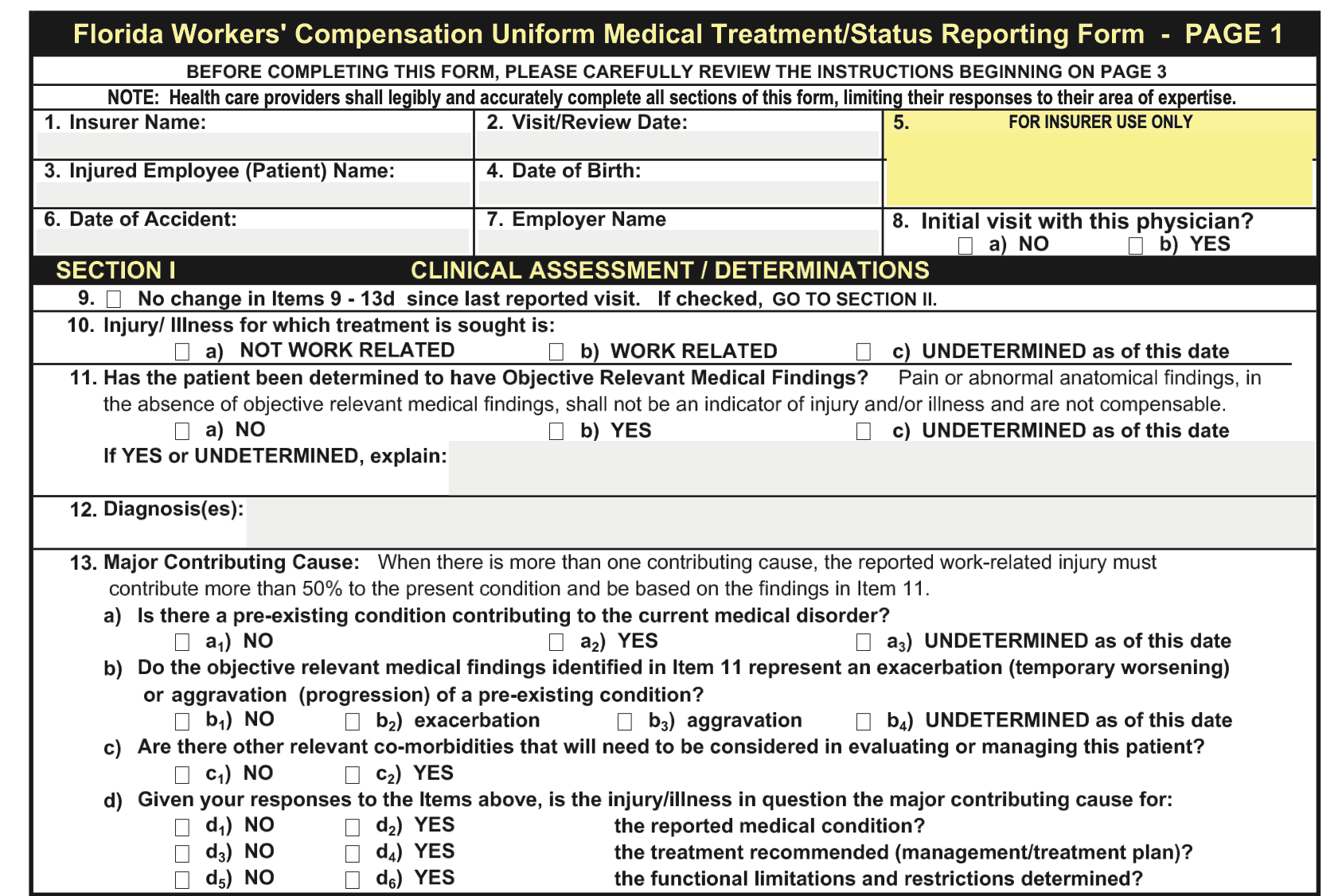
- Form
- DFS-F5-DWC-25, Florida Workers’ Compensation Uniform Medical Treatment/Status Reporting Form
- Issued by
- Florida Department of Financial Services, Division of Workers’ Compensation
- Blank form
- DWC-25 PDF on myfloridacfo.com
- Revision
- 1/31/2008
- Instructions
- Form DFS-F5-DWC-25-A
- Send to
- the insurer, and the employer (always for the first visit, on request after that)
Key points
- It is the only form Florida accepts for this report. Your note still goes with it.
- After the first visit, send it within three business days.
- After later visits, send it by the next business day, and at least every 30 days.
- Section III asks the insurer to authorize treatment.
- Section IV is the work status. Check one of three.
- Only a physician can set maximum medical improvement or a rating.
Before you start: one form that does four jobs
The DWC-25 is how a treating clinician in Florida reports on an injured worker to the workers’ compensation insurer. It does more than give a work status. The same form asks the insurer to authorize the treatment you want next, reports how your patient is doing, and records the date your patient stopped improving and any permanent impairment rating. So one two-page form does four jobs.
My understanding is that Florida’s rule allows only this form for a physician to report an injured worker’s treatment and status, and no other report can be used in its place or added to it. It does not replace your office note, though, and what the form says has to match what the note says. What I would do is write the note first and fill out the form from it, rather than the other way round.
The rule: Fla. Admin. Code R. 69L-7.720 and 69L-7.730; section 440.13, Florida Statutes.
When it is due, and who gets it
- The first treatment after the injury. To the insurer and the employer, within three business days of the visit.
- Every later visit. To the insurer, and the employer if they ask, by the next business day. At least every 30 days, even when nothing has changed.
- Maximum medical improvement or a rating. To the insurer, and the employer if they ask, by the next business day, with a copy to your patient within three business days.
- A hospital stay of more than 24 hours. At the pre-admission visit or on the day of admission, and again on the day of discharge, each by the next business day.
- Visits more than three times a week. Once a week instead, unless something changes clinically or the restrictions change.
These timings come from Florida’s completion instructions. The first deadline is the one that matters most. My understanding is that under section 440.13, a claim for that first treatment is not valid against the employer or your patient unless the treating physician sends this notice by the end of the third business day. Florida’s instructions also say there is no payment for filling out the form itself, and the Division’s provider questions page says an insurer can refuse to pay for treatment when the DWC-25 that asked for it was never sent.
The rule: sections 440.13(3) and 440.13(4)(a), Florida Statutes; Fla. Admin. Code R. 69L-7.730; the completion instructions, Form DFS-F5-DWC-25-A.
Who fills it out, and who signs
Florida’s instructions say every physician who gives direct billable care after the injury completes it, including physician assistants and advanced registered nurse practitioners (ARNPs) working under a physician’s supervision, wherever they see the patient. An emergency physician completes a shorter set, items 1 to 8, 10, 11, 12, Section IV and the attestation. A physician who only reads a test, an anesthesia provider working with the surgeon, and an assistant surgeon do not have to complete it.
Page 2 has two signature blocks. The top one is the physician’s. The lower one is for a provider other than a physician who gave billable care at that visit, such as a therapist. If only the physician gave care, the instructions say to write N/A there. An electronic signature is fine, but an ink stamp is not.
Two rules about maximum medical improvement and the impairment rating are worth knowing. My understanding is that only a physician can decide them, and for this Florida counts medical and osteopathic physicians, chiropractors, podiatrists, optometrists and dentists as physicians. The form that reports them has to be signed by the physician who did the examination they are based on.
The rule: sections 440.13(1) and 440.15(3), Florida Statutes; Fla. Admin. Code R. 69L-7.730; Form DFS-F5-DWC-25-A.
Items 1 to 8: the top of page 1
The insurer, the date of the visit, your patient’s name and date of birth, the date of the accident, the employer, and whether this is your patient’s first visit with you. Item 5 is a yellow box marked for insurer use only, so leave it blank. On the first DWC-25 for a patient, Florida’s instructions want items 1 to 4 and 6 to 8 filled in. On every one after that, items 2, 3, 4 and 6 are the minimum.
Section I: the clinical assessment, items 9 to 13
Item 9 is a shortcut. If nothing in items 9 to 13 has changed since the last visit, check it and go straight to Section II.
Item 10 asks whether the injury or illness you are treating is work related, not work related, or undetermined as of today. Undetermined is an honest answer at a first visit when you do not yet have enough to say. If you check not work related, the instructions say to sign the attestation on page 2 and send the form without going further.
Item 11 asks whether your patient has objective relevant medical findings, meaning something you can see, measure or image, not only what your patient reports. The form prints Florida’s rule right there, that pain or abnormal anatomy without objective findings is not a sign of injury and is not compensable. If you answer yes or undetermined, explain in a few words what the findings are. Florida’s instructions say one box here must always be checked.
Item 12 is the diagnosis. Unlike the FMLA forms, this one expects it.
Item 13 is about the major contributing cause. When there is more than one cause, the work injury has to contribute more than half of the present condition. The item asks whether a pre-existing condition is contributing, whether today’s findings are a temporary worsening (exacerbation) or a lasting progression (aggravation) of that condition, whether other conditions affect treatment, and finally whether the work injury is the major contributing cause of the condition, of the treatment you recommend, and of the restrictions. One box must be checked in every part.
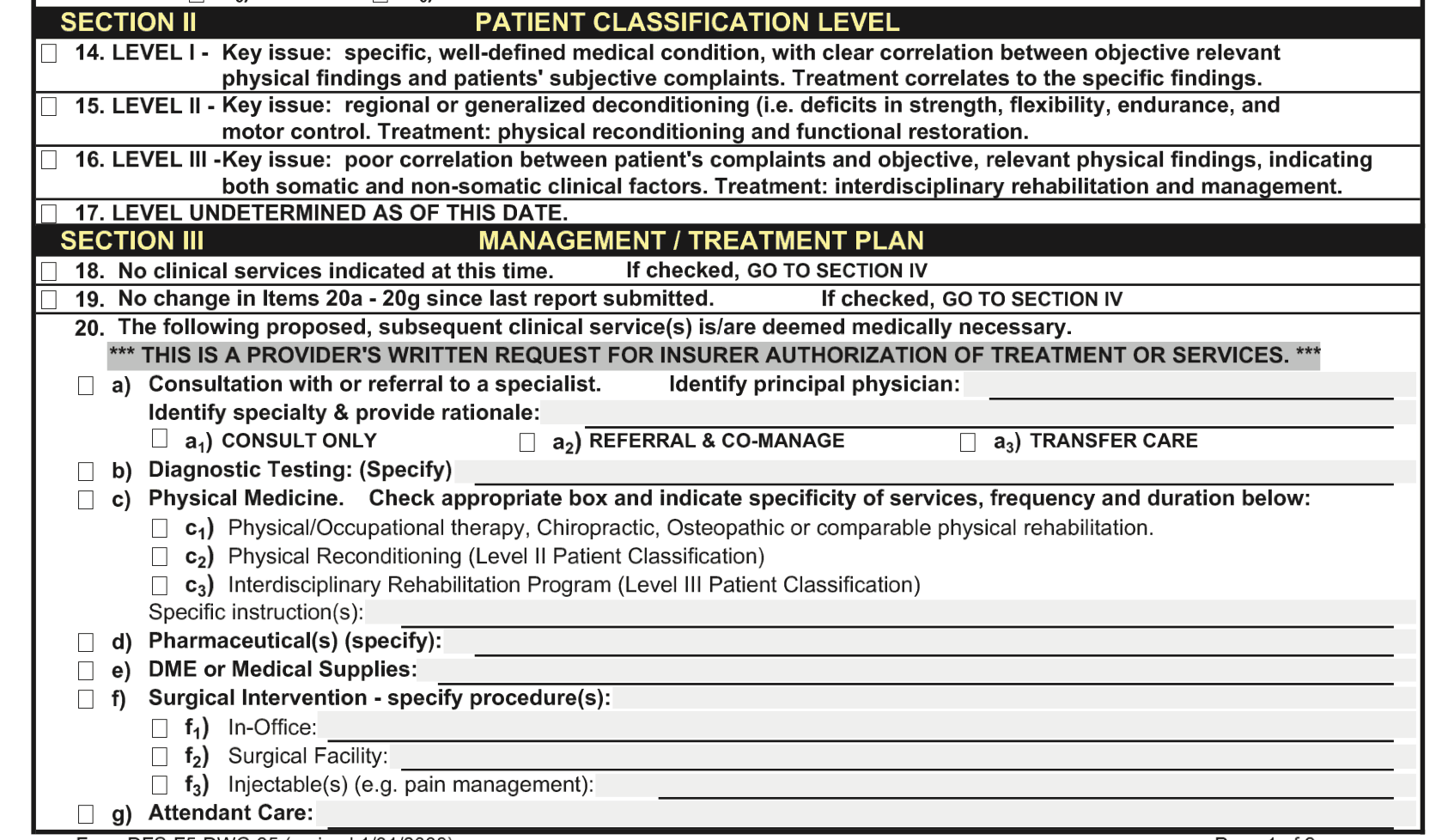
Section II: the classification level, items 14 to 17
Pick the level that fits your patient today. Level I is a specific, well-defined condition where the findings match the complaints. Level II is deconditioning, meaning a loss of strength, flexibility or endurance in one area or overall. Level III is when the complaints and the physical findings do not match well and other factors are part of the picture. If you cannot say yet, check item 17, undetermined. At least one box must be checked.
Section III: the treatment plan is a request, items 18 to 20
This is the part people miss. Item 20 prints, in capitals, that it is a provider’s written request for the insurer to authorize treatment or services. So whatever you check there, such as a referral, imaging or other tests, physical therapy, medication, equipment, surgery or attendant care, is what you are asking the insurer to pay for. Be specific about what you want and how often, because a vague request is harder for the insurer to authorize. For a referral, name the physician who keeps overall charge of the care in the space provided.
Sending the form is not the same as getting approval, though. My understanding is that the insurer still has to authorize the treatment before you provide it, except in an emergency.
If you need nothing more, check item 18, no clinical services indicated. If the plan has not changed since your last report, check item 19. If neither applies, at least one box in item 20 must be checked.
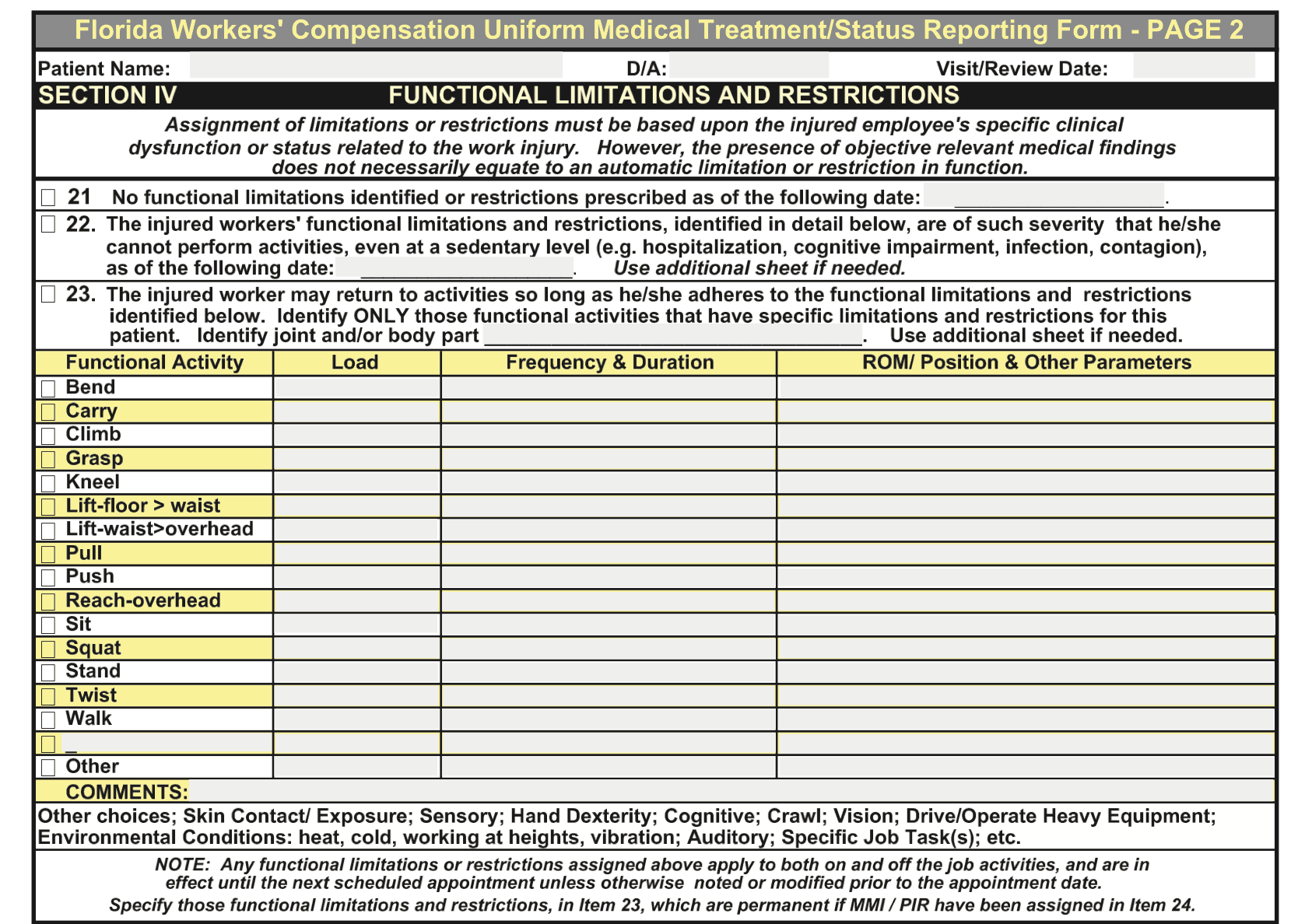
Section IV: the work status, items 21 to 23
This is the section your patient and the employer care about most, and there are three choices.
- Item 21 means no limits at all. The date you write in is the date your patient is released to work without restrictions.
- Item 22 means the limits are so severe that your patient cannot do even sedentary activity, such as during a hospital stay, as of a date. Florida’s instructions want the table filled in for this one too, describing the limits in detail. For a planned admission, write “hospital admission” and the expected date.
- Item 23 means your patient can go back to activity, within the limits you list in the table.
For item 23, the form asks you to list only the activities that have specific limits for this patient, and the body part. For each one, the table has room for the load, how often and for how long, and any position or range of motion. “Lift floor to waist, no more than 10 pounds, occasionally, for the left shoulder” tells the employer what light duty can look like. “Light duty” on its own does not. A limit on the whole working day, such as no more than four hours a day for the next three weeks, goes in the frequency and duration column or in the comments.
Under the table the form says the limits apply both on and off the job, and last until the next appointment unless you change them sooner. That is worth telling your patient, because people often assume work restrictions only apply at work.
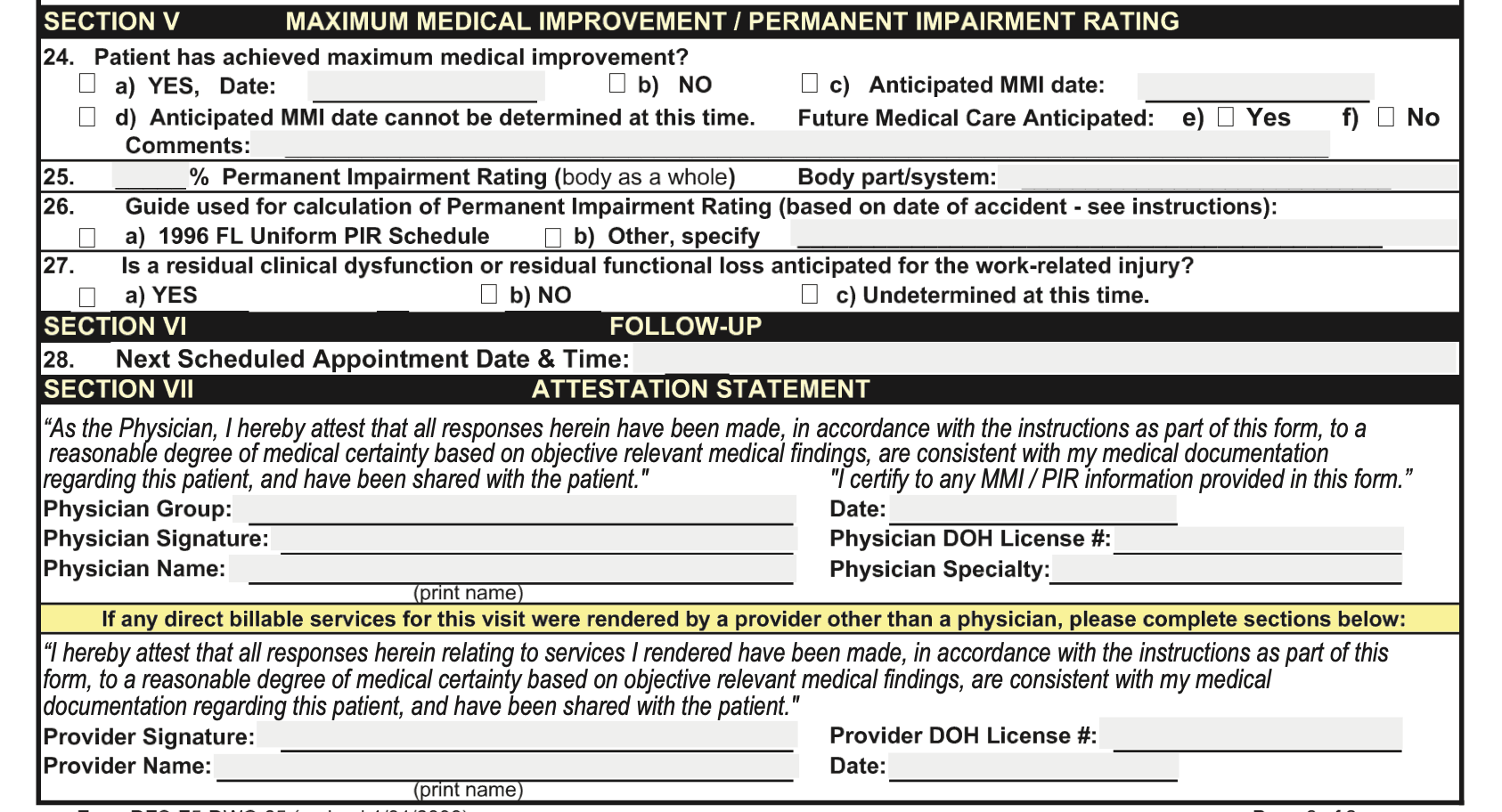
Section V: maximum medical improvement and the rating, items 24 to 27
Maximum medical improvement means your patient is not expected to get meaningfully better with more treatment. Item 24 asks whether your patient has reached it, with the date, or the date you expect it, or that you cannot say yet.
The future care question, at the end of item 24, is answered only once maximum medical improvement is set and a rating given. If you expect future care, describe it in Section III. Once maximum medical improvement is set, the form also asks you to say in item 23 which limits are permanent.
Items 25 and 26 are the permanent impairment rating, meaning a percentage of the body as a whole for the function your patient has permanently lost, the body part, and the guide you used to calculate it. My understanding from the instructions is that the guide depends on the date of the accident, and the 1996 Florida Uniform Permanent Impairment Rating Schedule printed in item 26 covers accidents since January 7, 1997. Item 27 asks whether you expect lasting loss of function from the work injury.
If you are seeing your patient early in the course, item 24’s “cannot be determined at this time” and item 27’s “undetermined” are the honest answers, and the rating lines stay blank.
Sections VI and VII: the next visit and the attestation
Item 28 is the date and time of the next appointment. If there is none, the instructions want a short reason instead, such as “as needed” or “discharged from care”. Then comes the attestation. By signing, you attest that your answers follow the form’s instructions, are made to a reasonable degree of medical certainty based on objective relevant medical findings, match your documentation, and have been shared with your patient. Next to it is a second line, that you certify any maximum medical improvement or rating information on the form. Fill in your group, printed name, Florida Department of Health license number, specialty and the date, and sign it yourself.
The boxes Florida says must be checked
I have not seen a Florida source that says which items are most often left incomplete, so I won’t guess. What Florida’s instructions do say is which items must be answered, and those are the ones I would look at twice before signing.
- Items 1 to 4 and 6 to 8 on the first DWC-25, and items 2, 3, 4 and 6 on every one after that.
- Item 10, one box.
- Item 11, one box, whatever the date of the accident.
- Item 13, one box in every part.
- Items 14 to 17, at least one classification level.
- Item 20, at least one box, unless item 18 or item 19 is checked.
PatientPapers makes completing the Florida DWC-25 faster and easier
I created PatientPapers to make this paperwork faster and easier, because as a physician I know how much of it lands on us. It is my own product, built through the same company as this site, so weigh this accordingly. It keeps your name, license number and specialty on file, walks you through the DWC-25 section by section, and fills in Florida’s own form for you to review and sign. It does not calculate an impairment rating, so the rating line takes only what you type. The pricing and the full description are on the PatientPapers site.
Open PatientPapers