Texas DWC-073, box by box
A restaurant cook burned her forearm on the fryer, and the workers’ compensation carrier has sent her to you. Before she leaves the exam room, Texas expects her to have a one-page report from you, and the box you check on it decides whether she works tomorrow, works with limits, or stays home.
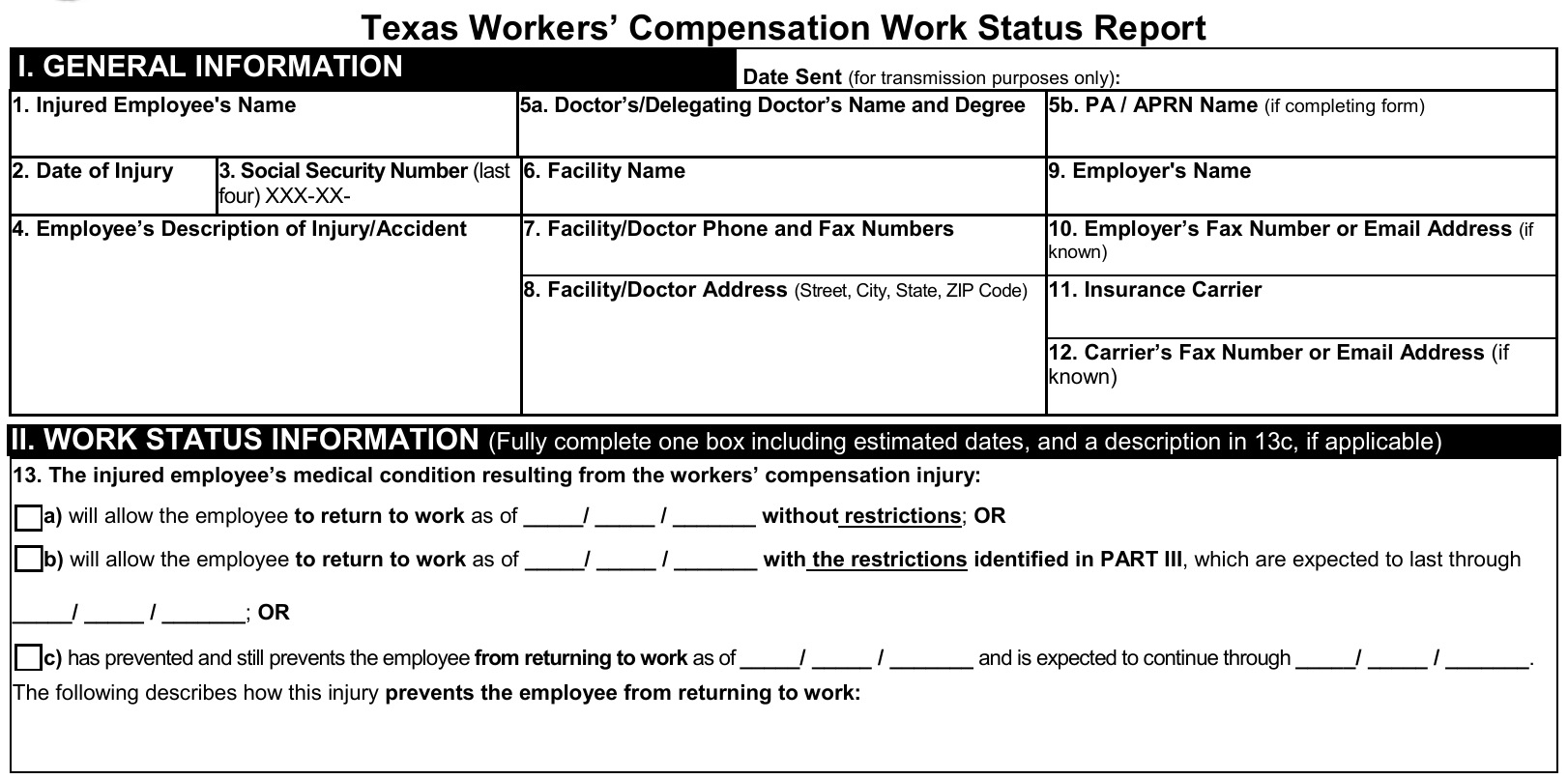
- Form
- DWC Form-073, Texas Workers’ Compensation Work Status Report
- Issued by
- Texas Department of Insurance, Division of Workers’ Compensation
- Blank form
- DWC-073 PDF on tdi.texas.gov
- Revision
- DWC073 Rev. 09/19
- Rule
- 28 Texas Administrative Code §129.5
- Goes to
- your patient at the visit, then the insurance carrier and the employer within two working days
Key points
- It is one page, and you check exactly one of three work statuses.
- Your patient gets it at the visit.
- The carrier and the employer get it within two working days.
- File again when the status or restrictions change substantially.
- Part III is only for a return to work with restrictions.
- A delegated PA or APRN may sign it, and it pays $15 under 99080-73.
Before you start: one page that answers one question
The DWC-073 is the Texas Work Status Report. It is how the doctor treating an injured worker tells three people, your patient, the employer and the workers’ compensation insurance carrier, whether your patient can work right now. The first page is the whole form. The second page is the Division’s own instructions, printed as a chart of who files it, when, and to whom, and there is nothing on it to fill in.
Texas gives you three choices and asks you to pick exactly one. Your patient can go back to work without restrictions, can go back with the restrictions you list, or cannot work at all for now. Everything else on the page either identifies the claim or supports the choice you made. As I read the rule, a release without restrictions is a statement about work and not a statement that your patient has finished improving, so checking the first box does not mean you are saying your patient has reached maximum medical improvement. That is a separate question on a separate Texas form.
The report matters beyond your chart. Under the Texas rule on offers of light duty, an employer who offers your patient a modified job has to include a copy of the Work Status Report the offer is based on. So the restrictions you write are, in a real sense, the instructions the employer will use to build a job your patient can do. What I would do is write them as if the supervisor reading them has never met your patient and has no medical background, because that is probably who reads them.
The rule: 28 Texas Administrative Code §129.5(a) and §129.6(c).
When it is due, and who gets it
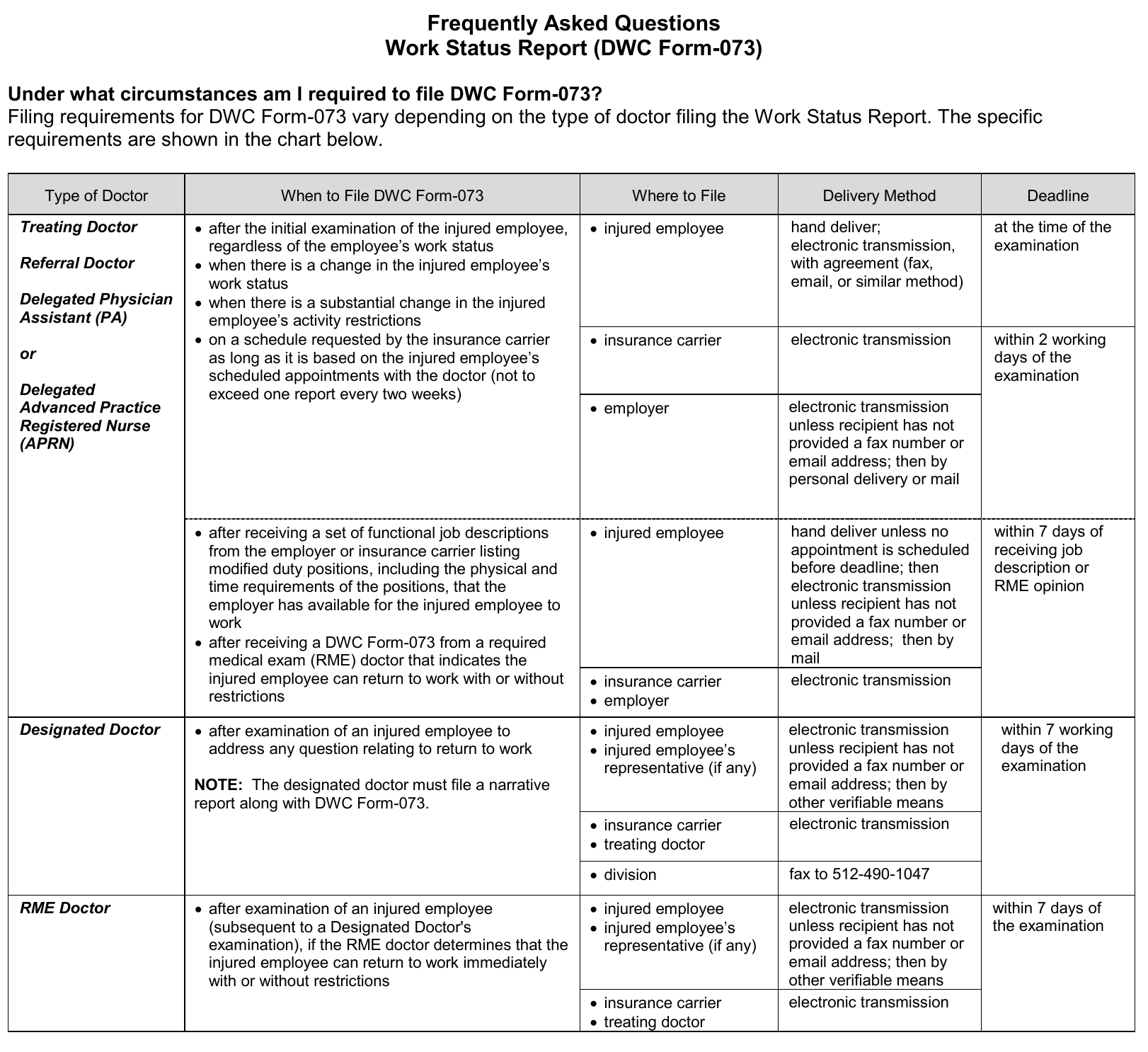
For a treating doctor or a referral doctor, and for a physician assistant or advanced practice registered nurse the treating doctor has delegated, the rule asks for a report at four points.
- After the first examination. Every time, whatever the work status turns out to be.
- When the work status changes. That means moving from one of the three choices to another, for example from off work to work with restrictions.
- When the restrictions change substantially. The rule means a change in your patient’s condition that either stops your patient working under the old restrictions or lets your patient do noticeably more, closer to the normal job.
- On the carrier’s schedule. If the carrier, its agent, or the employer through the carrier asks for regular reports, you send them on that schedule, tied to your scheduled appointments, and never more often than one every two weeks.
The deadline is short. Your patient gets the report at the time of the examination, by hand, or electronically if your patient agrees to that. The carrier and the employer get it no later than the end of the second working day after the examination. Texas counts a working day as Monday to Friday, leaving out national holidays, the Friday after Thanksgiving, December 24 and December 26. The report to the carrier goes electronically. The report to the employer goes electronically if you have been given the employer’s fax number or email address, and otherwise by personal delivery or mail, which is why the form has a box for each of those addresses.
There is one more trigger, and it does not depend on a visit. If the employer sends you functional job descriptions for modified duty positions, or if you receive a required medical examination doctor’s Work Status Report saying your patient can work, the rule gives you seven days from the day you receive it to send a new report to the carrier, the employer and your patient. The rule says this report does not require a new examination, so you can probably do it from the chart and the job descriptions.
Texas does pay for the report. The rule says the carrier has to pay $15 for a complete report that the rule requires, and you may not bill more than that. The rule spells out the codes. You bill CPT 99080 with modifier 73 for a report after the first examination, after a change, or after job descriptions or a required medical examination report. You add modifier RR for a report the carrier asked for on its schedule, and EC for an extra copy of a report you already filed. A separate rule says a work status report done as part of an examination ordered by the Division, such as a designated doctor examination, is not billed separately.
The rule: 28 Texas Administrative Code §129.5(a), (e) to (j); §102.3(b); §134.239; DWC Form-073, page 2.
Who fills it out, and who signs
The rule puts the duty on the “doctor,” and it defines that word narrowly for this purpose. It means the treating doctor, who is the doctor primarily responsible for managing and coordinating your patient’s care for the injury, or a referral doctor, who examines and treats your patient at the treating doctor’s request. If you are a primary care doctor who has become the treating doctor on a workers’ compensation claim, this report is for you to complete.
A physician assistant or advanced practice registered nurse can complete, sign and file the report, but only by delegation. As I read the rule, the treating doctor may delegate that authority if their licensing act allows it, and the treating doctor stays responsible for what the PA or APRN does under it. The form is built for that arrangement. Item 5a is the doctor’s or delegating doctor’s name and degree, and item 5b is the PA or APRN’s name, filled in only if they are completing the form. I would not leave 5a blank on a report a PA or APRN signs, because the delegating doctor is the person the rule holds responsible.
Other doctors file this form too, on different clocks. A designated doctor who examines your patient on a return-to-work question files it with a narrative report within seven working days, and a required medical examination doctor who finds your patient can return to work files it within seven days. Those are their reports, not yours, but one of them arriving in your office starts your own seven-day clock described above.
The report has to be signed. The bottom of the form has one line for the health care practitioner’s signature and license number. I have not seen a Texas source that says whether an electronic signature is enough on this form, so I won’t guess, and I would ask the carrier if it matters in your setup.
The rule: 28 Texas Administrative Code §129.5(a)(1), (b) to (d); §180.22(c) and (e); §126.6(g); §127.10(f).
Part I: general information, items 1 to 12
The block at the very top, in English and Spanish, is a notice to your patient about reporting the injury and getting help from the Division. There is nothing to fill in there. The “Date Sent” line next to the Part I heading is marked “for transmission purposes only,” and I would fill it in with the day it actually goes to the carrier and employer, since that is the date that proves you met the two-working-day deadline.
Items 1 to 4 are about your patient. Item 1 is the name, item 2 the date of injury, and item 3 only the last four digits of the Social Security number, which the form prints after a mask. Item 4 is the employee’s description of the injury or accident, meaning how your patient says it happened, in your patient’s terms.
Items 5 to 8 are about you. Item 5a is the doctor or delegating doctor with degree, 5b the PA or APRN if one is completing it, then the facility name, phone and fax, and address.
Items 9 to 12 are the employer and the carrier, each with a fax number or email address “if known.” Those two address boxes matter more than they look, because they decide how the report has to reach each of them. If the claim paperwork gives you the carrier’s or employer’s fax or email, copy it here so whoever sends the report does not have to hunt for it.
Part II: the work status, item 13
The heading tells you the rule for this part. It says to “Fully complete one box including estimated dates, and a description in 13c, if applicable.” So you check one box only, and you fill in every date in that box.
- Item 13a is a return to work without restrictions, as of a date.
- Item 13b is a return to work with the restrictions you list in Part III, as of a date, and the restrictions are expected to last through a second date.
- Item 13c says the injury has prevented and still prevents your patient from returning to work, as of a date, and is expected to continue through a second date. Below it is a space for “how this injury prevents the employee from returning to work.”
The end dates in 13b and 13c are estimates, and the rule says so. An expected expiration date is not binding and can be changed in a later report as your patient improves or does not, so I would not leave it blank because you are unsure. Write your honest best estimate, which in most cases will be the date of the next visit, and change it then.
The explanation under 13c is the one piece of writing the rule specifically requires, whenever you believe your patient cannot work. I would write it in terms of the job and not only the diagnosis. A diagnosis such as lumbar strain tells the carrier what is wrong, but it does not say why your patient cannot do any job at all, including a seated one. A sentence saying your patient cannot sit or stand for more than 20 minutes and is taking medication that causes drowsiness explains why no modified duty would work, which is the question the carrier is really asking.
The rule: 28 Texas Administrative Code §129.5(d); DWC Form-073, item 13.
Part III: the activity restrictions, items 14 to 20
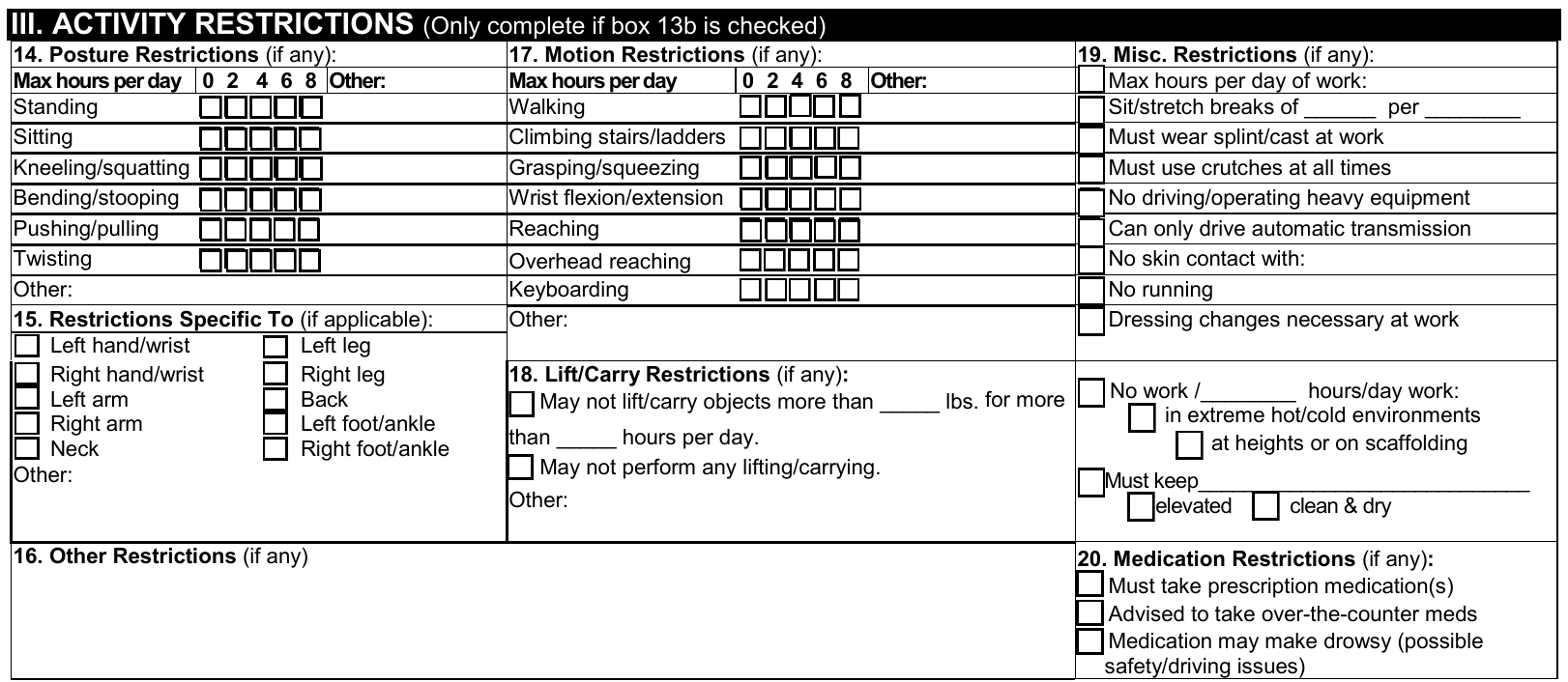
Part III is printed with the instruction “Only complete if box 13b is checked.” If you checked 13a or 13c, leave the whole part blank. If you checked 13b, this is where the employer learns what your patient can and cannot do, and every item is marked “if any,” so you fill in only what applies.
Item 14 is posture restrictions and item 17 is motion restrictions. Each is a grid with a row for an activity, such as standing, sitting, kneeling or squatting, bending, pushing and pulling, and twisting in item 14, or walking, climbing stairs or ladders, grasping, wrist movement, reaching, overhead reaching and keyboarding in item 17. Across the top are boxes for the maximum hours per day, 0, 2, 4, 6 or 8, and a space for another number. So for each activity you limit, you check the most hours a day your patient can do it. As far as I can tell, a check under 0 means not at all.
Item 15 is the body part the restrictions are specific to, with boxes for each hand and wrist, arm, leg and foot and ankle, the back and the neck. Item 16 is a free space for other restrictions.
Item 18 is lifting and carrying. You can set a weight limit in pounds and a limit on hours per day, or check that your patient may not lift or carry anything.
Item 19 covers the restrictions that do not fit a grid. It includes the maximum hours per day of work, sit or stretch breaks, a splint or cast, crutches, no driving or operating heavy equipment, an automatic transmission only, no skin contact with a named substance, no running, dressing changes at work, no work or limited hours in extreme heat or cold or at heights, and keeping a body part elevated or clean and dry.
Item 20 is about medication, whether your patient must take prescription medication, is advised to take over-the-counter medication, or takes medication that may cause drowsiness. That last box matters for an employer deciding whether your patient can drive or work around machinery.
The form gives you enough boxes that you rarely need to write much. Where I would add words is item 16, for a limit the grids do not cover, such as no use of the right hand above shoulder height. A specific limit lets the employer build a job around it, and a vague one may leave your patient at home when there was work your patient could have done.
The rule: 28 Texas Administrative Code §129.5(d)(3); DWC Form-073, Part III.
Part IV: diagnosis, follow-up and signatures, items 21 and 22
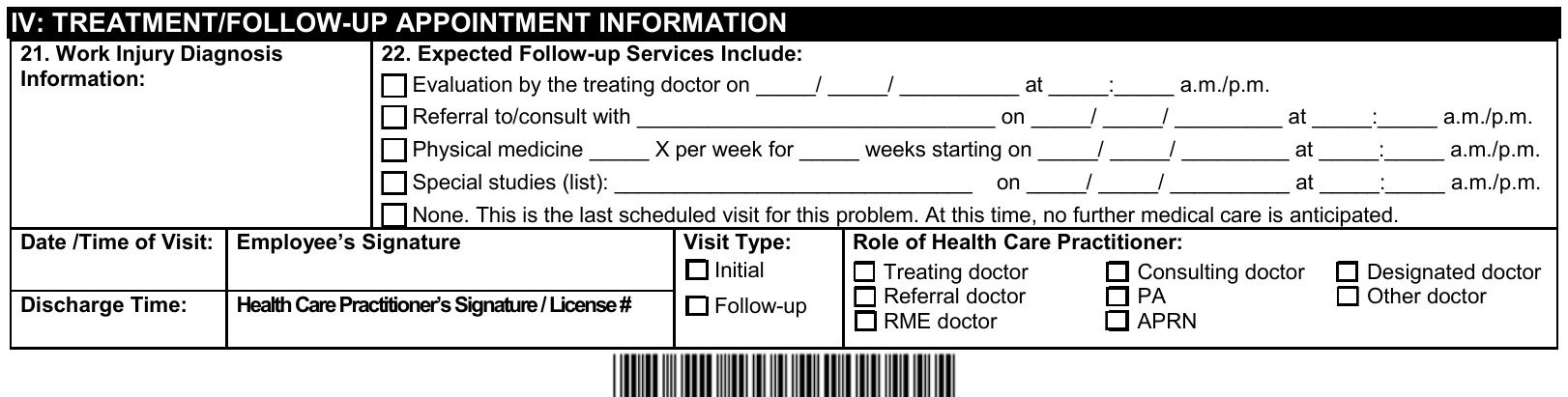
Item 21 is the work injury diagnosis. Keep it to the condition you are treating as part of this claim.
Item 22 is the follow-up you expect, and each line has a date and a time. The choices are an evaluation by the treating doctor, a referral or consult with a named doctor, physical medicine a number of times a week for a number of weeks, and special studies you list. The last box says “None. This is the last scheduled visit for this problem.” I would check that one only when you really expect no more care for this injury, because the carrier and the employer will probably read it that way.
The bottom row records the visit. It has the date and time of the visit and the discharge time, whether this was an initial or follow-up visit, and your role. The role boxes are treating doctor, referral doctor, required medical examination (RME) doctor, consulting doctor, PA, APRN, designated doctor and other doctor. There is a box for your patient’s signature and one for the health care practitioner’s signature and license number. I have not found a Texas rule that says what happens if your patient does not sign, so I won’t guess, and I would not hold the report back for it.
What Texas says a complete report must contain
I have not seen a Texas source that lists the reasons a Work Status Report is most often not accepted, so I won’t guess. What the rule does say is what a complete report has to contain, and that matters twice, because the $15 is paid for a complete report. These are the items I would look at twice before it goes out.
- The work status, meaning one box checked in item 13.
- The effective date and the estimated end date of that status and of any restrictions, in the box you checked.
- The activity restrictions in Part III, if you checked 13b.
- The explanation under 13c of how the injury keeps your patient from working, if you checked 13c.
- The general information that identifies the claim, in Part I.
- A signature, on the form the Division prescribes.
The rule: 28 Texas Administrative Code §129.5(d) and (j).
Questions the office asks
What is the DWC-073 form?
The DWC-073 is the Texas Work Status Report. It is how the doctor treating an injured worker tells your patient, the employer and the workers’ compensation insurance carrier whether your patient can work without restrictions, can work with the restrictions you list, or cannot work for now.
When is the DWC-073 due?
After the first examination, whenever the work status or the restrictions change substantially, and on the carrier’s schedule if it asks, never more often than every two weeks. Your patient gets it at the visit, and the carrier and the employer get it by the end of the second working day after the examination.
Can a nurse practitioner or PA sign the DWC-073?
Yes, if the treating doctor has delegated that to them and their licensing act allows it. As I read the rule, the treating doctor stays responsible for the report, and the form has separate places for the delegating doctor’s name in item 5a and the PA or APRN’s name in item 5b.
How do I bill for the DWC-073?
The rule sets the payment at $15 for a complete required report, billed as CPT 99080 with modifier 73. You add RR for a report the carrier asked for on its schedule, and EC for an extra copy of a report you already filed.
PatientPapers makes completing the Texas DWC-073 faster and easier
I created PatientPapers to make this paperwork faster and easier, because as a physician I know how much of it lands on us. It is my own product, built through the same company as this site, so weigh this accordingly. It keeps your name, license number and specialty on file, walks you through the DWC-073 part by part, and fills in the Texas Division of Workers’ Compensation’s own form for you to review and sign. The pricing and the full description are on the PatientPapers site.
Open PatientPapers