New York handicap parking permit, the doctor’s part of the MV-664.1
A man three weeks out from an Achilles tendon repair swings in on crutches with the New York form, Part 1 already filled in by his wife. He asks me to check permanent, because a neighbor told him it saves coming back, and the honest answer is the other box, with a recovery date and the crutches written in.
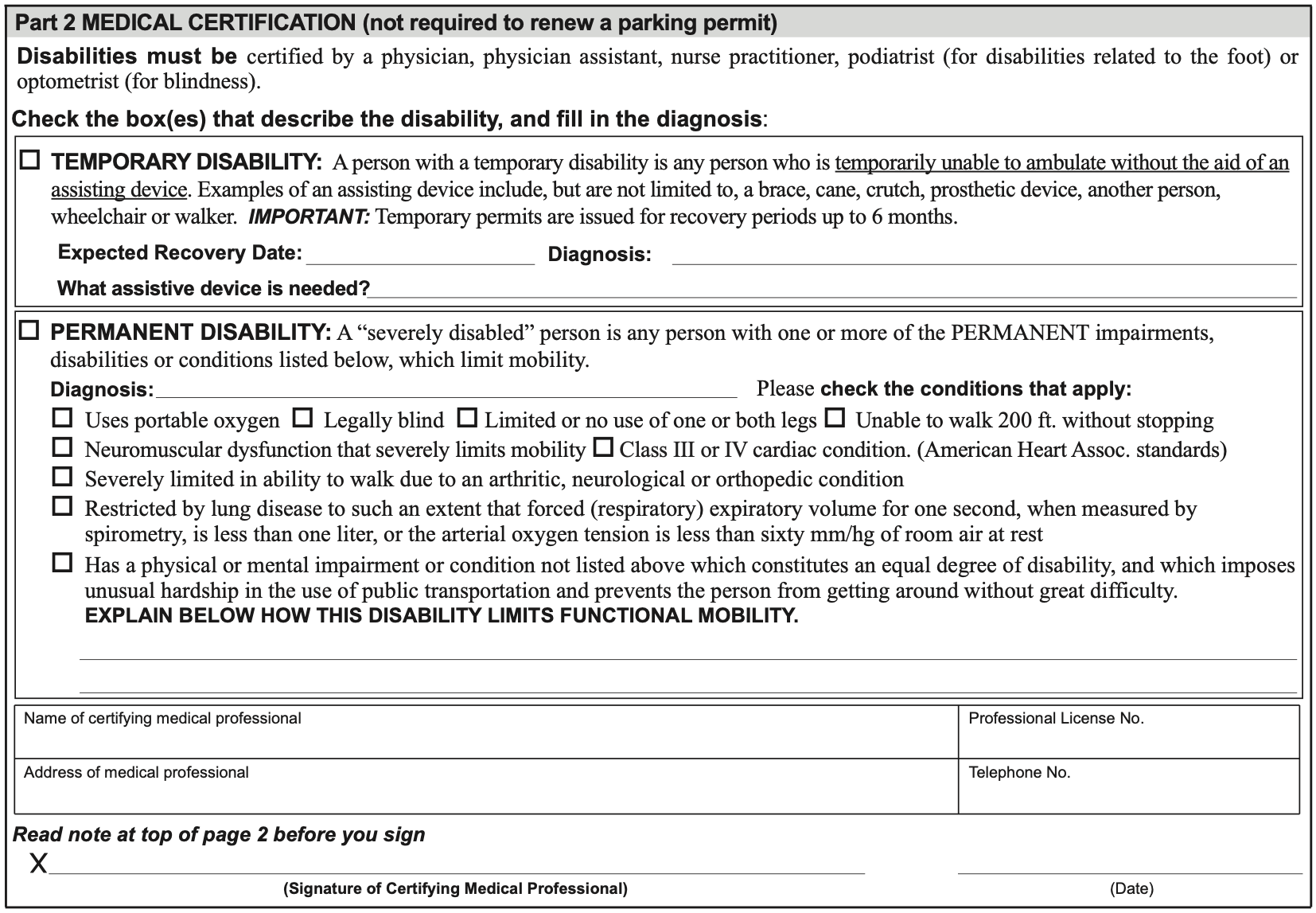
- Form
- MV-664.1, Application for a Parking Permit or License Plates, for Persons with Severe Disabilities
- Issued by
- New York State Department of Motor Vehicles (the form); the permit itself comes from your patient’s city, town or village, or from NYC DOT in New York City
- Blank form
- MV-664.1 PDF on dmv.ny.gov
- Revision
- 8/26
- Rule
- Vehicle and Traffic Law §§ 404-a and 1203-a; 15 NYCRR 24.2
- Temporary
- recovery periods up to 6 months
Key points
- A physician, physician assistant or nurse practitioner may sign.
- Temporary means unable to walk without a device, for up to six months.
- Permanent means one of nine printed conditions.
- The walking limit is 200 feet without stopping.
- Permanent permits renew without a new Part 2.
- It goes to the local clerk or NYC DOT, never to the DMV.
Before you start: what you are signing
The MV-664.1 is New York’s application for a disability parking permit, and the same form is used for the special license plates. It is a three-page packet. Pages 1 and 2 are instructions for your patient, and page 3 is the application itself, with Part 1 for your patient, Part 2 for you, and Part 3 for the office that issues the permit.
That office is not the Department of Motor Vehicles (DMV). The form says in bold, on page 3, that the DMV does not issue parking permits. My understanding is that state law has every city, town and village appoint its own issuing agent, usually the clerk, and that agent relies on your Part 2 rather than examining your patient. So the question is not whether a closer space would help your patient, but whether they fit one of the conditions printed on the form.
The permit belongs to the person, not to a car. Page 1 says your patient does not need a driver license or a vehicle, and that children of any age with a severe disability, and people who are legally blind, are eligible. A patient who is always the passenger can still have one.
My understanding is that you do not strictly have to use Part 2. The DMV says a statement on your practice letterhead can take its place, as long as it is less than one year old, describes the condition and how it limits your patient’s mobility, and carries your license number and signature, with your licensing state if that is not New York. In most cases I would still fill in Part 2, because it puts the state’s own list in front of me while I decide.
The rule: sections 404-a and 1203-a, New York Vehicle and Traffic Law; the instructions on pages 1 and 3 of Form MV-664.1; the DMV’s Parking for People with Disabilities pages.
Who may certify
The first line of Part 2 names five kinds of licensee. Those are a physician, a physician assistant, a nurse practitioner, a podiatrist (for disabilities related to the foot) and an optometrist (for blindness).
My understanding is that where you are licensed matters for some of them. The DMV says physicians, physician assistants and nurse practitioners may be licensed in any state, except that the ninth permanent condition, the one for an impairment not on the list, needs a New York license, which is also what section 404-a says. A podiatrist or an optometrist has to be licensed in New York and may certify only the conditions they treat in their own practice.
One source reads differently, and it is worth knowing about. The New York City Department of Transportation (NYC DOT), which issues the state permit to people who live in the five boroughs, describes the certifier on its own page as a New York State-licensed physician or podiatrist. I don’t know whether NYC DOT holds applications to that narrower wording. If your patient lives in the city and you are licensed in another state, or you are a physician assistant or nurse practitioner, it may be worth your patient calling NYC DOT before mailing the form.
The rule: section 404-a(4), (4-a) and (4-b), New York Vehicle and Traffic Law; Part 2 of Form MV-664.1; the DMV’s Parking for People with Disabilities, The Law page.
The temporary box
The form defines a temporary disability narrowly. In its words, it is a person who is “temporarily unable to ambulate without the aid of an assisting device,” and it gives a brace, cane, crutch, prosthetic device, another person, wheelchair or walker as examples. So the test is the device, not the diagnosis. A patient in a walking boot who is slow but gets about unaided does not fit those words. A patient who needs a family member’s arm to get from the car to the door probably does, because the form counts another person as an assisting device.
Check the box and fill in three lines. Expected Recovery Date is the date you expect your patient to walk without the device. Diagnosis is the condition in plain clinical words, such as “left Achilles tendon rupture, surgically repaired.” What assistive device is needed? asks for the device itself, such as crutches, a walker or a knee scooter. The three lines should agree with each other. A recovery date a year away for an ankle sprain leaves the person reading it with no way to ask you what you meant.
The box prints its own limit, that temporary permits are issued for recovery periods up to six months. My understanding is that the law says the same, that a temporary permit is valid for no more than six months, and the DMV describes it as lasting one to six months. What I would do is write the honest recovery date even when it is further out than that, and expect to see the form again if your patient still needs the device when the permit runs out.
My understanding is also that the law lets each city, town or village choose whether to issue temporary permits, and lets another office issue one when a patient’s own town does not.
The rule: section 1203-a(1) and (3), New York Vehicle and Traffic Law; Part 2 of Form MV-664.1; the DMV’s Parking for People with Disabilities, The Law page.
The permanent box: the diagnosis and nine conditions
The permanent box opens with New York’s definition. The form describes a “severely disabled” person as any person with “one or more of the PERMANENT impairments, disabilities or conditions listed below, which limit mobility.” Fill in the Diagnosis line, then check every condition that applies. These are the nine, in the form’s own words and in the order they are printed.
- Uses portable oxygen
- Legally blind
- Limited or no use of one or both legs
- Unable to walk 200 ft. without stopping
- Neuromuscular dysfunction that severely limits mobility
- Class III or IV cardiac condition. (American Heart Assoc. standards)
- Severely limited in ability to walk due to an arthritic, neurological or orthopedic condition
- Restricted by lung disease to such an extent that forced (respiratory) expiratory volume for one second, when measured by spirometry, is less than one liter, or the arterial oxygen tension is less than sixty mm/hg of room air at rest
- Has a physical or mental impairment or condition not listed above which constitutes an equal degree of disability, and which imposes unusual hardship in the use of public transportation and prevents the person from getting around without great difficulty.
My understanding is that the list comes from two places. The statute names four conditions, the legs, the neuromuscular dysfunction, blindness and the catch-all, and a DMV regulation adds the other five, including the walking distance.
The walking distance is 200 feet, the fourth box, and the words are “without stopping.” The best support for it is something you saw or measured, written in the note. That could be the patient who has to stop and lean on the reception counter between the waiting room and the scale, or a walk test that ended early. A patient’s own estimate is a starting point, but I would want my own observation behind the check.
Three of the other boxes rest on something you can point to in the chart. The cardiac box uses the American Heart Association’s functional classes, so Class III (symptoms with less than ordinary activity) or Class IV (symptoms at rest) should already be in your note. The lung box needs a number, either a forced expiratory volume in one second under one liter on spirometry, or an arterial oxygen tension under 60 on room air at rest, so breathlessness on the stairs is not enough without one of them. Portable oxygen is met if your patient uses it, and no number is asked for.
The ninth box is the catch-all, for an impairment that is not on the list but is just as disabling, makes public transport an unusual hardship and keeps your patient from getting around without great difficulty. My understanding is that this is the one box that needs a New York license, and that section 404-a expects the certifier to name the particular condition. So be specific in the diagnosis line and in the explanation below it, because a check on its own does not tell the reader what you had in mind.
Every condition in this box is permanent by definition. If you expect your patient to get better, the temporary box is the honest one, even when the permanent permit would be more convenient for them.
The rule: section 404-a(4), New York Vehicle and Traffic Law; 15 NYCRR 24.2(a); Part 2 of Form MV-664.1.
Explaining how the disability limits mobility
Under the ninth condition, still inside the permanent box, the form prints in capitals “EXPLAIN BELOW HOW THIS DISABILITY LIMITS FUNCTIONAL MOBILITY,” with two lines to write on. Because of where it sits, it reads as if it belongs to the ninth condition alone, but the form does not say so.
What I would do is fill it in for every permanent certification. The DMV’s rule for a letterhead statement asks for the same thing, how the condition limits mobility, and NYC DOT says the physician must describe how severely and how regularly the condition affects walking. Two lines here answer both. I would write function, not the diagnosis again, for example “walks about 50 feet with a cane before stopping to rest because of hip arthritis, cannot manage steps without a rail.”
Your details, your signature, and the penalty
Below the two boxes are four lines about you, Name of certifying medical professional, Professional License No., Address of medical professional and Telephone No. Then comes the signature line, with the date beside it. If the issuing office has a question, the telephone number is probably how they will reach you, so I would give a number that someone in the office answers.
Just above the signature, the form says in italics to read the note at the top of page 2 before you sign. That note says that when you sign Part 2 you certify two things, that the medical information you give is true and complete, and that in your opinion the person named in Part 1 is medically qualified under the criteria in Part 2. It goes on to say that a false statement on the application is a crime under the Vehicle and Traffic Law and the Penal Law, a felony or a misdemeanor, punishable by a fine, imprisonment or both, and that for a parking permit it can also bring a civil penalty of $250 to $1,000.
My understanding is that the DMV reads these penalties as applying to the clinician who signs as well as to the applicant. So I would sign only for a patient I have examined myself, for a condition my own note supports, and I would keep a copy of the completed Part 2 in the chart.
The rule: sections 392 and 1203-a(4), New York Vehicle and Traffic Law; section 210.45, New York Penal Law; the note at the top of page 2 of Form MV-664.1.
Permanent, temporary, and renewal
The header of Part 2 says it is not required to renew a parking permit, and page 1 says that someone renewing a permit for a permanent disability only needs to complete Part 1. My understanding is that this comes from the statute, which says a severely disabled resident does not need an updated medical certification to renew. The same statute leaves temporary permits out of that rule, so a patient whose temporary permit runs out probably needs a new Part 2 from you to get another one.
Permanent does not mean the permit never expires, though. My understanding is that every New York permit carries an expiration date, permanent ones included, and that the renewal procedure is set by the local office. NYC DOT says the state permit it issues lasts up to five years. Part 3, at the bottom of the page, is for the issuing office only, so leave it blank.
The same form is used for the special license plates, which are for a permanent disability only and come from a DMV office rather than the clerk. Page 1 says that for plates it is the Permanent Disability section of Part 2 you fill in.
The rule: section 1203-a(1-a), New York Vehicle and Traffic Law; pages 1 and 3 of Form MV-664.1; the DMV’s Parking for People with Disabilities, The Law page.
Where it goes, and the New York City exception
Your patient takes the completed form to the office that issues permits in the city, town or village where they live. The form says most city, town and village clerks issue them, and some police departments do. In Nassau County, it points residents to the county’s Office for the Physically Challenged. My understanding is that there is no fee for the permit.
In New York City, NYC DOT issues the state permit. The form says city residents mail the application, with a copy of their driver license or non-driver ID, to NYC DOT, Permits and Customer Service, 30-30 Thomson Avenue, 2nd Floor, Long Island City, NY 11101-3045.
The city is also where patients are most often surprised. My understanding is that New York City does not reserve street spaces for people with disabilities, so the state permit you are certifying works there only in off-street lots, such as at a shopping center or an apartment building. Parking at the curb takes a separate City permit, the NYC Parking Permit for People with Disabilities, which has its own application. NYC DOT says that one needs medical documentation from a physician (an MD or DO) dated within a year, with exam notes and diagnostic testing, reviewed by a physician designated by the city’s Health Department, and that a podiatrist cannot certify it. If your patient lives in the city and wants to park on the street, that is a different packet from this one.
One more thing may save a visit. My understanding is that for an obvious, visible, permanent disability, such as the loss of a leg or foot, the local issuing agent may waive the medical statement for a permit altogether.
The rule: section 1203-a(1), New York Vehicle and Traffic Law; page 1 of Form MV-664.1; the DMV’s Parking for People with Disabilities pages; NYC DOT’s Parking Permits for People with Disabilities page and its NYC PPPD application.
What Part 2 asks you to complete
I have not seen a New York source that lists the usual reasons an MV-664.1 is not accepted, so I won’t guess. What I can tell you is what Part 2 itself asks for, and those are the lines I would look at twice before handing the form back.
- The box for the disability, temporary or permanent, checked.
- For temporary, the expected recovery date, the diagnosis and the assistive device.
- For permanent, the diagnosis, and at least one of the nine conditions checked.
- The lines explaining how the disability limits functional mobility.
- Your name, professional license number, address and telephone number.
- Your own signature, and the date.
PatientPapers makes completing the New York MV-664.1 faster and easier
I created PatientPapers to make this paperwork faster and easier, because as a physician I know how much of it lands on us. It is my own product, built through the same company as this site, so weigh this accordingly. It keeps your name, license number, address and telephone number on file, asks whether the disability is temporary or permanent and, for a permanent one, which of the nine conditions apply, and fills in Part 2 of New York’s own MV-664.1 for you to review and sign. It will not let you sign a permanent certification with no condition checked, and it leaves the rest of Part 1, including the signature there, to your patient. The pricing and the full description are on the PatientPapers site.
Open PatientPapers