New York DB-450, Part B, box by box
A bookkeeper at a small accounting firm slipped on the ice in her own driveway and broke her ankle, and last week she had surgery to fix it with a plate and screws (an open reduction and internal fixation). Because it happened at home, her pay while she is out comes from New York’s disability benefits, not workers’ compensation. Her claim cannot move until you fill in Part B of the form she hands you, and New York gives you seven days.
- Form
- DB-450, Notice and Proof of Claim for Disability Benefits
- Issued by
- New York State Workers’ Compensation Board
- Blank form
- DB-450 PDF on wcb.ny.gov
- Revision
- DB-450 (10-23)
- Rule
- Workers’ Compensation Law §217; 12 NYCRR §363.11
- Your part
- Part B, the Health Care Provider’s Statement, back to your patient within seven days
Key points
- It is for illness or injury off the job, including pregnancy.
- Part B is for you to complete, and it is due within seven days.
- Return it to your patient, or mail it to the carrier.
- Physicians, chiropractors, dentists, podiatrists, psychologists and nurse-midwives can sign it.
- Item 7d needs a real return-to-work date, never “unknown”.
- Benefits are paid for no more than 26 weeks in any 52-week period, counting any Paid Family Leave.
Before you start: your half of an off-the-job claim
The DB-450 is the claim form for New York’s statutory disability benefits, the weekly cash payments that replace part of a worker’s wages when an illness or injury that has nothing to do with the job keeps them home. It is not workers’ compensation. The Board describes the benefit as paying “if you can’t work because you were injured or became ill outside your employment,” and it adds that this can include pregnancy and recovery from childbirth. So the patients who hand you this form are the ones with a broken ankle from a fall at home, a new cancer diagnosis, a back that went out over the weekend, or a pregnancy.
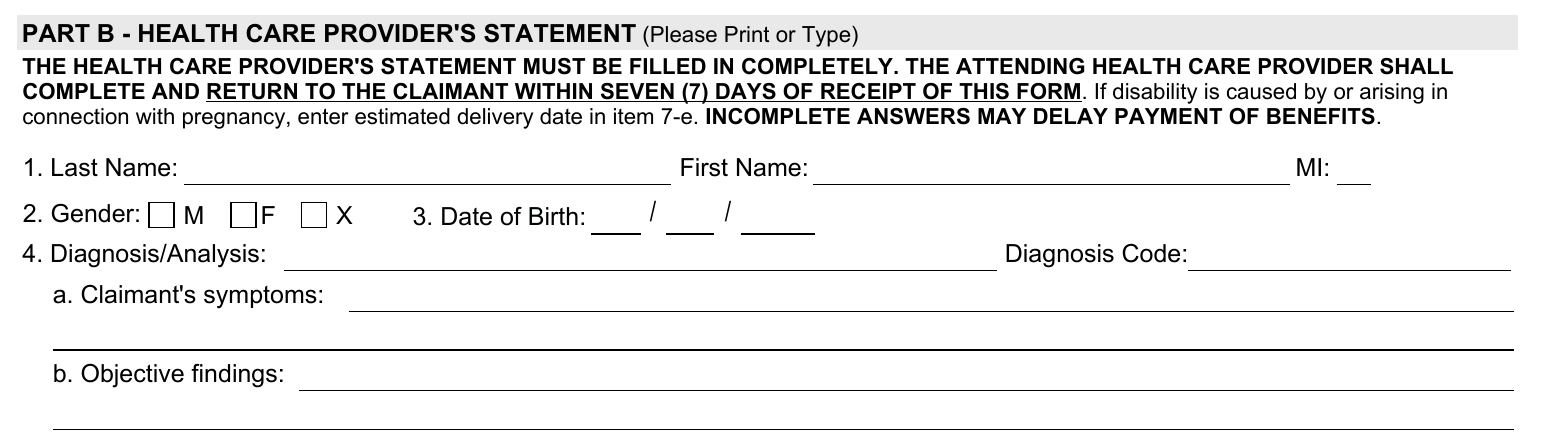
The form has three parts. Your patient fills in Part A, the employer fills in Part C, and Part B, the Health Care Provider’s Statement, is for you to complete. It sits on the second printed page of the form, under your patient’s signature, and it is only eight items long. Short as it is, it is the medical proof the claim stands on. New York’s law asks for a statement of disability from the attending provider “containing facts and opinions as to such disability,” and as far as I can tell Part B is the form the Board prescribes for that statement.
One more thing is worth knowing before you start writing. Disability benefits are cash only, and the Board says plainly that this insurance “does not cover medical care.” Your visit is billed to your patient’s health insurance as usual. Part B is about whether your patient can work, and when.
The rule: Workers’ Compensation Law §201(9) and §217(1); 12 NYCRR §363.1 and §363.11; the Board’s disability benefits fact sheet.

When it is due, who gets it, and who pays
- Your deadline. Seven days from the day you receive the form. Part B says so in capital letters, and so does the Board’s rule.
- Where it goes. The form tells you to return it to your patient. The rule also lets you mail it straight to the insurance carrier or the self-insured employer instead. If you do, I would tell your patient the same day, because the form tells them to wait for your part before sending the claim.
- Your patient’s deadline. Thirty days from the first day of disability, to the employer or the employer’s carrier.
- Who pays the benefit. The employer’s disability benefits carrier, or the employer itself if it is self-insured. If your patient had been out of work and collecting unemployment for more than four weeks, the claim goes to the Board instead.
The seven days matter more than they might seem, because your patient is waiting on you. The instructions on the front of the form tell your patient that if there is a delay with Part B, “you must wait to submit the form to your insurance carrier.” That is different from the employer’s part, which your patient can send on without. And your patient’s own clock is short. As I read New York’s rule, when the proof is late, the carrier does not have to pay for any period more than two weeks before the proof arrives. The rule does allow a late claim to be excused when it was not reasonably possible to file on time, and the example it gives is “delay by medical provider,” but I would not want my office to be the reason a patient has to make that argument.
A few other dates help you answer your patient’s questions. The Board’s fact sheet says there is a seven-day waiting period, with benefits starting on the eighth consecutive day of disability, and the benefit is half of your patient’s average weekly wage up to a weekly maximum. Benefits last no more than 26 weeks in any 52 consecutive weeks, and that limit is shared with Paid Family Leave. The form tells your patient to expect a response within 18 days of the first day of disability leave or of the carrier receiving the completed claim, whichever is later.
I have not found a New York source that says whether a provider may charge a patient for completing Part B, so I won’t guess. If it matters to your office, I would ask the Board’s Disability Benefits Bureau, whose number, (877) 632-4996, is printed on the form, and I would not hold the form back over a fee, because your seven days still run.
The rule: Workers’ Compensation Law §217(1) and §205(1); 12 NYCRR §363.11 and §363.13; the DB-450 instructions; the Board’s disability benefits fact sheet.
Who fills it out, and who signs
The signature block on Part B asks you to certify what kind of provider you are, and it prints the list right under the line, “Physician, Chiropractor, Dentist, Podiatrist, Psychologist, Nurse-Midwife.” New York’s law names the same six, the attending physician, podiatrist, chiropractor, dentist, psychologist or certified nurse midwife. The Board’s older claims rule lists only five and leaves out psychologists, but the law and the form both include them, and as I read it the law controls. The Board’s page for workers says the same thing from the other side, that your patient must be under the care of one of them to qualify at all.
Two things follow from that list. First, it is the attending provider who signs, meaning the one actually treating your patient for this disability. A doctor who saw your patient once a year ago is not in a good position to answer item 7. Second, nurse practitioners and physician assistants are not on it. I have not seen a New York source that lets a nurse practitioner or physician assistant sign Part B, and the form gives them no box to check. Your patient also has to be under the care of one of the six listed providers to qualify at all. So if an NP or PA is the only clinician treating your patient for this, I would book a visit with a listed provider, such as your collaborating physician, who examines your patient and signs as the attending provider. A countersignature from someone who has not seen your patient does not make them the attending provider, and I would arrange it early, because your patient’s 30-day clock is running. As I read the Board’s Paid Family Leave pages, that form is different, and an NP or PA can sign the family care certification. A bill adding nurse practitioners to this law has passed both houses of the Legislature, but as far as I can tell it has not been signed. If it is signed, it takes effect 60 days later, and it does not cover physician assistants.
For pregnancy, the Board says the medical report has to come from a doctor or a certified nurse midwife. And if your patient lives in another state, or fell ill while traveling, the rule accepts the statement of an attending physician, podiatrist, chiropractor or dentist licensed where they are.
The rule: Workers’ Compensation Law §217(1); 12 NYCRR §363.10, §363.11(b) and §378.1; Form DB-450, Part B.
Items 1 to 4: who your patient is, and what is wrong
Items 1 to 3 are your patient’s name, gender and date of birth. They repeat what your patient wrote in Part A, and they are there so your half can be matched to theirs if the pages get separated. I would copy them from your own chart rather than from Part A, because if the two disagree, you want yours to be the one that matches your records.
Item 4 is the heart of the statement. It asks for the diagnosis and a diagnosis code, then in two lines, your patient’s symptoms and your objective findings. The law asks for “facts and opinions,” and as I read it, the objective findings line is where the facts go. “Right ankle pain” is a symptom. “Bimalleolar fracture on X-ray, open reduction and internal fixation on the 3rd, non-weight-bearing in a boot” is a finding, and it is the line that tells a claims examiner who has never met your patient why a desk job, or any job, is out of reach for now.
The rule lets the carrier deny a claim, without prejudice, for “insufficient certification of disability.” I have not seen a New York source that says how thin a statement has to be before a carrier calls it insufficient, so I won’t guess. What I would do is make sure the findings line explains why your patient cannot do the regular duties of the job, because that is how the Board’s rule defines disability while employed.
The rule: Workers’ Compensation Law §217(1); 12 NYCRR §363.1(a) and §363.13(d).
Items 5 and 6: the hospital, and an operation
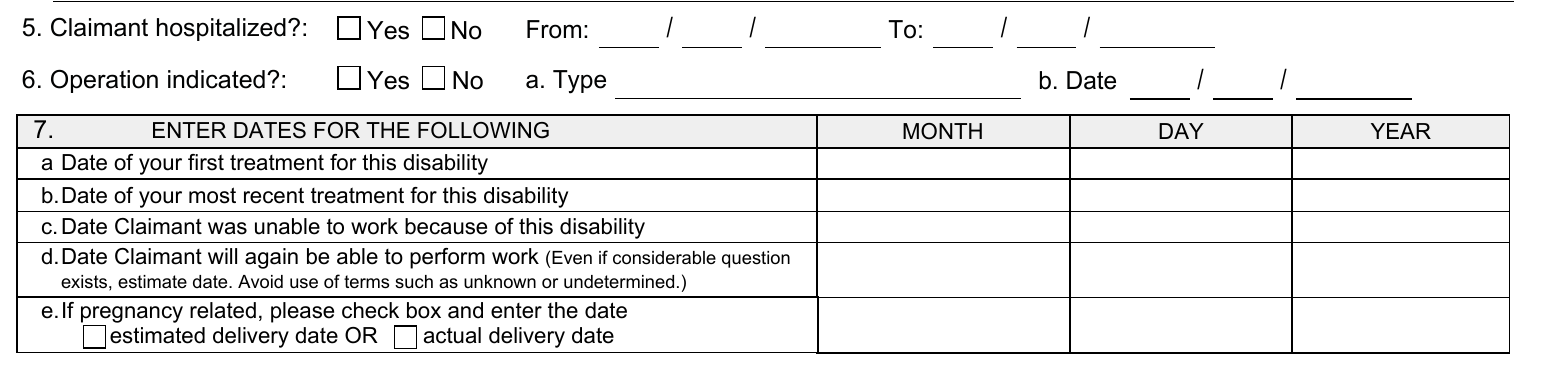
Item 5 asks whether your patient was in the hospital, and if so, from and to which dates. Item 6 asks whether an operation is indicated, and if yes, what kind and the date. Answer no to both when they do not apply, rather than leaving them blank, because the form says incomplete answers may delay payment. If the operation has already been done, check Yes in item 6 and give the date it was done. If it is scheduled, give the planned date. For day surgery with no overnight stay, I have not found New York guidance, so I would check No in item 5 and put the operation in item 6.
One thing about item 6 is worth knowing. The Board says benefits are not payable for time off work “due to elective surgery,” and gives an elective sterilization as its example. I have not found a New York source that defines elective for this purpose, so I won’t try. What I would do is name the operation plainly and write the medical reason for it in item 4. For an operation that also ends fertility, such as a hysterectomy, that reason matters most, for example fibroids with heavy bleeding and anemia, so the carrier can see it was not an elective sterilization.
Item 7: the dates, in month, day and year
Item 7 is a small table, and every row has its own boxes for the month, the day and the year.
- 7a. The date you first treated your patient for this disability.
- 7b. The date you most recently treated your patient for it.
- 7c. The date your patient became unable to work because of it.
- 7d. The date your patient will be able to work again.
- 7e. Only if the disability is related to pregnancy. Check whether the date is the estimated delivery date or the actual one, and enter it.
Item 7d is the easiest one to leave blank, and the form anticipates that. It says, “Even if considerable question exists, estimate date. Avoid use of terms such as unknown or undetermined.” So write a real date, your honest best estimate, even if you expect to revise it. As I read the rules, this date does more than it looks like. The carrier can deny a claim when the leave your patient asks for “exceeds the leave needed as stated in the medical certification,” so an estimate that is too short can cost your patient benefits. And the rule generally keeps the carrier from asking for an update before your certification runs out or twelve weeks have passed, whichever comes first. If your patient is still out when your date arrives, the Board’s advice to workers is to submit further medical evidence, which usually means a new statement from you. If the carrier writes to you shortly before your date, I would answer by the deadline in its letter with a new estimate and the reason.
For 7e, New York presumes disability from pregnancy for at least four weeks before the estimated due date, and for six weeks after a vaginal delivery or eight weeks after a Cesarean section. Anything longer, as I read the rule, needs your certification of a complication of the pregnancy or the delivery, and item 4 is where you would describe it. Before the birth, check estimated and enter the due date. If you fill in Part B after the birth, check actual and enter the delivery date.
The rule: 12 NYCRR §363.1(e) and §363.13(c) and (f); Form DB-450, Part B, item 7.
Item 8: is it work related
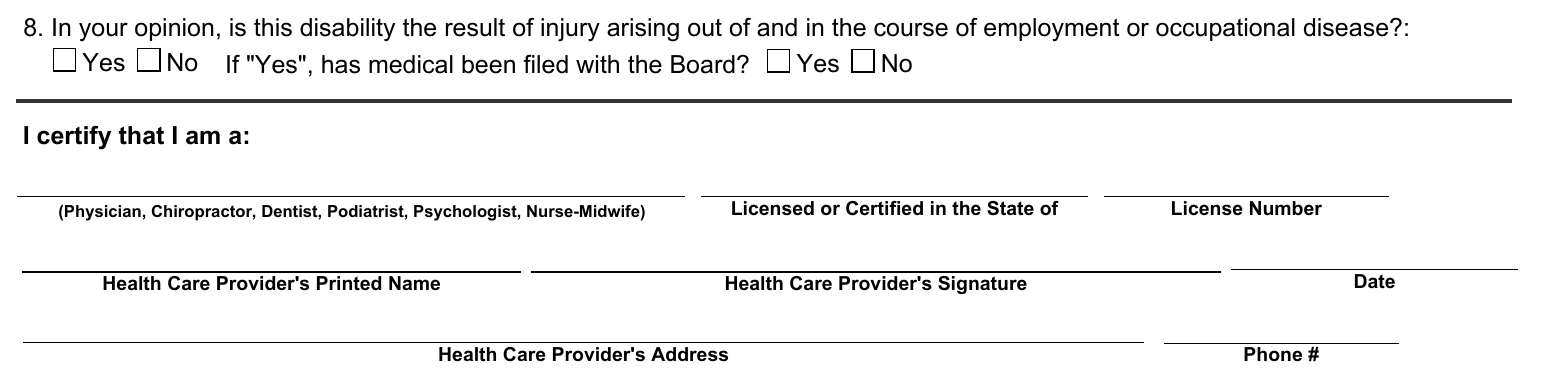
Item 8 asks, in your opinion, whether the disability came from an injury “arising out of and in the course of employment” or from an occupational disease, and if yes, whether medical reports have been filed with the Board. For most patients who bring you this form, the honest answer is no, and that is the expected answer, because disability benefits are for conditions that are not work related.
A yes is not a dead end, though. As I read the rule, a carrier can deny a disability benefits claim when the disability arose out of the job, because that belongs to workers’ compensation. But when a workers’ compensation claim is disputed on the ground that the injury was not work related, the rule tells the disability benefits carrier to pay in the meantime if your patient is otherwise eligible. I would always check Yes or No in item 8, because Part B has to be filled in completely and a blank lets the carrier call the claim incomplete. It asks for your opinion, so check the one you think more likely, and if you are unsure, say so in item 4. If you check Yes, also answer the question about medical reports filed with the Board, and check No if your office has not filed any. A yes only protects your patient if they also file a workers’ compensation claim, because the disability carrier pays in the meantime only once that claim is filed and disputed, so I would tell them to file one.
The rule: 12 NYCRR §363.12(a) and §363.13(f)(8).
The certification and your signature
Under item 8 is the line “I certify that I am a,” with the six kinds of provider printed beneath it. Write in which one you are, then the state that licensed you and your license number. Then print your name, sign, date it, and give your address and phone number. The phone number is worth getting right, because the carrier is allowed to investigate a claim and ask for more information, and that is how it will reach you.
There is no separate attestation paragraph for you to read, but your patient signs one in Part A just above yours, certifying that the claim is true and complete. I would read Part A before signing Part B, mostly to check that the date your patient says they became disabled, in their item 8, agrees with your item 7c. If the two dates differ, a claims examiner will notice, and it is easier to sort out in the exam room than by letter. I would also check 7c against your own 7a. If your patient stopped work before you first saw them, say in item 4 where they were treated first, such as an emergency department visit, so the carrier can accept the earlier date.
The rule: 12 NYCRR §363.11(c); Form DB-450, Parts A and B.
What New York says Part B must contain
I have not seen a New York source that lists which items on Part B are most often left blank, so I won’t guess. What New York does say is that the statement must be filled in completely, that incomplete answers may delay payment, and that a carrier with an incomplete claim has to tell your patient each missing piece. Those are the items I would look at twice before signing.
- Your patient’s name, gender and date of birth (items 1 to 3).
- A diagnosis with a code, your patient’s symptoms, and your objective findings (item 4).
- A yes or no for the hospital and for an operation, with dates when the answer is yes (items 5 and 6).
- Every date in item 7, including an estimated return-to-work date, never “unknown” (items 7a to 7d).
- The delivery date, estimated or actual, when the disability is related to pregnancy (item 7e).
- Your opinion on whether the disability is work related (item 8).
- Your type of license, the state, your license number, your signature and the date.
The rule: Workers’ Compensation Law §217(1); 12 NYCRR §363.13(e) and §363.15(c); Form DB-450, Part B.
Questions the office asks
What is the DB-450 form?
The DB-450 is the claim form for New York’s statutory disability benefits, the weekly payments for workers who cannot work because of an illness, injury or pregnancy that is not related to the job. Your patient fills in Part A, the employer Part C, and you fill in Part B, the Health Care Provider’s Statement.
How long do I have to complete Part B?
Seven days from the day you receive the form. You return it to your patient, or you may mail it to the employer’s insurance carrier or self-insured employer instead. Your patient has to file the whole claim within 30 days of the first day of disability, and cannot send it on until your part is done. If you mail Part B to the carrier yourself, tell your patient so they do not wait for it.
Can my office charge for completing Part B?
I have not found a New York source that says either way. If it matters to your office, I would ask the Board’s Disability Benefits Bureau at (877) 632-4996, and I would not hold the form back over a fee, because your seven days still run.
Can a nurse practitioner or PA sign the DB-450?
The form and the law name physicians, chiropractors, dentists, podiatrists, psychologists and certified nurse midwives. I have not seen a New York source that lets nurse practitioners or physician assistants sign it, so if one of them is the only clinician treating your patient, I would have a listed provider examine your patient and sign. A bill adding nurse practitioners has passed the Legislature but, as far as I can tell, has not been signed.
What do I put if I don’t know when my patient can go back to work?
An estimated date. Item 7d says to estimate even when considerable question exists, and to avoid words like unknown or undetermined. If your patient is still out when that date comes, a new statement from you can extend the claim, within New York’s limit of 26 weeks, counting any Paid Family Leave. If the carrier writes to you before your date, I would answer by the deadline in its letter.
PatientPapers makes completing the New York DB-450 faster and easier
I created PatientPapers to make this paperwork faster and easier, because as a physician I know how much of it lands on us. It is my own product, built through the same company as this site, so weigh this accordingly. It keeps your name, license number and specialty on file, walks you through Part B of the DB-450 item by item, and fills in the Board’s own form for you to review and sign. The pricing and the full description are on the PatientPapers site.
Open PatientPapers