Texas handicap placard application, the doctor’s part of the VTR-214
Your patient with heart failure is checking out when the front desk brings you a Texas VTR-214. His daughter has already filled in page 1 and left page 2 for you. Your part is one sentence, one check and a signature, and it takes a minute to write, but it is not finished when you sign it, because for a placard Texas wants a notary to watch you do it.
- Form
- VTR-214, Application for Persons with Disabilities Parking Placard and/or License Plate
- Issued by
- Texas Department of Motor Vehicles (TxDMV)
- Blank form
- VTR-214 PDF on txdmv.gov
- Revision
- Rev. 09/24
- Rule
- Texas Transportation Code §§ 681.001, 681.003 and 681.004
- Temporary
- six months or less (red placard)
- Filed with
- the county tax assessor-collector, by your patient
Key points
- Page 1 is your patient’s. Your part is the Disability Statement on page 2.
- The only box you check is permanent or temporary.
- The walking test is 200 feet without stopping to rest.
- For a placard, sign in front of a notary, or write an original prescription.
- Temporary lasts six months or less. Permanent lasts four years.
- Licensees from Texas and its four neighboring states may sign.
Before you start: one sentence, one check and a notary
The VTR-214 is the single application Texas uses for both the disabled parking placard and the disabled person license plates. Page 1 belongs to your patient, or to whoever is applying on your patient’s behalf. Page 2 is where you come in. Its top half prints Texas’s legal definitions, and its bottom half is the Disability Statement, the part the Texas Department of Motor Vehicles (TxDMV) tells patients to have their doctor or health care provider complete.
There is no list of conditions on this form for you to check. You write your patient’s name into one sentence certifying that they have a permanent or a temporary disability “as defined above”, check one of those two words, and add your details and signature. My understanding is that the department decides eligibility on the evidence the applicant brings, so your sentence is what it relies on, and that for a placard Texas also wants your signature notarized, or an original prescription from you in place of the statement. The notary is the step I would plan for before your patient leaves the room.
The rule: Texas Transportation Code § 681.003(c); the instructions on page 1 of Form VTR-214.
Who may sign
The form says what it means by a licensed medical professional, in its own words “a physician, podiatrist, optometrist, or qualifying physician’s assistant or advanced practice nurse as defined in Chapter 301, Occupations Code.” It then gives three ways to qualify, and you need only one. You hold a license in Texas, Arkansas, Louisiana, New Mexico or Oklahoma, which is Texas and the four states that border it. Or you practice medicine at a U.S. military installation based in Texas. Or you practice in a federal veterans’ hospital or health facility.
My understanding is that the statute behind the form, section 681.003 of the Transportation Code, is narrower than that list in three places. A podiatrist may sign only when the walking problem comes from a disorder of the foot. An optometrist may sign only when the disability is a problem with vision. And an advanced practice nurse or physician assistant working under a physician’s delegation and supervision, or a physician assistant licensed in Texas acting as a physician’s agent, may sign only for a patient’s first application. The statute’s main route is a physician licensed in Texas or a neighboring state, or one authorized to practice in a federal veterans’ hospital or health facility. I did not find the military installation route in the statute’s wording, only on the form.
That last limit matters for temporary placards. My understanding is that when a temporary placard is renewed, the statute asks for a physician’s statement or prescription, so if you are a nurse practitioner or physician assistant, what I would do is leave the renewal to the physician you work with.
The rule: Texas Transportation Code §§ 681.003(c), (e) and (f), and 681.004(d); the Disability Statement on page 2 of Form VTR-214.
What you are certifying, in Texas’s own words
Texas defines a disability in two layers, and the form prints both above your signature. The first layer says a disability is a condition in which a person has one of these three, in the form’s words.
- mobility problems that substantially impair the person’s ability to ambulate;
- visual acuity of 20/200 or less in the better eye with correcting lenses; or
- visual acuity of more than 20/200 but with a limited field of vision in which the widest diameter of the visual field subtends an angle of 20 degrees or less.
The second and third are what most of us would call legal blindness. The first, a problem with walking (“ambulate” is the statute’s word for it), is defined by a second list of nine. The form says a mobility problem is one that substantially impairs a person’s ability to ambulate, and the person
- cannot walk 200 feet without stopping to rest;
- cannot walk without the use of or assistance from an assistance device, including a brace, cane, crutch, another person or a prosthetic device;
- cannot ambulate without a wheelchair or similar device;
- is restricted by lung disease to the extent that the person’s forced respiratory expiratory volume for one second, measured by spirometry, is less than one liter, or the arterial oxygen tension is less than 60 millimeters of mercury on room air at rest;
- uses portable oxygen;
- has a cardiac condition to the extent that the person’s functional limitations are classified in severity as Class III or Class IV according to standards set by the American Heart Association;
- is severely limited in the ability to walk because of an arthritic, neurological, or orthopedic condition;
- has a disorder of the foot that, in the opinion of a physician licensed to practice medicine in this state or in a state adjacent to this state, limits or impairs the person’s ability to walk; or
- has another debilitating condition that, in the opinion of a physician licensed to practice medicine in this state or a state adjacent to this state, or authorized by applicable law to practice medicine in a hospital or other health facility [of the federal veterans’ health system], limits or impairs the person’s ability to walk.
The walking test is item (a), 200 feet without stopping to rest. That is about two-thirds of the length of a football field, so a patient who has to stop partway across a large parking lot may well meet it. Items (d) and (f) turn on a number or a class you can point to in the chart, and item (e) is met by portable oxygen in use, with no measurement asked for. Items (g) and (i) are broader and rest on your judgment.
Because the form never asks you which item applies, what I would do is name it in my note, something like “meets item (a), stopped to rest twice walking to the exam room today”. My understanding is that the statute describes the statement as certifying and providing evidence acceptable to the department, and a note that names the item is the evidence I would want to be able to show if anyone asked.
The rule: Texas Transportation Code § 681.001(2) and (5), printed as the Definitions on page 2 of Form VTR-214; § 681.003(c).
The Disability Statement, line by line
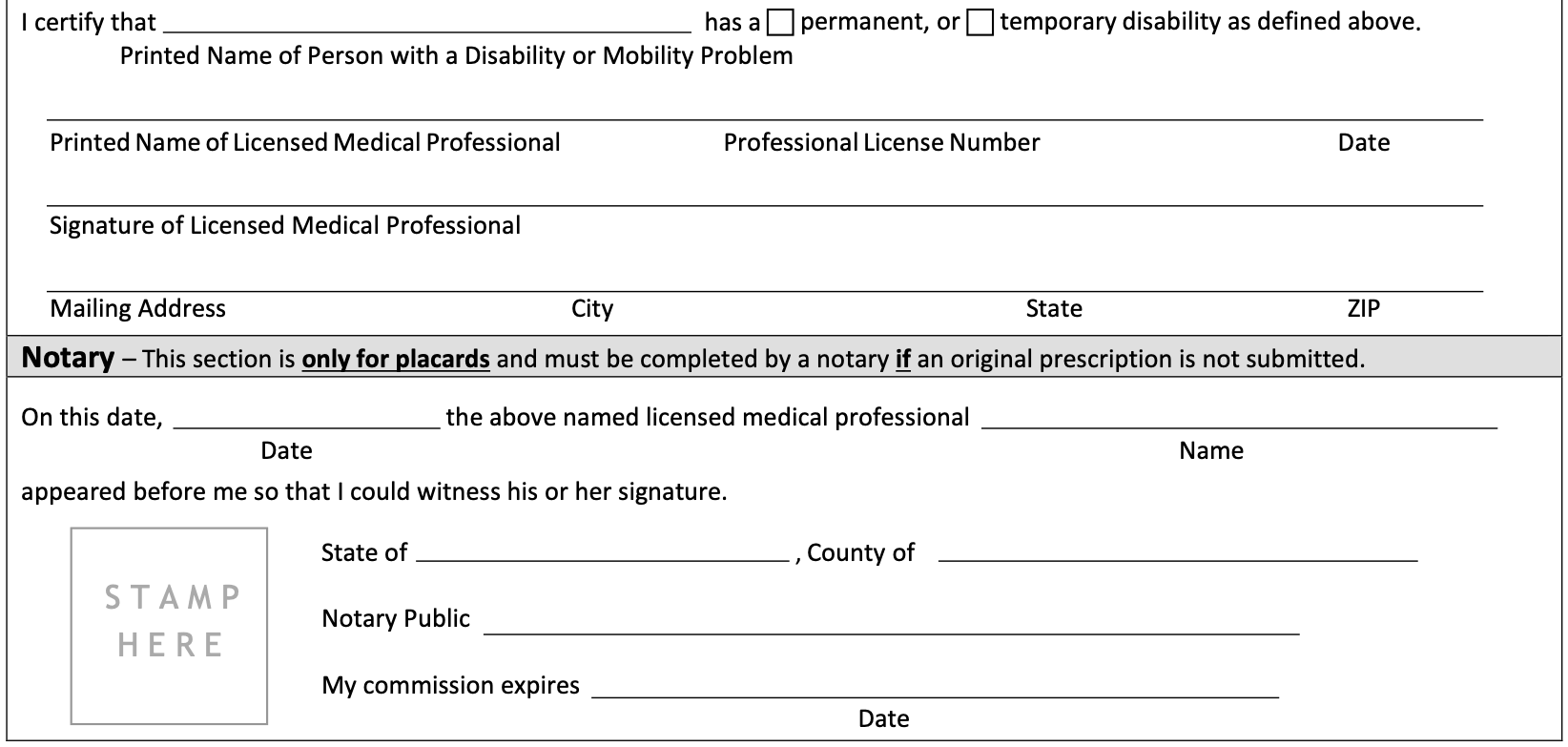
The certifying sentence. It reads “I certify that ___ has a permanent, or temporary disability as defined above,” with a check box before each of the two words. Print your patient’s full name on the line, spelled the same way as on page 1, since the two pages go in together. Then check exactly one box. The section on permanent and temporary below says how I would choose.
Printed name, professional license number and date. Your name, your license number, and the date you sign. The form does not ask which state issued the license or what kind of license it is, so the number is the only identifier you give.
Signature. Sign it yourself, and for a placard, sign it in front of the notary rather than beforehand, for the reason in the next section.
Mailing address, city, state and ZIP. These are yours, not your patient’s.
That is the whole of your part. Everything on page 1, including the vehicle details for plates and the applicant’s own certification, is for your patient to complete, and the notary block is the notary’s.
The notary, or an original prescription instead
Page 1 says, under the heading Important, that the licensed medical professional’s signature “must be notarized on page 2 if an original prescription is not submitted.” The notary block under your section says the same, and adds that the block is only for placards.
So you have two ways to finish it. The first is to sign the VTR-214 in front of a notary. The notary fills in the date, your name, the state and county, their own signature, the date their commission expires, and their stamp, and the block says you “appeared before me so that I could witness his or her signature.” A form you signed earlier at your desk does not fit those words, so sign it with the notary watching. If your practice has a notary on staff, this is probably the simplest route.
The second is to leave the Disability Statement and the notary aside and give your patient an original prescription instead. Page 1 says it must include your patient’s name, your signature, and a statement of whether the disability is permanent or temporary. The form says original, so I would hand your patient the signed paper itself rather than fax it or send a copy. My understanding is that the statute also wants a statement or prescription to carry enough information for the department to decide which type of placard your patient qualifies for, so I would add a line saying which item of the definition your patient meets.
If your patient is applying only for the disabled person license plates, with no placard, the form says the notary block does not apply.
The rule: Texas Transportation Code §§ 681.003(c) and 504.201(d); the instructions on page 1 and the Notary section on page 2 of Form VTR-214.
Permanent or temporary, and what happens at renewal
The box you check decides the color of the placard. My understanding is that a permanent disability gets a blue placard and a temporary one gets a red placard, and that only a permanent disability qualifies for the disabled person license plates.
My understanding is that a permanent placard lasts four years for a Texas resident, and six months for someone who lives outside Texas. When a resident’s placard runs out, they renew it with a new page 1 and either a copy of the original application or the expiring placard, and the TxDMV says the doctor does not have to complete the Disability Statement again. So permanent is a decision that will not come back to you every few years.
A temporary placard, according to the TxDMV, expires in six months or less, and the form has no line for you to set the date. If your patient’s disability lasts longer, they apply again, and that means a new statement from you, notarized again, or a new prescription. A patient recovering from a joint replacement is the kind of case temporary is for. If I could not say whether a condition would improve, what I would do is check temporary and see my patient again before it runs out, since a permanent placard renews for years without anyone looking again.
Two notes for the front desk. My understanding is that a lost or stolen placard can be replaced with a copy of the VTR-214 your patient filed the first time, and that a placard seized by the police is replaced with a new application whose Disability Statement does not need to be completed. In neither case does your patient need a new statement from you, unless they have no copy of the original, or the county cannot confirm the placard was issued.
The rule: Texas Transportation Code §§ 681.002(b), 681.004(c) and (d), and 504.201(b); the TxDMV disabled parking page; the instructions on page 1 of Form VTR-214.
The felony warning, and what sits over your signature
The form prints “State law makes falsifying information a third-degree felony” twice, both times on page 1, over the applicant’s identification statement and the applicant’s certification. Your Disability Statement on page 2 has no penalty line of its own, and my understanding is that the placard chapter of the Transportation Code does not set a separate penalty for the person who certifies. I won’t guess at what other law might apply.
The county sees your sentence, not your patient. What I would do is sign only when I can point to the item in my note, and see my patient first if the last examination was long enough ago that the answer may have changed.
The rule: Texas Transportation Code chapter 681; the Identification Statement and Certification on page 1 of Form VTR-214.
Where it goes, and what your patient pays
Your patient files it, not your office. The form tells them to take the completed application, any payment and the proof of eligibility to the county tax assessor-collector’s office where they live, or to the one in the county where they are getting medical treatment. Payment is by personal check, money order or cashier’s check. To apply by mail, the form says to contact the county office first, not to mail cash, and to include a copy of a photo ID.
A placard for a permanent disability is free, and a placard for a temporary disability costs $5 each. My understanding is that a person can have up to two placards, or one placard alongside a set of disabled person plates. The TxDMV’s disabled parking page has a county office finder and links to the current blank.
The rule: Texas Transportation Code §§ 681.003(b) and 681.004(a) and (b); the instructions on page 1 of Form VTR-214.
What the form says must be there
I have not seen a Texas source that lists the usual reasons a VTR-214 is not accepted, so I won’t guess. What the form and the statute do say must be there is short, and these are the things I would look at before your patient leaves with it.
- For a placard, the notary block completed by a notary, unless an original prescription goes in instead.
- If a prescription goes in instead, your patient’s name, your signature, and whether the disability is permanent or temporary.
- One box checked, permanent or temporary.
- A signer who meets one of the three conditions printed in the Disability Statement.
- For a temporary placard, the $5 fee for each placard.
PatientPapers makes completing the Texas VTR-214 faster and easier
I created PatientPapers to make this paperwork faster and easier, because as a physician I know how much of it lands on us. It is my own product, built through the same company as this site, so weigh this accordingly. It keeps your name, license number and mailing address on file, asks whether the disability is permanent or temporary, and fills in the Disability Statement on Texas’s own VTR-214, with your patient’s name in the certifying sentence and in the name boxes on page 1. It leaves the rest of page 1 for your patient and the notary block for the notary, and because a placard needs your signature notarized, it gives you a copy to print and sign in front of the notary. The pricing and the full description are on the PatientPapers site.
Open PatientPapers