Illinois handicap placard application, the doctor’s part of the VSD 62
A man with emphysema brings the Illinois form to his follow-up visit with page 1 already filled in by his daughter. Page 2 is mine, and before I check anything I have to work out which placard he is asking for, because the one that also lets him park at a meter for free has its own shorter list, a 20-foot walking limit and a second signature.
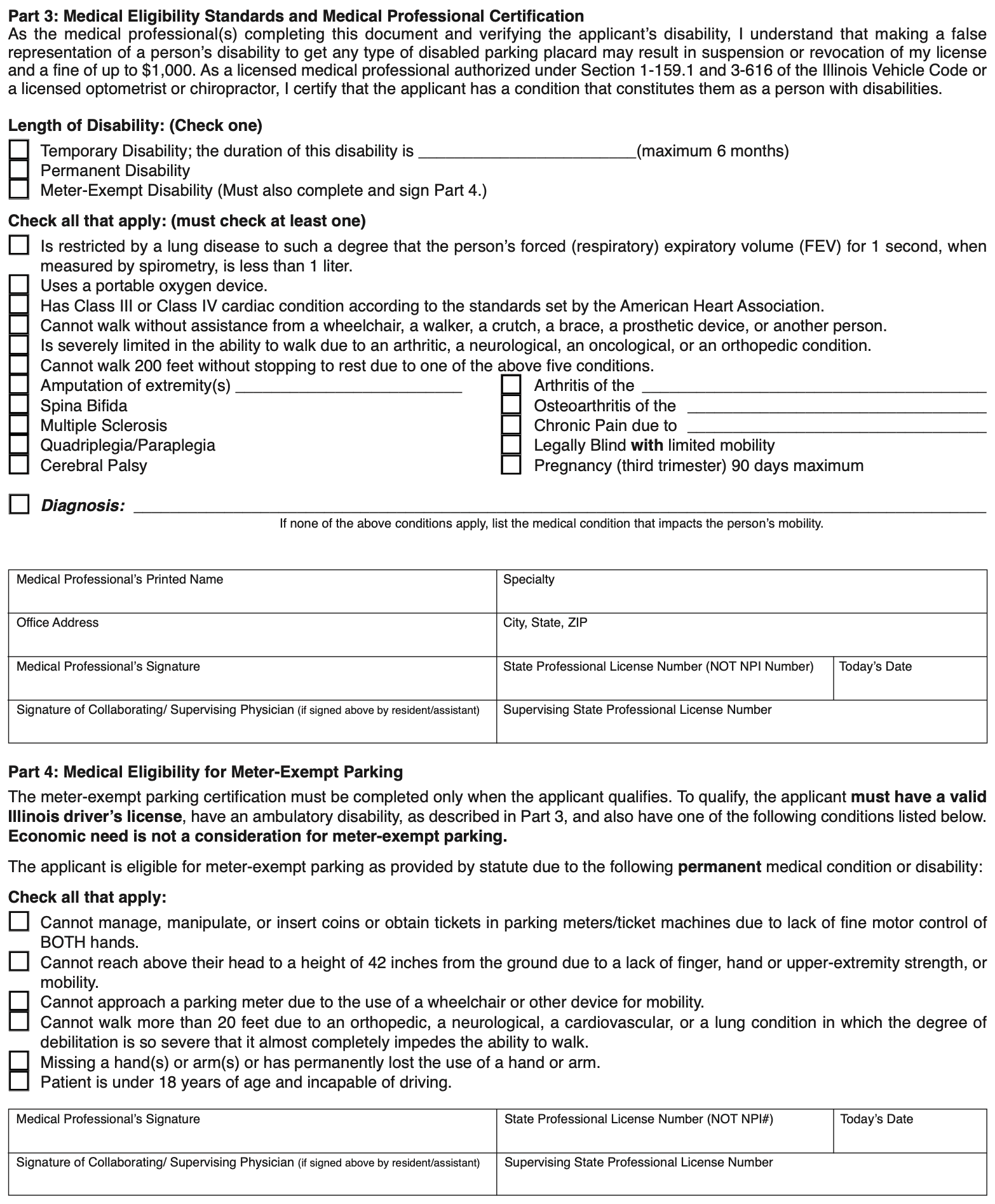
- Form
- VSD 62, Persons with Disabilities Certification for Parking Placard
- Issued by
- Illinois Secretary of State
- Blank form
- VSD 62 PDF on ilsos.gov
- Revision
- March 2026, VSD 62.33 ADA
- Rule
- 625 ILCS 5/1-159.1, 5/3-616 and 5/11-1301.2; 92 Ill. Adm. Code 1100
- Temporary
- up to six months, and 90 days for pregnancy
Key points
- Page 2 is yours. Part 4 is only for the meter-exempt placard.
- Check one length of disability and at least one condition.
- The walking limit is 200 feet in Part 3 and 20 feet in Part 4.
- A temporary placard is six months at most, and pregnancy 90 days.
- Write your state license number, not your NPI.
Before you start: what you are signing, and who may sign
The VSD 62 is two pages. Page 1 belongs to your patient, and to a parent or guardian if the patient is a minor. Page 2 is yours. Part 3 is the certification every placard needs, and Part 4 is a second certification used only for the meter-exempt placard, which also lets your patient park at a meter without paying. The directions at the top say both sides must be signed and completed fully, and that all fields are required.
My understanding is that the Illinois Vehicle Code lets a licensed physician, physician assistant, advanced practice registered nurse or physical therapist make this certification, and lets an optometrist certify one thing, legal blindness that limits walking. The form’s certification sentence also names chiropractors. My understanding is that this matches the Secretary of State’s rule, which defines the certifier by the Medical Practice Act, and that Act counts a chiropractic physician as a physician.
My understanding is that the same rule accepts a physician licensed under a similar law in another state, but that at least every six months the Secretary of State pulls a random sample of these forms, has the state’s licensing department check that the signer is licensed in Illinois under the number written, and starts proceedings to revoke the placard when they are not. If you hold only an out-of-state license, I would tell your patient that before they file.
The rule: 625 ILCS 5/1-159.1 and 5/3-616; 92 Ill. Adm. Code 1100.5 and 1100.25; 225 ILCS 60/2.
Length of disability: check one
The first choice in Part 3 is how long the disability will last, and each answer leads to a different placard. The Secretary of State’s guide names each one by its color.
| You check | Your patient gets, and you complete |
|---|---|
| Temporary | A red placard for the length you write. Part 3. |
| Permanent | A blue placard. Part 3. |
| Meter-exempt | A yellow and gray placard for a permanent condition. Parts 3 and 4, each signed. |
For temporary, the line reads “the duration of this disability is” with “(maximum 6 months)” after the blank. The blank has no unit printed, so write one, such as 8 weeks or 4 months, and pick the length that matches the expected recovery, because the guide says the placard runs for the time you indicate. My understanding is that a temporary placard cannot run past six months from the date you certify, and that renewing it needs a new certification.
For permanent, the top of page 1 says the form is valid for four years from your signature date. My understanding is that the Vehicle Code and the Secretary of State’s rule both put a permanent placard on a five-year cycle instead, and I have not seen the state explain the difference. Either way, a permanent placard in Illinois comes back to you for a new VSD 62 every few years, with Renewal checked on page 1.
The rule: 625 ILCS 5/3-616(d) and (h); 92 Ill. Adm. Code 1100.20.
The conditions, in Illinois’s own words
Under “Check all that apply: (must check at least one)” the form prints six conditions first, and they follow the statute’s definition closely.
- “Is restricted by a lung disease to such a degree that the person’s forced (respiratory) expiratory volume (FEV) for 1 second, when measured by spirometry, is less than 1 liter.”
- “Uses a portable oxygen device.”
- “Has Class III or Class IV cardiac condition according to the standards set by the American Heart Association.”
- “Cannot walk without assistance from a wheelchair, a walker, a crutch, a brace, a prosthetic device, or another person.”
- “Is severely limited in the ability to walk due to an arthritic, a neurological, an oncological, or an orthopedic condition.”
- “Cannot walk 200 feet without stopping to rest due to one of the above five conditions.”
The walking distance is 200 feet, and it is tied to the five items above it, so the reason your patient has to stop must be one of them.
Below those, the form lists amputation, arthritis, spina bifida, osteoarthritis, multiple sclerosis, chronic pain, quadriplegia or paraplegia, cerebral palsy, “Legally Blind with limited mobility” and “Pregnancy (third trimester) 90 days maximum” as diagnoses you can check, some with a line to say where or why. The bold is the form’s, and it means blindness alone is not the test. Pregnancy goes with Temporary, for 90 days or less. Last comes a Diagnosis line, for when none of the above apply.
My understanding is that the statute’s definition is the functional list above, not a list of diagnoses. So what I would do is check a diagnosis only when it limits your patient’s walking the way one of the six items describes, and check that item too.
My understanding is also that the statute is a little wider than Part 3, because it names a cane and any other assistive device, accepts an arterial oxygen tension under 60 mm Hg on room air at rest in place of the spirometry number, and counts a missing hand or arm, or the permanent loss of use of one. Part 3 prints none of these. If one of them is your patient’s route, I would check Diagnosis and write it on that line in the statute’s words.
The rule: 625 ILCS 5/1-159.1 and 5/11-1301.2(a-5); 92 Ill. Adm. Code 1100.5.
Part 4: meter-exempt parking and the 20-foot limit
Complete Part 4 only if you checked Meter-Exempt Disability. The form says your patient must have a valid Illinois driver’s license, an ambulatory disability from Part 3, and at least one of these permanent conditions, and that economic need is not a consideration.
- “Cannot manage, manipulate, or insert coins or obtain tickets in parking meters/ticket machines due to lack of fine motor control of BOTH hands.”
- “Cannot reach above their head to a height of 42 inches from the ground due to a lack of finger, hand or upper-extremity strength, or mobility.”
- “Cannot approach a parking meter due to the use of a wheelchair or other device for mobility.”
- “Cannot walk more than 20 feet due to an orthopedic, a neurological, a cardiovascular, or a lung condition in which the degree of debilitation is so severe that it almost completely impedes the ability to walk.”
- “Missing a hand(s) or arm(s) or has permanently lost the use of a hand or arm.”
- “Patient is under 18 years of age and incapable of driving.”
So the walking limit here is 20 feet, a tenth of the Part 3 distance. Part 4 has its own signature, license number and date lines, and it has to be signed separately. My understanding is that the statute lets only a licensed physician, physician assistant or advanced practice registered nurse certify meter-exempt parking, so a physical therapist or optometrist who signs Part 3 would leave Part 4 to one of them.
There is one quirk if you fill in the state’s PDF on a screen. The fillable file treats the Part 3 box for “Cannot walk without assistance” and the Part 4 box for “Cannot walk more than 20 feet” as a single box, so checking either one checks both. If only one is true for your patient, print the page and check it by hand.
The rule: 625 ILCS 5/11-1301.2(c-5); 92 Ill. Adm. Code 1100.5.
Your details, your signature and the penalty
The box under the conditions asks for your printed name, specialty, office address, city, state and ZIP, signature, today’s date, and your “State Professional License Number (NOT NPI Number)”. My understanding is that this is the number the state spot-checks against its licensing records, so write the one on your state license.
If a resident or an assistant signs above, the next line is for the collaborating or supervising physician’s signature and license number. Part 4 repeats both lines.
The certification you sign opens with a warning that a false representation of a person’s disability “may result in suspension or revocation of my license and a fine of up to $1,000.” My understanding is that the Vehicle Code goes further, and that for a physician, physician assistant or advanced practice registered nurse, knowingly falsifying this certification is a Class A misdemeanor with a fine of at least $1,000 for a first offense, and a Class 4 felony after that. What I would do is keep the note that supports each box you checked, such as the walk you watched, the spirometry or the heart failure class, in the chart for that visit.
The rule: 625 ILCS 5/11-1301.5(b)(7) and (c); 92 Ill. Adm. Code 1100.25.
Where the form goes, and what your patient pays
Page 1 says a temporary application can be taken to any Secretary of State DMV or mailed in. A permanent one is mailed to the Persons with Disabilities Placard Unit at 501 S. 2nd St., Room 541, Springfield, IL 62756, or walked in at the Flagship Center in Springfield. The Secretary of State’s guide says local DMV facilities cannot issue permanent placards, which come only through the Springfield office, and my understanding is that a city or village cannot issue a permanent or meter-exempt one either.
The Secretary of State’s parking program FAQ says that either the patient or the doctor may mail a permanent form, and to allow 45 to 60 days. It also says the placard is free to eligible Illinois residents. A lost, stolen or damaged placard is replaced on a different form, the VSD 415, for $10.
The rule: 92 Ill. Adm. Code 1100.15; page 1 of Form VSD 62.
What the form says must be complete
I have not seen an Illinois source that lists the usual reasons a VSD 62 is not accepted, so I won’t guess. What the form itself says is below, and these are the lines I would look at twice before it leaves the office.
- Both sides signed, and every field completed.
- One length of disability checked.
- For temporary, a duration of six months or less, or 90 days or less for pregnancy.
- At least one condition checked in Part 3.
- Your state license number, not your NPI.
- For meter-exempt, Part 4 completed and signed as well.
- The supervising physician’s signature and license number, if a resident or assistant signed.
PatientPapers makes completing the Illinois VSD 62 faster and easier
I created PatientPapers to make this paperwork faster and easier, because as a physician I know how much of it lands on us. It is my own product, built through the same company as this site, so weigh this accordingly. It keeps your name, specialty, office address and license number on file, asks whether the disability is temporary, permanent or meter-exempt and which conditions apply, and fills in Part 3, and Part 4 when it applies, on Illinois’s own VSD 62 for you to review and sign. A collaborating or supervising physician still signs their own line on the paper. The pricing and the full description are on the PatientPapers site.
Open PatientPapers