Florida handicap parking permit form, the doctor’s part of the HSMV 83039
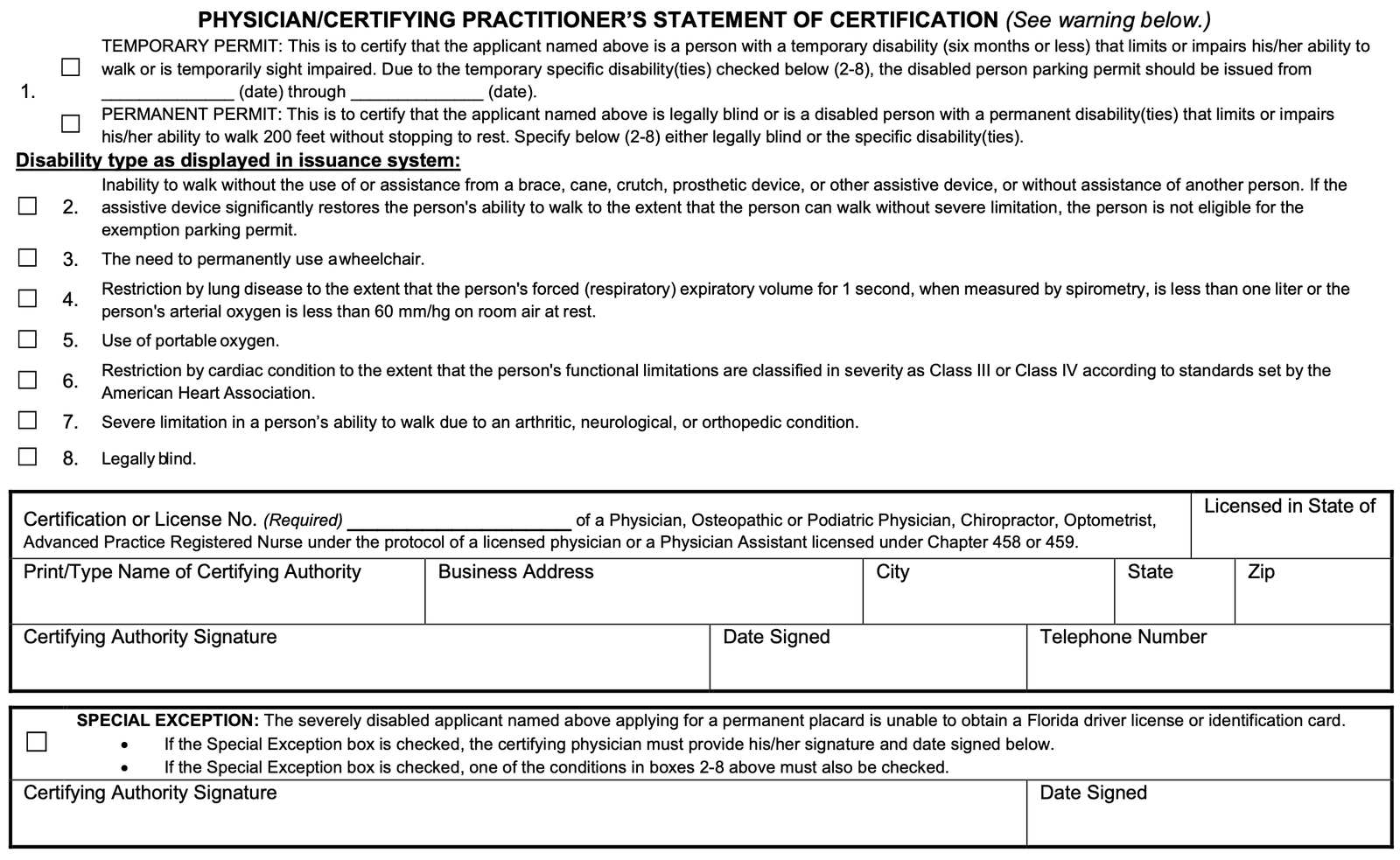
A woman brings her husband’s Florida HSMV 83039 to his first visit after a stroke, with the top of the page already filled in. The middle of the page is mine. It asks me to choose permanent or temporary, check the condition that keeps him from walking 200 feet, and, if I choose temporary, write the two dates the placard should run, because Florida issues it for exactly the window I give.
- Form
- HSMV 83039, Application for Disabled Person Parking Permit
- Issued by
- Florida Department of Highway Safety and Motor Vehicles (FLHSMV)
- Blank form
- HSMV 83039 PDF on flhsmv.gov
- Revision
- Rev. 06/22/22
- Rule
- Florida Statutes § 320.0848
- Temporary
- the dates you write, six months at most
- Filed with
- the county tax collector or a license plate agency, by your patient
Key points
- Your part is the Statement of Certification in the middle of page 1.
- Check permanent or temporary, then at least one of items 2 to 8.
- The bar is 200 feet without stopping to rest, or legal blindness.
- A temporary placard runs for the dates you write, six months at most.
- Your signature is good for 12 months, and no notary is needed.
- Write your license number and the state that issued it.
Before you start: a check, a list and maybe two dates
The HSMV 83039 is Florida’s one application for a disabled person parking permit, which is what Florida calls the placard. It is two pages, but only page 1 has anything to fill in. The top block is your patient’s, with their name as it appears on their Florida driver license or identification card, their signature, and their own check boxes for a frequent traveler or a quadriplegic, who may get a second placard. The bottom block is for organizations that transport disabled people, and for the tax collector’s staff. Page 2 is the department’s instructions.
The middle block is yours, the Physician/Certifying Practitioner’s Statement of Certification. You choose a permanent or a temporary permit in item 1, check which of items 2 to 8 your patient has, and add your license number, the state that issued it, your name, business address, signature, date and telephone number. There is a Special Exception box under that, which most patients will not need.
Unlike some states, Florida does not ask for a notary. What it does ask is that the form be recent. A line in red across the top of the page says the form “is not valid for more than 12 months from the date of the certifying authority’s signature,” so a copy you signed last year and your patient never filed will not be accepted.
The rule: Florida Statutes § 320.0848(1); the heading and the Statement of Certification on page 1 of Form HSMV 83039.
Who may sign
The license line on the form lists who may certify, as “a Physician, Osteopathic or Podiatric Physician, Chiropractor, Optometrist, Advanced Practice Registered Nurse under the protocol of a licensed physician or a Physician Assistant licensed under Chapter 458 or 459.” Chapters 458 and 459 are Florida’s medical and osteopathic practice acts. My understanding is that the statute says the same thing, with the chiropractor listed as a physician licensed under chapter 460, Florida’s chiropractic act.
A physician licensed in another state may also sign, but not on the form alone. My understanding is that the statute accepts “a similarly licensed physician from another state” only if the application comes with documentation of that license and a form signed by the physician verifying their knowledge of Florida’s eligibility guidelines. Page 2 of the form says the same. So if you practice outside Florida, what I would do is send a copy of your license verification and a short signed statement that you have read Florida’s criteria along with the form. The statute names only physicians for this route, so I would not expect an out-of-state nurse practitioner or physician assistant to be accepted.
Two narrower points. The department’s general page marks the optometrist “(sight only)”, and its frequently asked questions go further and say legal blindness is certifiable only by an optometrist, which is not what the form or the statute says. If item 8 is the only box your patient meets and I were not their eye doctor, what I would do is leave this one to the eye doctor. And an advanced practice registered nurse signs under the protocol of a licensed physician, which the form prints in the license line.
The rule: Florida Statutes § 320.0848(1)(b)2.; the license line on page 1 and Certifying Authorities on page 2 of Form HSMV 83039; the FLHSMV disabled person parking permit pages.
What you are certifying, in Florida’s own words
Florida’s test has two parts, and the form prints both. Your patient must be legally blind, or must have one of six conditions that leaves them unable to walk 200 feet without stopping to rest. The permanent permit sentence in item 1 says this directly, and page 2 repeats it under Provisions of Law.
That shape matters when you read the list. There is no box for “cannot walk 200 feet”. The 200 feet is the bar, and the box you check is the reason your patient cannot clear it. Under the heading “Disability type as displayed in issuance system” the form lists them like this.
- Inability to walk without the use of or assistance from a brace, cane, crutch, prosthetic device, or other assistive device, or without assistance of another person. If the assistive device significantly restores the person’s ability to walk to the extent that the person can walk without severe limitation, the person is not eligible for the exemption parking permit.
- The need to permanently use a wheelchair.
- Restriction by lung disease to the extent that the person’s forced (respiratory) expiratory volume for 1 second, when measured by spirometry, is less than one liter or the person’s arterial oxygen is less than 60 mm/hg on room air at rest.
- Use of portable oxygen.
- Restriction by cardiac condition to the extent that the person’s functional limitations are classified in severity as Class III or Class IV according to standards set by the American Heart Association.
- Severe limitation in a person’s ability to walk due to an arthritic, neurological, or orthopedic condition.
- Legally blind.
Item 2 is the one I would read twice. A cane alone is not enough. If the cane or walker gets your patient walking without severe limitation, the form says they are not eligible. So the patient who walks a long way briskly with a cane does not qualify on item 2, and the patient who still has to stop every few yards with one does.
Items 4, 5 and 6 rest on things in the chart, a spirometry number, an oxygen prescription, a functional class. Items 2, 3 and 7 rest on your judgment of how your patient walks. The form never asks you to write a diagnosis, only to check boxes, so what I would do is make sure my note says which box and why, something like “item 7, lumbar stenosis, stops to rest after about 50 feet”.
The rule: Florida Statutes § 320.0848(1)(b)1.; items 1 to 8 on page 1 and Provisions of Law on page 2 of Form HSMV 83039.
The Statement of Certification, line by line
Item 1, temporary or permanent. Check one of the two boxes. The temporary sentence certifies a disability of six months or less that limits or impairs your patient’s ability to walk, or that they are temporarily sight impaired, and then asks for the dates the permit “should be issued from ______ (date) through ______ (date).” Fill in both. The permanent sentence has no dates. The section on permanent or temporary below says how I would choose.
Items 2 to 8. Check every box that applies, and at least one. Both item 1 sentences point you to this list, so it is not only for permanent permits. The heading says these are the disability types “as displayed in issuance system”, which I read as meaning what you check is what the tax collector’s system records.
Certification or License No. (Required). Your license number. The form marks it required, and page 2 says the section must include both your license number and the name of the state that issued it.
Licensed in State of. The state that issued that license. For most of us this is Florida. If it is not, see Who may sign above.
Printed name, business address, city, state and ZIP. Yours, not your patient’s. The address is your practice address.
Certifying Authority Signature, Date Signed and Telephone Number. Sign and date it yourself. The date starts the 12 months the form stays valid. Give a number where the tax collector’s office can reach your office.
That is all of your part, unless your patient needs the Special Exception in the next section. The top of the page and its signature are your patient’s or their guardian’s, and the organization and tax collector blocks are not yours at all.
The Special Exception box
Florida prints your patient’s driver license or identification card number on the placard, and the form says that number is required for both permits “unless exception is noted by physician below.” The Special Exception box is that note. It reads “The severely disabled applicant named above applying for a permanent placard is unable to obtain a Florida driver license or identification card.”
My understanding is that the statute means this for a patient whose disability is too severe for them to visit, or be taken to, an office to get an identification card, someone who is bedbound at home, for example. It applies only to a permanent placard. If you check it, the form asks for two more things, your signature and date on the line under the box, and at least one of items 2 to 8 checked above. Both the box and the statute say physician here rather than certifying practitioner, so if you are a nurse practitioner or physician assistant, what I would do is ask the physician you work with to sign this part.
The rule: Florida Statutes § 320.0848(2)(a); the Special Exception box on page 1 and Application Requirements on page 2 of Form HSMV 83039.
Permanent or temporary, and what happens at renewal
A temporary permit lasts for the dates you write, and no longer than six months. Page 2 says temporary permits are “issued for the time period specified by the certifying authority, not to exceed six (6) months.” So the dates you write are the placard’s life, and I would make the window match the recovery I expect, eight weeks after a fracture, say, rather than writing six months by habit. If your patient still needs it when it runs out, they apply again with a new form from you.
A permanent permit lasts up to four years and runs out on your patient’s birthday. If I could not say whether a condition would improve, what I would do is choose temporary, see my patient again before it runs out, and switch to permanent once the answer is clear.
Renewal is where the paper and the law have drifted apart. The form’s renewal instructions, and the department’s own web pages when I read them, say a renewal needs a new HSMV 83039 signed within the last 12 months. My understanding is that the statute was changed, and now says the department renews a permanent permit for one more four-year period without a new certificate, and asks for one only after that. My understanding is also that the statute now adds a lifetime permit for a person who is permanently disabled by an amputation or permanent dismemberment, valid until death. The form has no box for a lifetime permit, and I have not seen the department say how one is requested, so I would tell such a patient to ask at the tax collector’s office. Until the form catches up, I would expect most patients renewing a permanent permit to come back to you for a new form.
The rule: Florida Statutes § 320.0848(1)(a) and (d) and (3)(b); Renewal Instructions and Miscellaneous Information on page 2 of Form HSMV 83039.
The misdemeanor warning, and what sits over your signature
The warning at the foot of page 1 covers you as well as your patient. It says anyone who knowingly makes a false or misleading statement “in an application or certification” commits a first-degree misdemeanor, and that “the penalty is up to one year in jail or a fine of $1,000 or both.” My understanding is that the statute also makes a violation grounds for discipline by your own licensing board, and the department’s frequently asked questions say every application is tracked and the number signed by a given physician can be reviewed.
The tax collector sees your boxes, not your patient. What I would do is check only the items I can point to in my note, and see my patient first if it has been long enough that the answer may have changed.
The rule: Florida Statutes § 320.0848(6) and (11); the Warning on page 1 of Form HSMV 83039; the FLHSMV disabled person parking permit questions page.
Where it goes, and what your patient pays
Your patient files it at their county tax collector’s office or a license plate agency, which the department’s pages call a motor vehicle service center, with proof of identity and their Florida driver license or identification card. The form also lets your office help. Page 2 says the original or a copy “can be submitted in person at your local tax collector office or faxed directly from the certifying authority” to the tax collector or license plate agency. If your patient struggles to get there, faxing it from your office is allowed.
A permanent placard is free, and a temporary one costs $15. A second temporary placard within a year of the first is free. My understanding is that a person may have up to two placards, and the second is only for a frequent traveler or a quadriplegic. The FLHSMV disabled person parking permits page links to the current blank and the office finder.
The rule: Florida Statutes § 320.0848(1)(a), (2)(c) and (3)(c); Application Requirements and Miscellaneous Information on page 2 of Form HSMV 83039.
What the form says must be there
I have not found a Florida source that lists the usual reasons an HSMV 83039 is not accepted, so I won’t guess. What the form and the statute do say must be there is short, and these are what I would look at before the form leaves the office.
- One box in item 1 checked, temporary or permanent.
- For a temporary permit, both dates, no more than six months apart.
- At least one of items 2 to 8 checked.
- Your license number and the state that issued it.
- Your signature and date, no more than 12 months before your patient files it.
- If you are licensed outside Florida, documentation of that license and your signed statement that you know Florida’s criteria.
- If the Special Exception box is checked, the second signature and date under it.
PatientPapers makes completing the Florida HSMV 83039 faster and easier
I created PatientPapers to make this paperwork faster and easier, because as a physician I know how much of it lands on us. It is my own product, built through the same company as this site, so weigh this accordingly. It keeps your name, license number, licensing state, business address and telephone number on file, asks whether the permit is permanent or temporary and, for temporary, the two dates, and checks the items from 2 to 8 you choose, on Florida’s own HSMV 83039. It puts your patient’s name in the box at the top, checks the Special Exception box when you say your patient cannot get a Florida license or identification card, and leaves the rest of your patient’s block for them. You review it before you sign. The pricing and the full description are on the PatientPapers site.
Open PatientPapers