Missouri handicap placard application, the doctor’s part of Form 1776
A man with severe COPD hands the front desk Missouri’s Form 1776 at his three-month visit, his daughter’s handwriting already filling the patient’s block. His last spirometry shows an FEV1 of 0.9 liters, and because the form prints a cutoff of one liter, that number in the chart is what lets you check the box.
- Form
- Form 1776, Physician’s Statement for Disabled License Plates or Placards
- Issued by
- Missouri Department of Revenue, Motor Vehicle Bureau
- Blank form
- Form 1776 PDF on dor.mo.gov
- Revision
- 08-2026
- Rule
- Section 301.142, RSMo
- Valid
- 90 days
- Temporary
- up to 180 days, renewable once
Key points
- Your patient must meet a condition on the state’s printed list. Nothing else qualifies.
- Missouri’s walking limit is 50 feet without resting. Most states use 200 feet.
- Temporary needs a date, no more than 180 days out. Left blank, Missouri issues 30 days.
- Sign it yourself and keep the supporting exam in the chart. A stamp is not accepted.
- Your patient files it within 90 days, with Form 2769, at a license office or by mail.
Before you start: what you are signing
A parking placard is issued by the state’s motor vehicle office, not by you, and the office does not examine your patient. It relies on one page, your statement that you examined your patient and found that they meet one of the conditions the state’s law lists. So the form is not asking whether your patient would benefit from parking closer. It is asking whether they fit a definition written by the legislature, and the definition is printed on the page.
My understanding is that Missouri’s Form 1776, revised August 2026, works like this. The statement is valid for 90 days, so the patient has to file it within that time. It is required for a new applicant and again every eighth year on renewal. You must sign it personally. You must keep a copy in the patient’s chart, with enough documentation to objectively confirm the condition, and your records are open to your licensing board to check that you did. And it is a Class B misdemeanor to sign it for a person who does not meet a listed condition, or for a condition outside your license’s scope. The rest of this page is that one form, block by block.
The rule: Section 301.142, RSMo; the instructions printed on Form 1776.
The two blocks at the top: the patient, and you
The patient’s block asks for their name, their driver license number (the box also allows a federal employer identification number), their date of birth, their gender and their address. The form asks to be completed in full, so I would see that every line here is filled in before the form leaves the office.
Your block asks for your printed name, phone number, license number and the state that issued it, and a check for which kind of licensee you are: physician, advanced practice registered nurse, physician assistant, chiropractor, podiatrist, physical or occupational therapist, or optometrist. My understanding is that the law requires your license number on the statement, and the Department of Revenue checks it with your licensing board, so a statement without it does not meet the law.
The rule: section 301.142.3 and 301.142.17, RSMo.
The list is the law
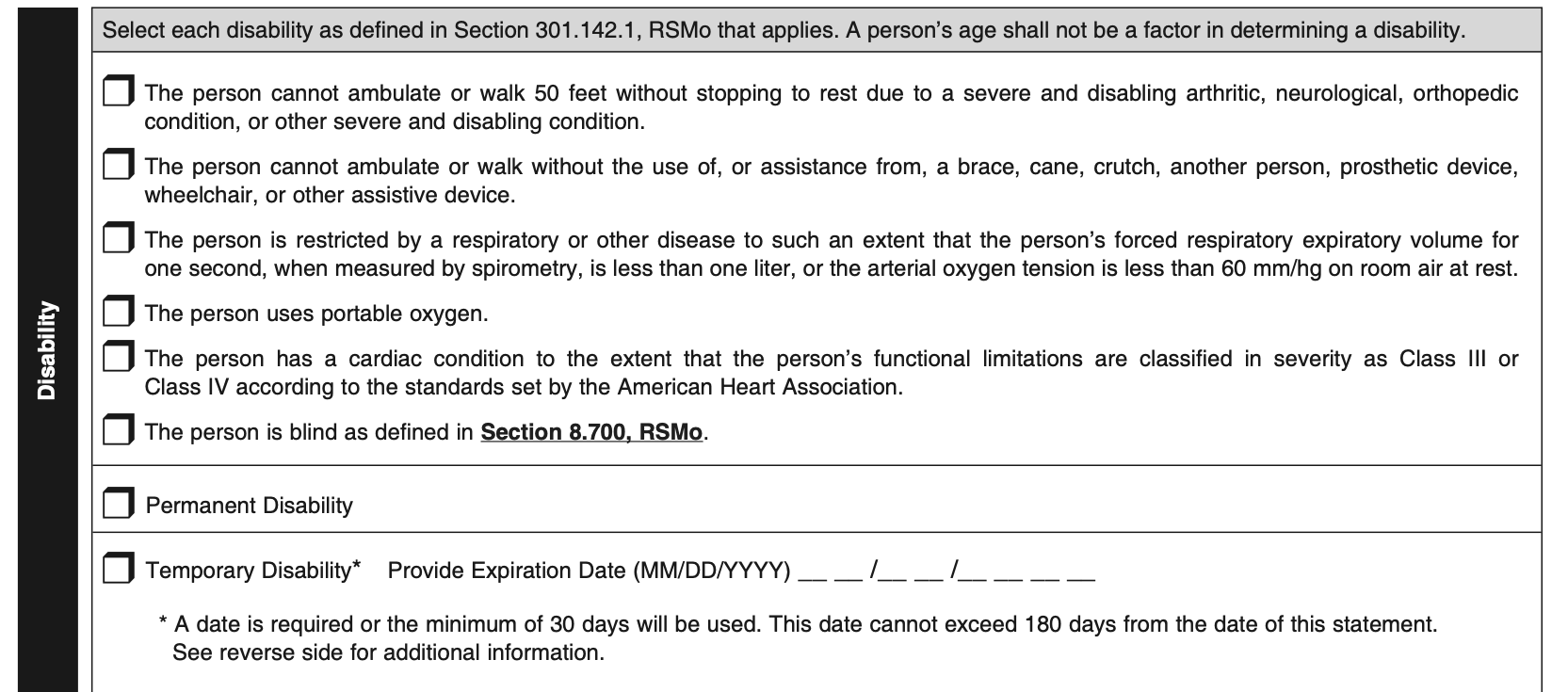
The Disability block opens with an instruction: select each disability, as defined in the statute, that applies, and a person’s age shall not be a factor. At least one box must be checked. What follows is the whole of Missouri’s definition of “physically disabled” for this purpose, six items long.
Read the six before you reach for the pen. Two kinds of patient make this the box that matters: the one who plainly cannot walk across a parking lot but whose condition you would describe in words that are not on the list, and the one who is elderly and frail and asks because a neighbor has one. The first one qualifies under the 50-foot item if the walking limit is real. The second does not qualify on age, and the form says so. Nothing written in the margin adds a seventh item.
The rule: section 301.142.1(4), RSMo.
Cannot walk 50 feet without stopping, or cannot walk without help
The first item: the person cannot walk 50 feet without stopping to rest because of a severe and disabling arthritic, neurological, orthopedic or other severe and disabling condition. The second: the person cannot walk without a brace, cane, crutch, another person, a prosthetic device, a wheelchair or another assistive device.
Check the first when you have seen the limit or can support it from the chart: the patient who stops halfway down the corridor, the six-minute walk that ended early, the knee or the claudication that explains it. Write that observation in the note, because the form’s reverse side requires documentation that objectively confirms the condition. Check the second when your patient cannot walk without the aid, not just because they arrived with a walker. Fifty feet is a short distance, roughly the length of a bus. My understanding is that most states use 200 feet and a few use 100, so a patient who qualifies elsewhere may not qualify here.
The rule: section 301.142.1(4)(a) and (b), RSMo; the reverse of Form 1776.
The breathing numbers, and portable oxygen
The third item is a measurement: the person is so restricted by a respiratory or other disease that their forced expiratory volume in one second, on spirometry, is under one liter, or their arterial oxygen tension is under 60 mm Hg on room air at rest. A patient who gets short of breath on the stairs does not meet this item without one of those two numbers in the chart, and your licensing board can ask to see it.
The fourth item is met on its own: the person uses portable oxygen. If the oxygen is prescribed and in use, check it and move on. No measurement is asked for.
The rule: section 301.142.1(4)(c) and (d), and 301.142.6, RSMo.
A Class III or IV heart condition, and legal blindness
The fifth item is a heart condition whose functional limitation is Class III or IV by American Heart Association standards: symptoms with less than ordinary activity, or at rest. The class you assign in the note is the answer, so assign it there first and check here second.
The sixth item is blindness as defined in section 8.700 of Missouri’s statutes. My understanding is that this means central vision of 20/200 or worse in the better eye with correcting lenses, or a field of vision in the better eye no wider than 20 degrees, found on examination by an eye physician or an optometrist. So I would want that eye examination in the chart before checking it. If you sign as a chiropractor, podiatrist or optometrist, the scope rule on the back of the form decides whether either of these two is yours to check.
The rule: section 301.142.1(4)(e), RSMo; section 8.700, RSMo.
Permanent
Check permanent when the condition is not expected to improve: the amputation, the advanced heart failure, the neurological disease that progresses. Missouri asks for a fresh statement every eighth year on renewal, so permanent is reviewed, not forever, and you are not promising the state a lifetime. If you are unsure whether it will improve, that is what temporary is for.
My understanding is that two groups skip that renewal statement: a patient aged 75 or older who gave one with the first application, and a veteran whose permanent disability is verified in a federal statement, who does not need your form at all.
The rule: section 301.142.4, 301.142.11 and 301.142.16, RSMo.
Temporary, with a date
Check temporary and write an expiration date. The form sets out the rules under the box and on the back. If you leave the date blank, the state issues 30 days. The date cannot be more than 180 days from the date of your statement. And the placard can be renewed once, for another 180 days, on a new statement. My understanding is that the 30 days is what Missouri does with a blank box, not a minimum, so a shorter recovery can have a shorter date.
Recovery after surgery is the obvious example. Pick the date that matches the recovery, not the date of the next visit, because a placard that expires the week before your patient can walk to the shop sends them back for another form.
The rule: section 301.142.1(7), 301.142.4 and 301.142.12, RSMo; Form 1776.
Signature, and who may sign
Missouri accepts a licensed physician, an advanced practice registered nurse, a physician assistant, a chiropractor, a podiatrist, a physical or occupational therapist, or an optometrist, and the form’s reverse side adds that a chiropractor, podiatrist or optometrist may sign only for conditions they are legally allowed to diagnose and treat. Whoever signs must sign personally. The form says twice that a stamped signature or a nurse’s signature is not acceptable.
My understanding is that the statute also names assistant physicians, although the form has no box for them. The form asks for the state of your license, but I have not seen a Missouri source that says whether a clinician licensed only in another state may sign, so if that is you, I would ask the Department of Revenue first.
Read the certification before you sign it. It says you have physically examined the person listed and determined that they are physically disabled for the reasons checked above. That is a statement about an examination, not a favor to a patient you know well, and the misdemeanor paragraph sits directly above it. If the examination was some time ago and the condition may have changed, see the patient.
That paragraph applies to everyone who signs, and the form prints the penalty as a fine of up to $500 or up to six months in jail. My understanding is that Missouri’s general sentencing law now allows a fine of up to $1,000 for a Class B misdemeanor, so the printed figure is probably out of date.
The form has no line for a diagnosis, although my understanding is that the statute says the statement should set one out. The law also says your chart must record that you issued the statement, the date you signed it, the diagnosis that qualified your patient, and enough to objectively confirm it, so the diagnosis belongs in your note either way.
The rule: section 301.142.1(3), 301.142.2, 301.142.3, 301.142.5 and 301.142.26, RSMo; section 558.002, RSMo; Form 1776.
Where the form goes
Your patient files it, not your office. They take it, with Missouri’s Application for Disabled Person Placard (Form 2769), to any Missouri license office, or mail both to the Motor Vehicle Bureau, P.O. Box 598, Jefferson City, MO 65105-0598. My understanding is that a permanent placard is free and a temporary one costs your patient $2. The same statement also supports an application for disabled license plates, which goes in on a different form.
For the other states, where the list and the walking distance are different, see the disabled parking placards page.
The rule: section 301.142.12 and 301.142.16, RSMo; Form 2769; the reverse of Form 1776.
What Missouri says the form must have
I have not seen a Missouri source that says why these statements are most often not accepted, so I won’t guess. What the form and the statute do say is what a statement has to carry, and these are the things I would look at twice before it leaves the office.
- At least one disability box checked, and no condition written in that is not on the list.
- Permanent or temporary checked, and for temporary, a date no more than 180 days from the statement.
- Your own signature, with no stamp and no nurse or anyone else signing for you.
- Your license number and the state that issued it.
- A statement no older than 90 days when your patient files it.
PatientPapers makes completing Missouri Form 1776 faster and easier
I created PatientPapers to make this paperwork faster and easier, because as a physician I know how much of it lands on us. It is my own product, built through the same company as this site, so weigh this accordingly. It keeps your name and license number on file, asks which of Missouri’s six conditions apply and whether the disability is permanent or temporary, and fills in Missouri’s own Form 1776 for you to review. Because Missouri wants your personal signature, it gives you an unsigned copy to sign by hand. The pricing and the full description are on the PatientPapers site.
Open PatientPapers