WH-380-E examples, filled in for four common cases
You have read what each box on the WH-380-E asks, and now a patient with arthritis flares is in front of you and you want to see a finished one. Here are four, filled in for made-up patients, with the reasons behind each answer.
- Form
- WH-380-E, Certification of Health Care Provider for Employee’s Serious Health Condition
- Issued by
- U.S. Department of Labor, Wage and Hour Division
- Revision
- June 2020
- Patients
- fictional, all named Example
- Clinician
- Alex Rivera, MD, fictional
- Filled in by
- PatientPapers, from the answers on this page
Key points
- Four fictional patients, each with the real form filled in.
- Flares get two numbers in item 9, how often and how long.
- A condition that will not end is ongoing in item 2. The chronic box also needs visits at least twice a year.
- A planned overnight stay for surgery is inpatient care, even before it happens.
- Physical therapy is a referral, in item 6.
- The diagnosis stays out. The symptoms go in.
Before you start: what these four examples are
The question I hear most about the WH-380-E is not what a box means but what a finished one looks like for a patient like the one in front of you. So here are four, for the patterns the form is built around. Two are conditions that flare and settle, one is a planned operation with a recovery afterward, and one is a pregnancy. Each was filled in by PatientPapers from the answers described below, and the pictures are the actual pages it printed.
Everything on them is made up. The patients all have the last name Example, the employers are invented, and the clinician, Alex Rivera, MD, is the same fictional internist who appears on the PatientPapers sample. The dates are written as if the form were being filled in during October 2026.
All four follow the approach I set out in the field-by-field walkthrough. The diagnosis stays out and the symptoms go in, a condition that will not end is called ongoing and chronic, and time off that comes and goes gets two numbers, how often and how long. These are examples of how I would answer, not the only acceptable answers, and your patient’s own history is what should decide yours.
Rheumatoid arthritis with flares
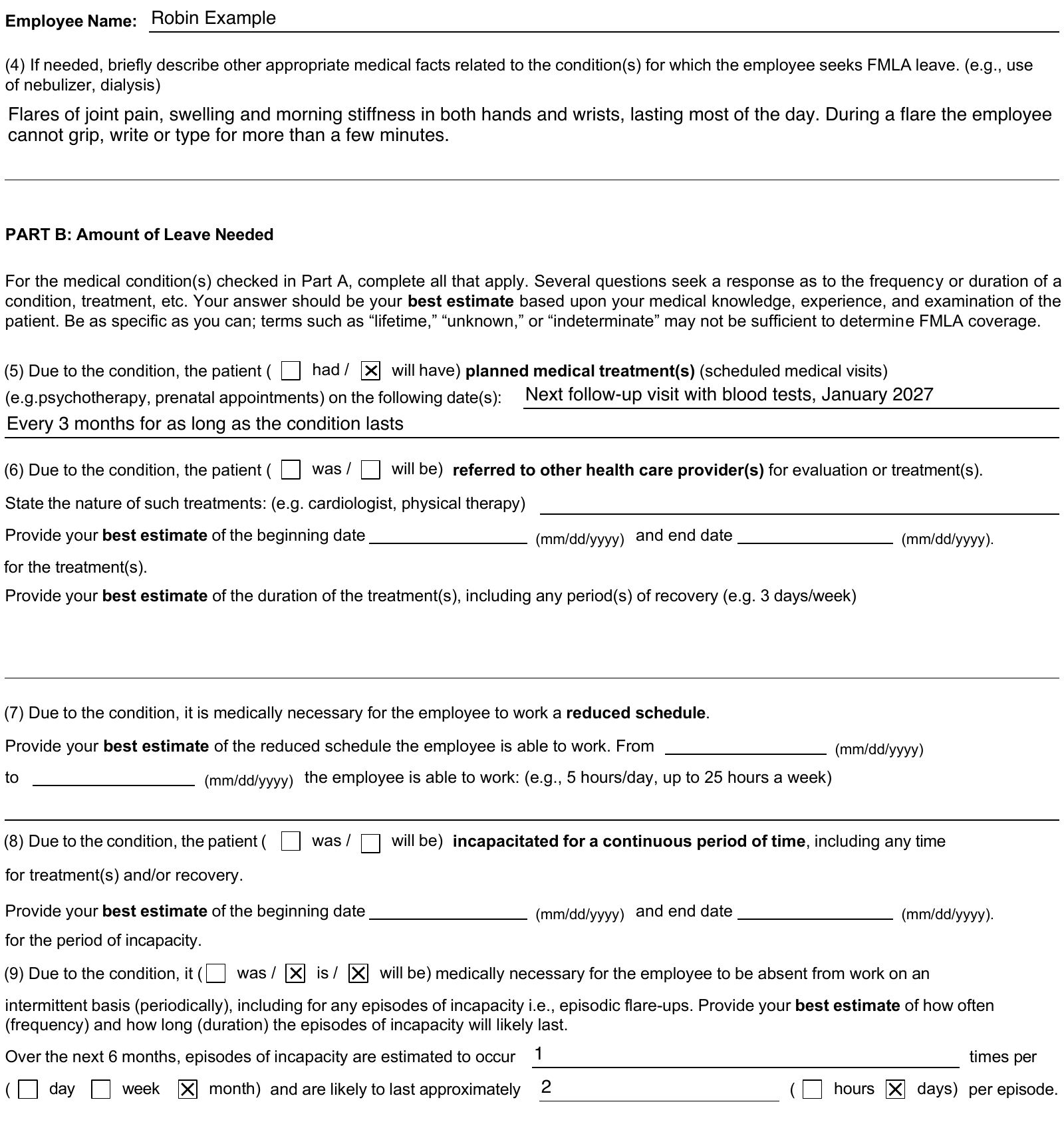
Robin Example is an administrative assistant at an insurance agency who has had inflammatory arthritis since about 2021. Most weeks are fine, but about once a month a flare leaves both hands and wrists swollen and stiff for a couple of days, and on those days Robin cannot type. Robin asks for intermittent leave to cover the flares.
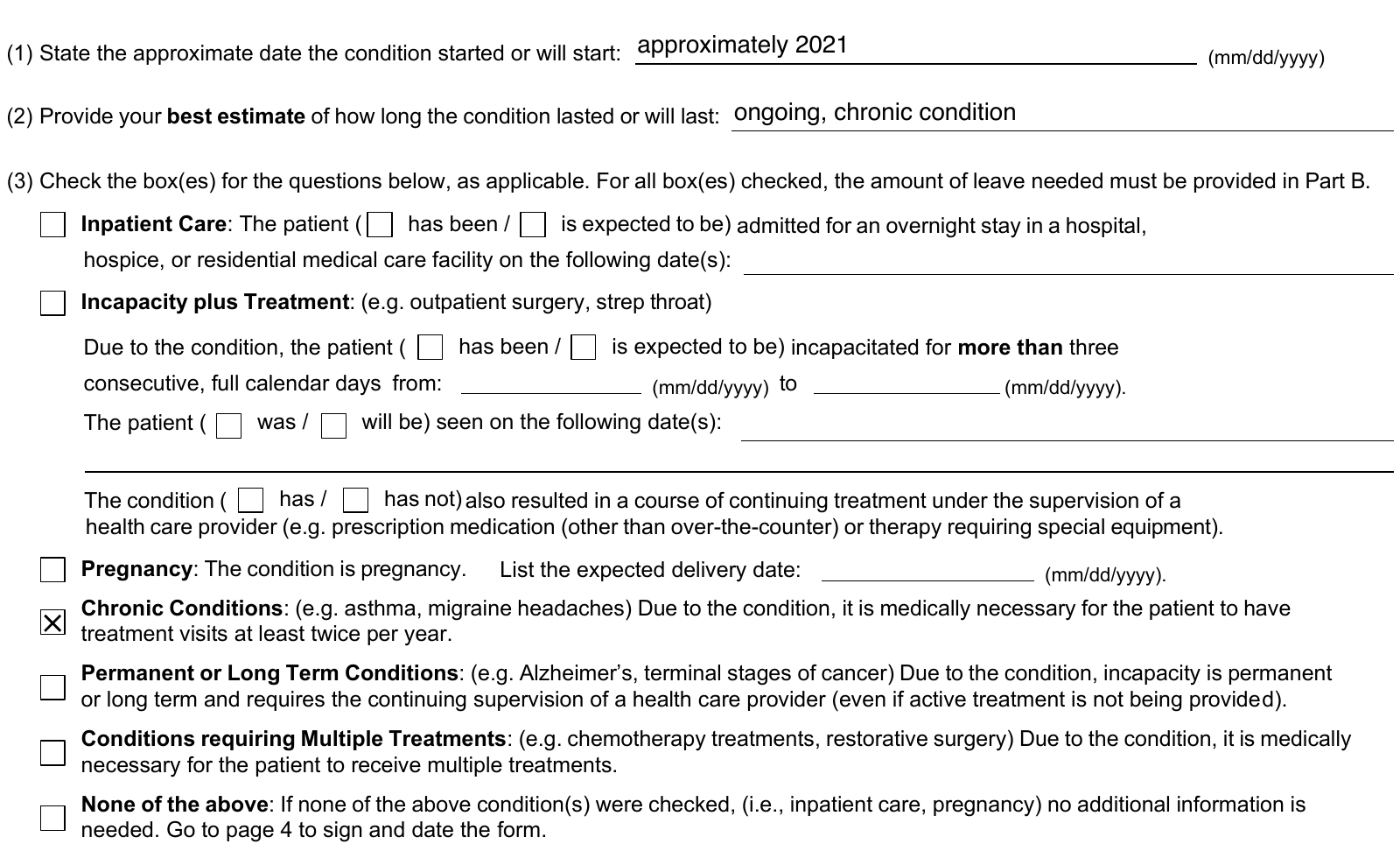
Item 1 is “approximately 2021”, because a month and a year, or even just a year, is enough for something long-standing. Item 2 is “ongoing, chronic condition”, because item 2 asks how long the condition will last, and this one will not end. Item 3 is the chronic conditions box and nothing else. It fits because the flares come and go over a long time and Robin is seen every three months, and the box itself asks for treatment visits at least twice a year. A lifelong diagnosis on its own is not enough. Robin has not been in the hospital and is not out for a continuous stretch, so I would leave the other boxes alone rather than check them to look thorough.
Item 4 describes the flares in plain words, joint pain, swelling and morning stiffness in both hands and wrists, and says what that does to Robin’s day. There is no diagnosis on it. HR does not need the name of the disease to approve the leave, and the symptoms tell them more about why Robin cannot type than the diagnosis would.
Item 5 is the follow-up visit every three months, with blood tests, for as long as the condition lasts. Item 9 is the part that carries the leave. Over the next six months, flares are expected about once a month and to last about two days each, so the form says 1 time per month and 2 days per episode. If your patient’s flares come more often, or last longer, write what you actually expect. I settle these numbers with the patient in the room, because an estimate made from the chart alone tends to run low.
Part C on page 4 names the part of the job Robin cannot do during a flare, typing, writing and handling files, which is most of the job.
Migraine
Casey Example drives a delivery route and has had migraines since about 2018. Attacks come about three times a month and usually last a day, and during one Casey cannot drive safely. Casey asks for intermittent leave.
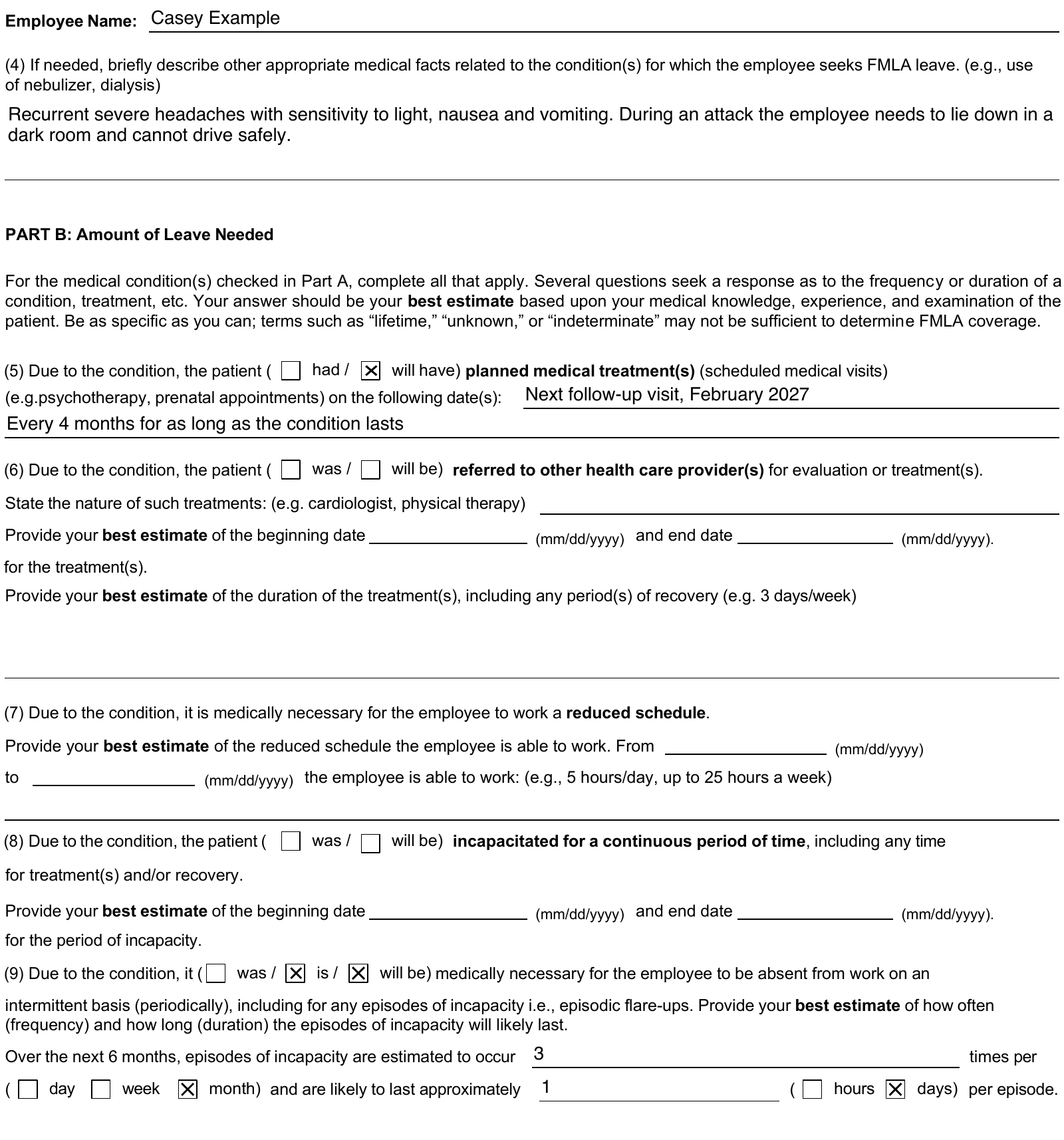
The pattern is the same as Robin’s, with different numbers. Item 2 is “ongoing, chronic condition” and item 3 is the chronic conditions box, which the form itself illustrates with migraine. There is no flare-up box in item 3. The chronic box says what kind of condition it is, and item 9 is where the flare-ups go. Item 4 describes the attacks, severe headache with sensitivity to light, nausea and vomiting, and says what that means at work, that Casey needs to lie down in a dark room and cannot drive. Again, there is no diagnosis on it.
Item 9 is 3 times per month and 1 day per episode. I would not write “as needed” here, because it gives HR neither number. Part C names driving the route and carrying packages, because that is the part of this job an attack takes away. For an office worker with the same migraines, it might be reading a screen.
A planned knee replacement
Jordan Example is an elementary school custodian with severe right knee pain who is having a knee replacement on November 9, with one night in the hospital and physical therapy afterward. The form is being filled in at the pre-operative visit, before anything has happened, and the surgeon’s plan is about six weeks off work. For a planned operation the surgeon’s office often fills in this form, but if it lands with you, I would take the dates from the surgeon’s plan rather than a guess, because HR may call you to confirm them.
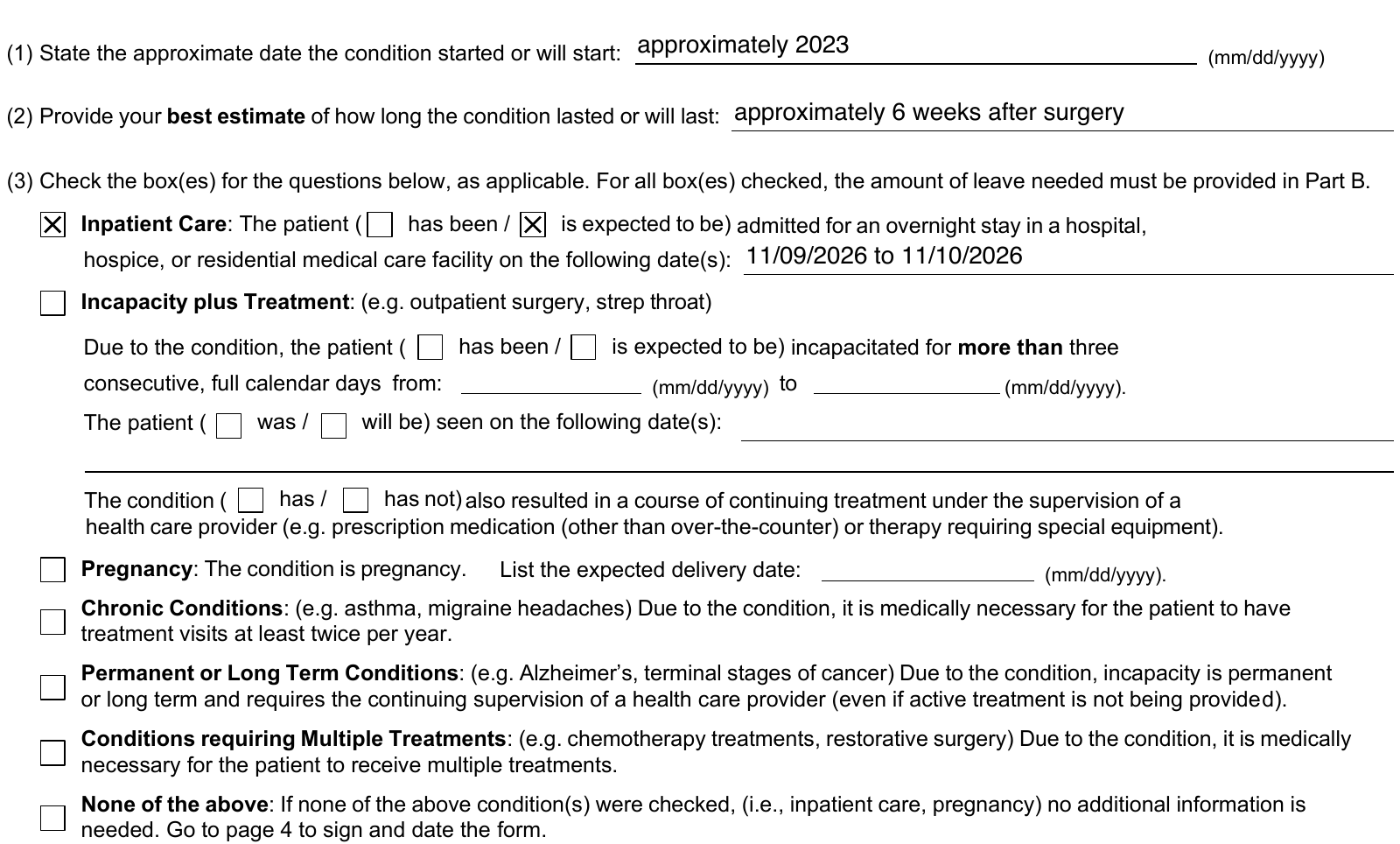
This is the example where the box you check in item 3 matters most. Because Jordan will stay overnight in the hospital, I would check inpatient care and give the admission and discharge dates, 11/09/2026 to 11/10/2026. An overnight stay qualifies on its own, and the recovery that follows it is part of the same claim, so there are no visits to count. Incapacity plus treatment would fit Jordan too. That box needs more than three full calendar days unable to work, plus two in-person treatment visits within 30 days of the first day of incapacity, the first within seven days of it, or one visit within seven days that starts ongoing treatment. The surgery on 11/09 is itself the first visit and the follow-up on 11/23 is the second. The pre-operative visit does not count, because it comes before the first day of incapacity. I check inpatient care here only because it is the simpler box when there is a night in the hospital. If the operation is same-day with no overnight stay, incapacity plus treatment is the box to check, and the form itself gives outpatient surgery as its example.
Notice the tense choices too. The form asks whether the patient has been or is expected to be admitted, and the answer here is expected to be, because the surgery has not happened yet. Item 2 is “approximately 6 weeks after surgery”, because this condition, unlike Robin’s, is expected to end. I would keep item 2 and item 8 saying the same thing. HR goes by the dates in item 8, so if item 2 said six to eight weeks and item 8 ended at six, the extra two weeks would not be covered and HR might call to ask which is right.
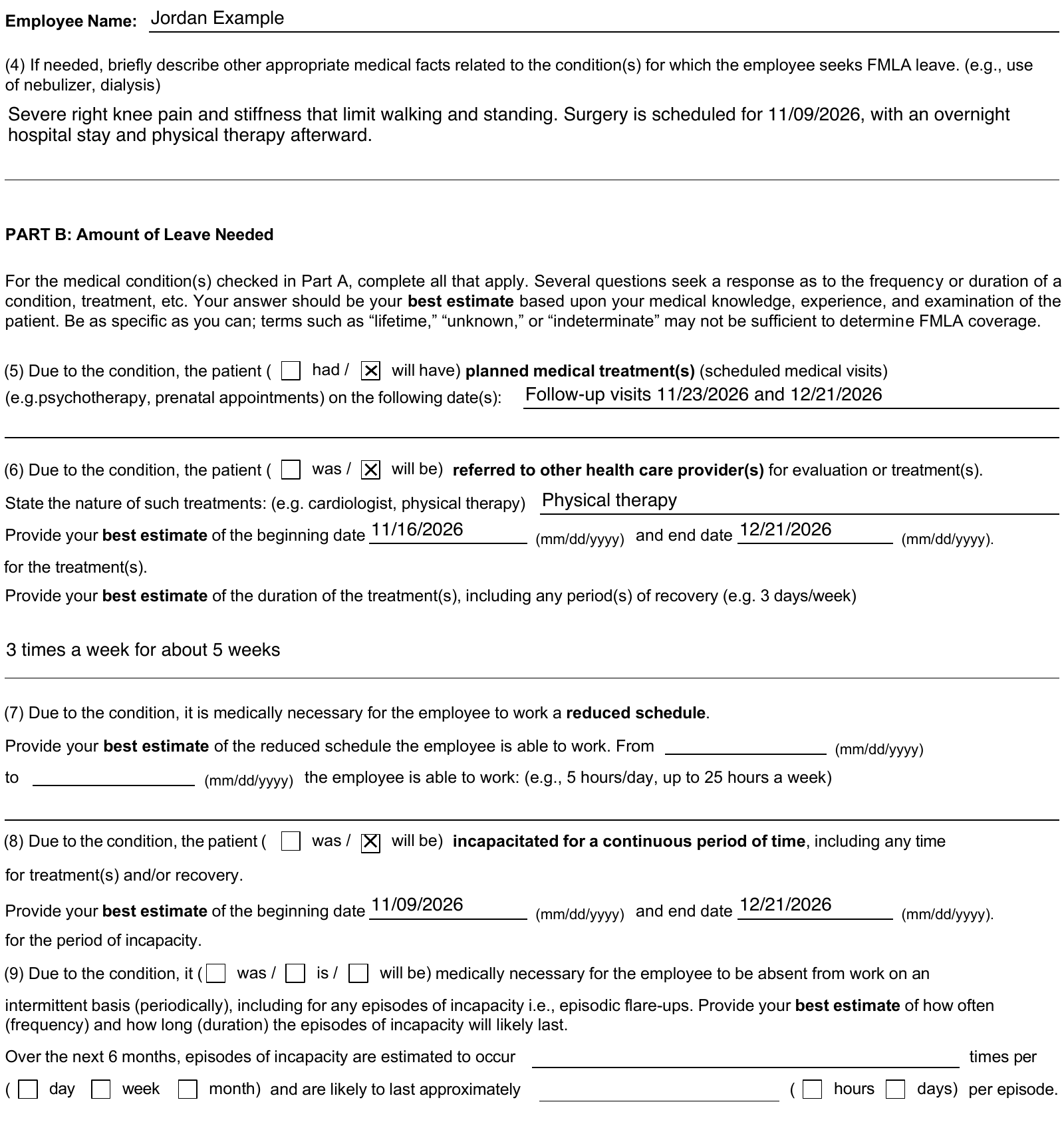
Part B splits the care the way the form asks. Item 5 is the follow-up visits, on 11/23/2026 and 12/21/2026. Physical therapy is care from another clinician, so it goes in item 6 as a referral, from 11/16/2026 to 12/21/2026, three times a week for about five weeks. If therapy will carry on after Jordan is back at work, I would give its real end date there, because those visits need covering too. Item 8 is the one continuous block off work, 11/09/2026 to 12/21/2026, with “will be” checked. There is nothing in item 9, because Jordan’s time off is one block, not episodes.
Part C says Jordan will not be able to stand, walk, climb stairs or kneel for any part of the custodial job until recovered. If recovery runs longer than six weeks, which it can for a job with kneeling and stairs, HR can ask for an updated form, and I would give a new end date then rather than pad this one.
Pregnancy
Taylor Example is a dental hygienist who is pregnant, with a due date of March 15, 2027. Taylor wants the prenatal visits covered now and the recovery after delivery covered as well. If an obstetrician or midwife is managing the pregnancy, they usually fill in this form, and if you fill it in anyway, I would list their care in item 6 as a referral.
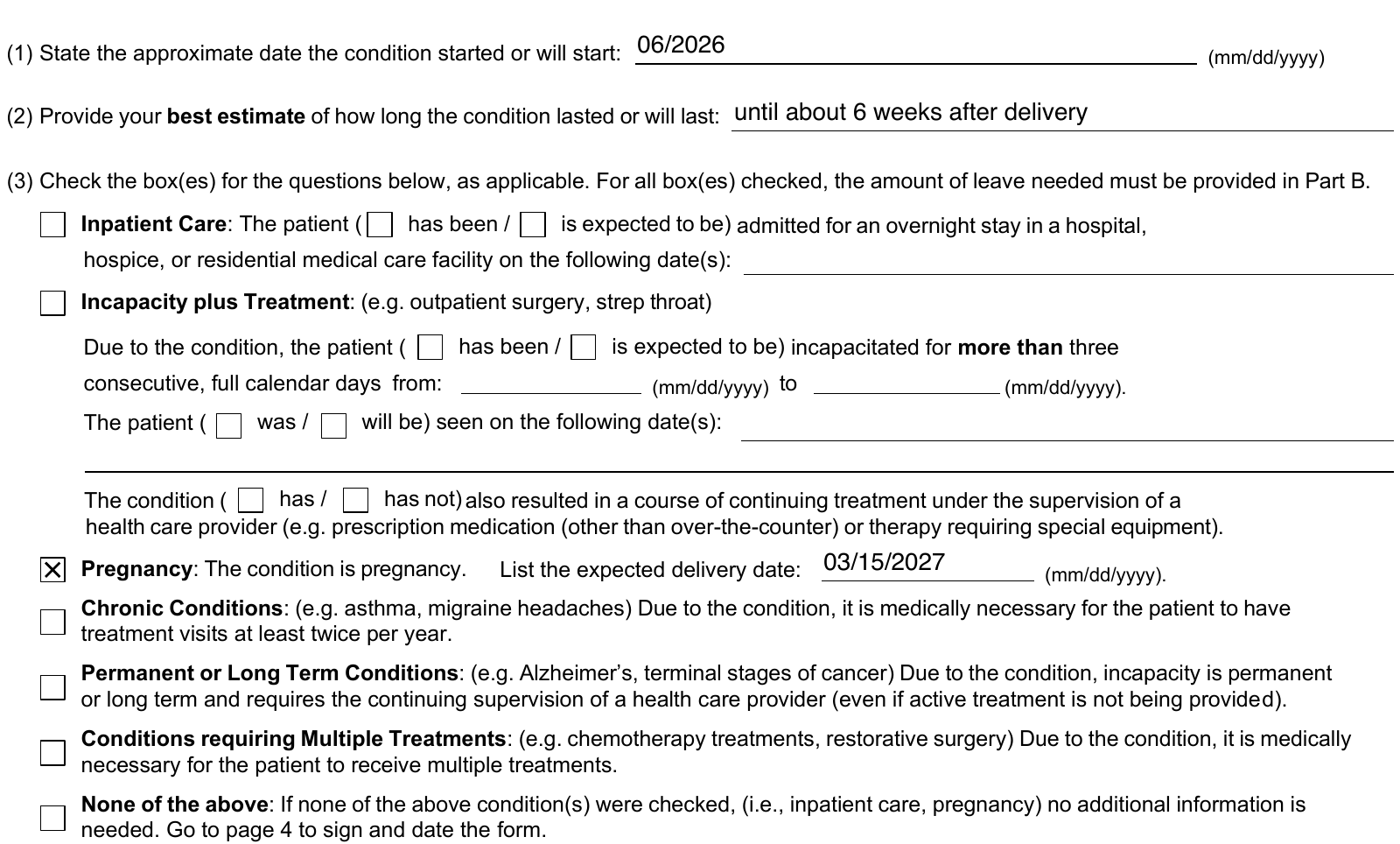
Item 3 is the pregnancy box, with the expected delivery date. The form lists pregnancy as its own kind of condition, so there is no need to fit it into one of the other boxes. Item 1 is when the pregnancy began, and item 2 is “until about 6 weeks after delivery”.
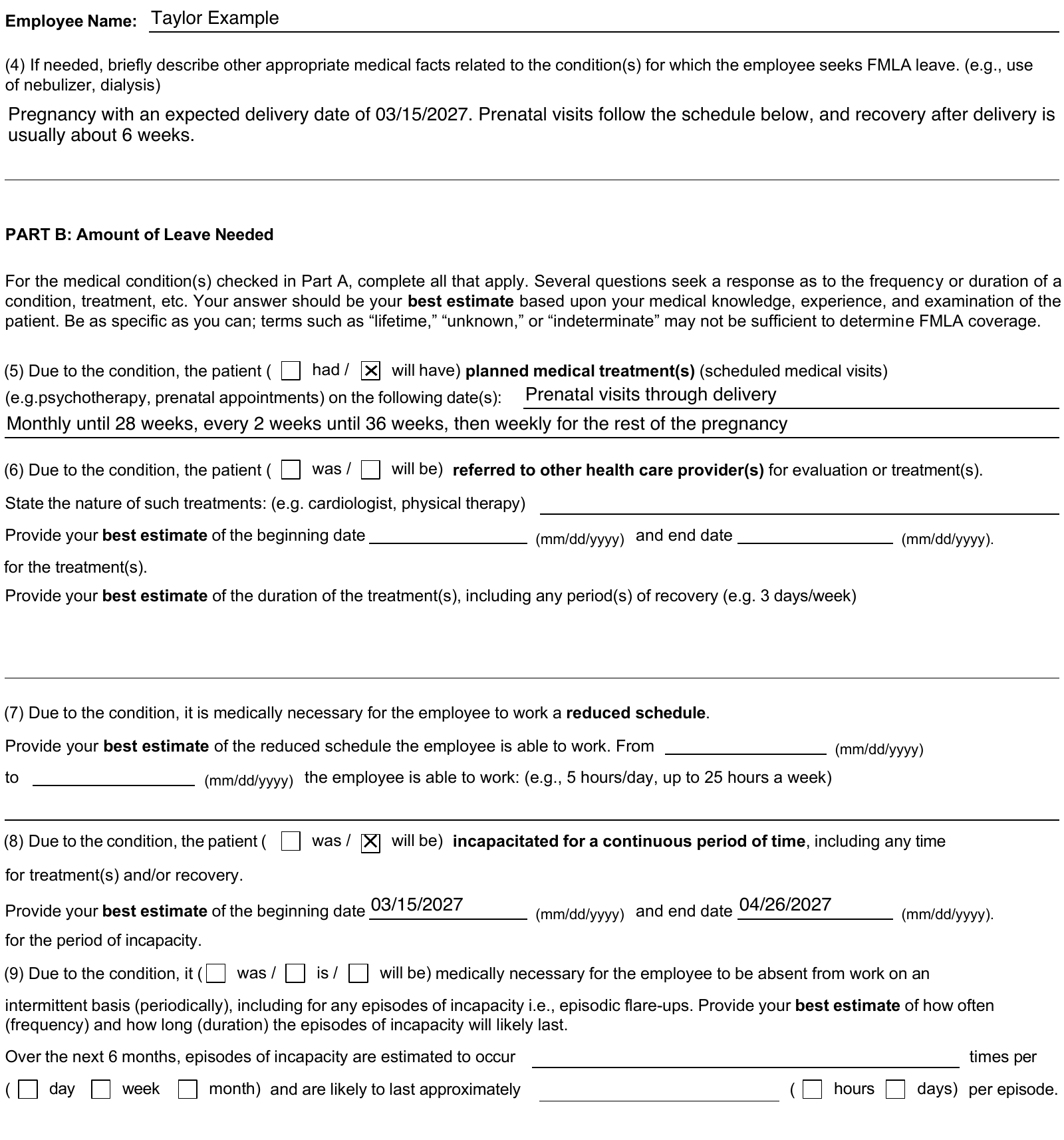
Item 5 covers the prenatal visits. Since they are not all booked yet, I gave the usual schedule instead of dates, monthly until 28 weeks, every two weeks until 36 weeks, then weekly for the rest of the pregnancy. Item 8 is the recovery after delivery as one continuous block, from the due date to about six weeks later, 03/15/2027 to 04/26/2027. Six weeks is a common recovery after a vaginal delivery, and I would give longer if you expect a cesarean or a complication. If the baby comes early or late, the dates can be updated then.
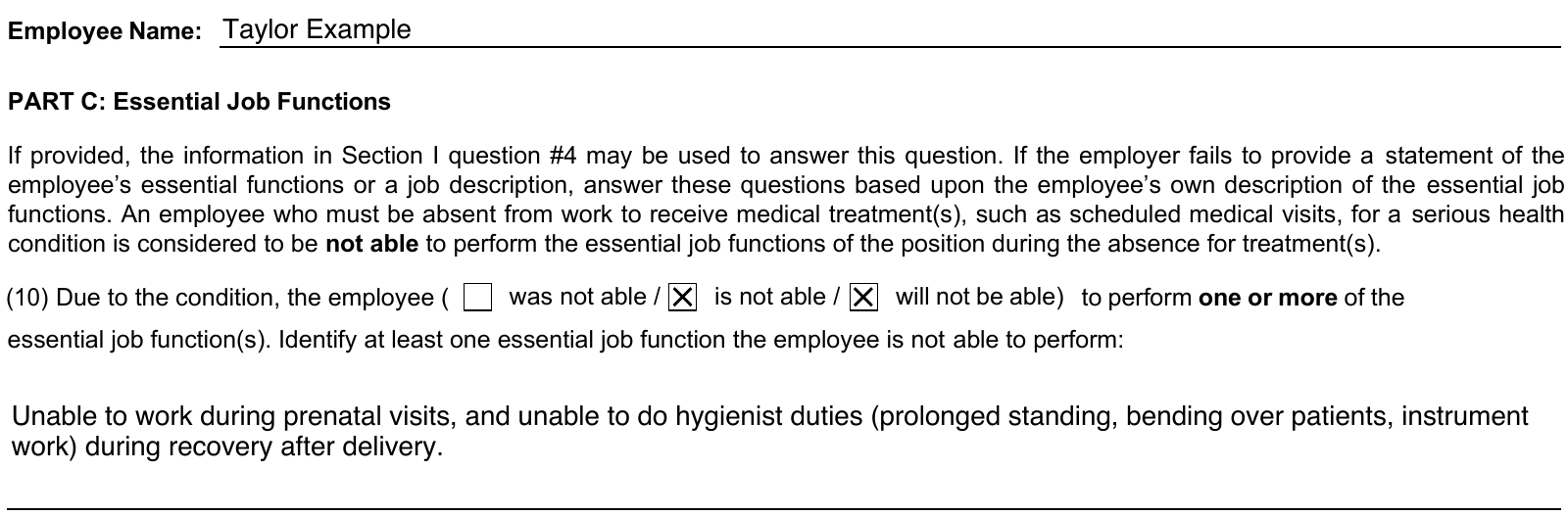
Leave to bond with a healthy baby is a separate question. The WH-380-E says an employer may not ask for a certification for bonding, so this form only covers Taylor’s own care and recovery. Part C names the hygienist’s actual duties, prolonged standing, bending over patients and instrument work, and checks both “is not able” and “will not be able”. The form itself says that time away for scheduled visits counts as not being able to do the job, so the prenatal visits happening now belong here as well as the recovery later.
What all four have in common
Looking at them side by side, the same few habits do most of the work. I would leave the diagnosis out and describe what the patient feels and cannot do. I would answer item 2 about the condition, not the leave, which is why Robin and Casey say ongoing and Jordan and Taylor give a span. I would check only the boxes in item 3 that the facts support. And I would make sure every kind of time off in Part B has a number attached, dates for a block, how often and how long for episodes, and a schedule for visits.
None of the four needed more than a few lines of writing. The form is short on purpose, and a specific short answer tells HR more than a long vague one.
Questions the office asks
Is there an example of a completed WH-380-E for rheumatoid arthritis?
Yes, the first example on this page. It checks the chronic conditions box, says “ongoing, chronic condition” in item 2, describes the flares without naming the diagnosis, and gives flares of about once a month lasting two days in item 9.
What do I write on the WH-380-E for migraines?
For episodes that come and go, check chronic conditions, describe the attacks in item 4, and give two numbers in item 9, how many times per month and how many days each. “As needed” is not an answer.
How do I fill out the WH-380-E before a planned surgery?
Check the “is expected to be” and “will be” tenses and give the dates you expect. If there is an overnight hospital stay, check inpatient care. If the surgery is same-day and keeps the patient off work more than three full days, check incapacity plus treatment instead. Put the follow-up visits in item 5, physical therapy in item 6 as a referral, and the weeks off work in item 8.
How do I fill out the WH-380-E for pregnancy?
Check the pregnancy box with the due date, put the prenatal visit schedule in item 5, and the recovery after delivery in item 8 as one continuous block. Leave to bond with a healthy baby does not need a certification.
PatientPapers filled in the forms on this page
I created PatientPapers to make this paperwork faster and easier, because as a physician I know how much of it lands on us. It is my own product, built through the same company as this site, so weigh this accordingly. The four forms on this page were filled in by PatientPapers from the answers described above, for made-up patients and a made-up clinician, and the pictures are the pages it printed. It keeps your details on file, asks the questions in plain English, and fills in the Department of Labor’s own WH-380-E for you to review and sign. The pricing and the full description are on the PatientPapers site.
Open PatientPapers