Virginia handicap placard form, the doctor’s part of the MED 10
Your patient is booked for a knee replacement a week from Thursday, and she hands the front desk a Virginia MED 10 with page 1 already done. Page 2 is yours. Virginia lets you sign it before the operation, there is no notary to find, and the one thing I would slow down for is the pair of dates that decides how long her placard lasts.
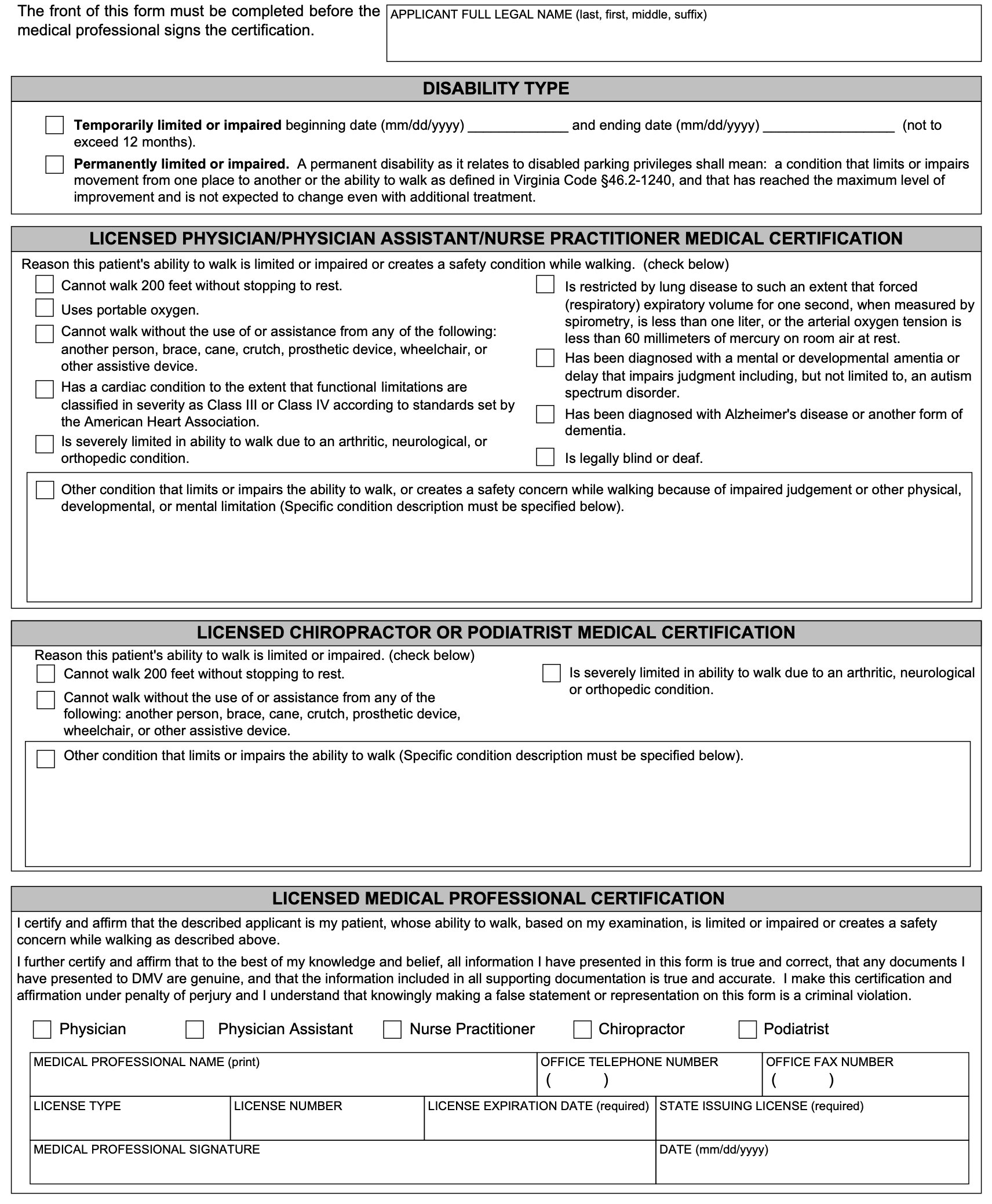
- Form
- MED 10, Disabled Parking Placard or License Plates Application
- Issued by
- Virginia Department of Motor Vehicles (DMV)
- Blank form
- MED 10 PDF on dmv.virginia.gov
- Revision
- MED 10 (07/01/2026)
- Rule
- Code of Virginia §§ 46.2-1240 and 46.2-1241
- Temporary
- up to 12 months, between dates you write
- Filed with
- the DMV, by your patient
Key points
- Page 1 is your patient’s, and it should be done before you sign page 2.
- Physicians, physician assistants and nurse practitioners use the ten-reason section.
- Chiropractors and podiatrists have a shorter section of their own.
- The walking test is 200 feet without stopping to rest.
- Temporary needs two dates, no more than 12 months apart.
- No notary, and no fee for the placard.
Before you start: page 2 is yours, and page 1 comes first
Virginia uses one application, the MED 10, for the disabled parking placard and for disabled parking license plates. Page 1 is the applicant’s. It has their name, address and description, which kind of placard or plate they want, and their own certification. Page 2 is the medical professional’s, from top to bottom.
The top of page 2 says it plainly, “The front of this form must be completed before the medical professional signs the certification.” So if a patient hands you a MED 10 with page 1 blank, I would give it back to them to fill in first rather than sign and hope. There is also a box at the top of page 2 for the applicant’s full legal name, which I would copy from page 1 exactly as written there.
Unlike some states, Virginia does not ask for a notary, and there is no prescription route in place of the form. Your part is a check for temporary or permanent, at least one reason, your details and your signature.
The rule: Code of Virginia § 46.2-1241(A) and (B); page 2 of Form MED 10.
Who may sign, and which section is yours
My understanding is that the statute lets five kinds of licensed professional sign the certification, a physician, a physician assistant, a nurse practitioner (the statute says advanced practice registered nurse), a podiatrist or a chiropractor. The form has a check box for each of the five at the bottom of page 2, and you check the one that matches your license.
Page 2 then splits into two sections, and you use only one. If you are a physician, physician assistant or nurse practitioner, yours is the larger section, headed “Licensed Physician/Physician Assistant/Nurse Practitioner Medical Certification”, with ten reasons and an Other box. If you are a chiropractor or podiatrist, yours is the smaller section under it, with four reasons. My understanding is that the statute limits chiropractors and podiatrists to those four (walking 200 feet, needing a device or another person, a severe arthritic, neurological or orthopedic limit, and another condition that limits walking), which is why their section is shorter.
The form marks two of your details as required, the date your license expires and the state that issued it. It does not say a license from another state is turned away, and I did not find the statute saying either way, so I won’t guess. I would fill in both boxes every time.
The rule: Code of Virginia § 46.2-1240, the definition of a person with a disability that limits or impairs the ability to walk, and § 46.2-1241(A) and (B); page 2 of Form MED 10.
Disability type: temporary with two dates, or permanent
The first box on page 2 is Disability Type, and you check one of two.
Temporarily limited or impaired. This one comes with a beginning date and an ending date, and the form says the gap is “not to exceed 12 months.” My understanding is that the statute makes the temporary placard good for the time you set, up to 12 months from when it is issued. So the dates are not a formality. They are the length of the placard. For a hip or knee replacement I would write the date of surgery as the beginning, and an ending date I would actually expect recovery to reach, rather than reaching for the full 12 months by habit.
Permanently limited or impaired. The form prints Virginia’s definition next to this box. In its words, a permanent disability is “a condition that limits or impairs movement from one place to another or the ability to walk as defined in Virginia Code §46.2-1240, and that has reached the maximum level of improvement and is not expected to change even with additional treatment.” That last clause is the part I would think about. A patient still in physical therapy who may get better has not reached the maximum level of improvement, and temporary fits them better, even if it means a second form next year.
It matters more than it looks, because my understanding is that a permanent placard lasts five years and Virginia renews it automatically, by mail, with no new certification from anyone. Once you check permanent, no doctor looks at it again.
The rule: Code of Virginia § 46.2-1241(A)(1) and (B)(2); the Disability Type section on page 2 and the Renewal box on page 1 of Form MED 10.
The reasons, in Virginia’s own words
Under the heading for physicians, physician assistants and nurse practitioners, the form asks for the “Reason this patient’s ability to walk is limited or impaired or creates a safety condition while walking,” with “(check below)” after it. You check each one that applies, and at least one has to. These are the ten printed reasons, in the form’s words.
- Cannot walk 200 feet without stopping to rest.
- Uses portable oxygen.
- Cannot walk without the use of or assistance from any of the following: another person, brace, cane, crutch, prosthetic device, wheelchair, or other assistive device.
- Has a cardiac condition to the extent that functional limitations are classified in severity as Class III or Class IV according to standards set by the American Heart Association.
- Is severely limited in ability to walk due to an arthritic, neurological, or orthopedic condition.
- Is restricted by lung disease to such an extent that forced (respiratory) expiratory volume for one second, when measured by spirometry, is less than one liter, or the arterial oxygen tension is less than 60 millimeters of mercury on room air at rest.
- Has been diagnosed with a mental or developmental amentia or delay that impairs judgment including, but not limited to, an autism spectrum disorder.
- Has been diagnosed with Alzheimer’s disease or another form of dementia.
- Is legally blind or deaf.
That is nine, and the tenth is the Other box, which has its own section below. The letters are mine, since the form numbers nothing.
The walking test is the first reason, 200 feet without stopping to rest, which is roughly the walk from the far end of a supermarket lot to the door. The heart and lung reasons turn on a class or a number you can find in the chart, and portable oxygen is met by the oxygen itself. The last three are what make Virginia different from most states. They are about safety, not stamina. A patient with dementia who can walk a mile but wanders into traffic qualifies, and so does a patient who is deaf and cannot hear a car backing up. The DMV’s own pages give Alzheimer’s disease, blindness and developmental amentia as examples of a condition that creates a safety concern while walking.
One thing I would know before choosing among these. The DMV’s information sheet, the MED 12, has a certification table, and it marks the three safety reasons (and the safety half of the Other box) as permanent only. I did not find that limit in the statute’s wording, but if the DMV is reading the form that way, checking temporary with one of those reasons alone is a combination I would avoid.
The rule: Code of Virginia § 46.2-1240, items (i) to (xi) of the definition; the physician, physician assistant and nurse practitioner section on page 2 of Form MED 10; the certification table in the DMV’s MED 12.
The Other box: name the condition
The Other box in the physician section reads “Other condition that limits or impairs the ability to walk, or creates a safety concern while walking because of impaired judgement or other physical, developmental, or mental limitation,” and then, in brackets, “Specific condition description must be specified below.” The box under it is blank space for you to write in.
My understanding is that this one box covers two separate items in the statute. One is any other debilitating condition that limits walking. The other is a condition that creates a safety concern because of impaired judgment or another limitation. For both, the statute says you have to name the condition in the space the form gives you. So a check here with the space left empty is not complete, and I would expect the DMV not to accept it.
What I would write is the diagnosis and one plain line on how it limits walking or makes walking unsafe, for example “Parkinson’s disease with freezing of gait and two falls this year”. If one of the nine printed reasons already fits, I would check that one instead, or as well, since a printed reason needs no explanation.
The chiropractor and podiatrist section has its own Other box with the same requirement, but its wording covers only conditions that limit walking, not the safety concern.
The rule: Code of Virginia § 46.2-1240, items (vii) and (xi) and the paragraph after the definition; both Other boxes on page 2 of Form MED 10.
Your details, the certification and the penalty
At the bottom of page 2, under “Licensed Medical Professional Certification”, the form has you certify that “the described applicant is my patient, whose ability to walk, based on my examination, is limited or impaired or creates a safety concern while walking as described above.” Two words there are worth noticing, “my patient” and “my examination”. If I had not examined the patient for the problem I was certifying, I would see them before signing.
The next paragraph says you make the statement “under penalty of perjury” and that “knowingly making a false statement or representation on this form is a criminal violation.” My understanding is that the statute makes a false statement of material fact to obtain a placard, or to help someone else obtain one, a Class 2 misdemeanor, and that this reaches the person who certifies as well as the applicant.
Then the boxes, in the order they appear.
Your profession. Check one of physician, physician assistant, nurse practitioner, chiropractor or podiatrist.
Medical professional name, office telephone and office fax. Your printed name and your office numbers.
License type, license number, license expiration date and state issuing license. The last two are marked required on the form. License type is the kind of license you hold, and the number is the license number itself.
Signature and date. Sign it yourself and date it the day you sign.
The rule: Code of Virginia § 46.2-1251; the Licensed Medical Professional Certification on page 2 of Form MED 10.
Before surgery, at renewal, and after a lost placard
Before a planned procedure. My understanding is that you may certify up to 15 days ahead of a patient’s medical procedure that they will have a temporary disability, as long as you give the length of time, still no more than 12 months. On the MED 10 that is simply the temporary box with a beginning date in the future. The DMV says that if the beginning date is more than 15 days away, a patient who applies in person will not be given the paper receipt that normally lets them park while the placard is in the mail.
When a temporary placard runs out. The DMV says temporary placards “cannot be renewed.” If your patient still needs one, they file a new MED 10, and that means a new page 2 from you. A lost or stolen temporary placard with more than 30 days left can be replaced without a new certification, according to the DMV.
When a permanent placard runs out. My understanding is that you are not involved. The DMV says a permanent placard is renewed automatically and mailed about 60 days before it expires, and that no certification from a medical professional is needed to replace a lost one either.
Plates. The form says only permanently disabled persons, or institutions that transport people with disabilities, may get disabled license plates. My understanding is that a patient who already has permanent disabled plates can get a permanent placard without a new certification, and the reverse.
The rule: Code of Virginia § 46.2-1241(A)(1), (B)(1) and (B)(2); the DMV’s pages on applying, on renewal and replacement, and describing placards and plates; the instructions on page 1 of Form MED 10.
Where it goes, and what your patient pays
Your patient files it, not your office. The form tells them to submit it at any DMV Customer Service Center or DMV Select office, or by mail to the DMV. The placard itself always comes by mail. If they apply in person, the DMV gives them a paper receipt to hang from the mirror while they wait for it.
The placard is free, temporary or permanent. Page 1 says “No fees apply” for a placard, and the DMV’s information sheet says there has been no placard fee since July 1, 2024. Plates are a separate matter, with their own application and fees. Virginia issues one placard per person, so a patient cannot get a second one for another car.
The DMV’s page on applying for a disabled parking placard has the current blank and the office finder.
The rule: the instructions on page 1 of Form MED 10; the DMV’s application page and its MED 12 information sheet.
What the form says must be there
I have not found a Virginia source that lists the usual reasons a MED 10 is not accepted, so I won’t invent one. These are the things the form and the statute say must be there, and the ones I would look at before your patient leaves.
- Page 1 completed before you sign page 2, and the applicant’s full legal name at the top of page 2.
- One Disability Type box checked, and for temporary, both dates, no more than 12 months apart.
- At least one reason checked, in the section that matches your license.
- If Other is checked, the specific condition written in the space under it.
- Your profession checked, and your license expiration date and issuing state filled in, since the form marks both required.
- Your signature and the date.
PatientPapers makes completing the Virginia MED 10 faster and easier
I created PatientPapers to make this paperwork faster and easier, because as a physician I know how much of it lands on us. It is my own product, built through the same company as this site, so weigh this accordingly. It keeps your name, license type and number, license expiration date, issuing state and office telephone and fax on file, asks which kind of professional you are, whether the disability is temporary or permanent (with the two dates for temporary), and which reasons apply, and asks for the condition whenever you check Other. It then fills in page 2 of Virginia’s own MED 10, in the section that matches your license, with your patient’s name at the top, for you to review and sign. It also puts that name in the name box on page 1, and leaves the rest of page 1 for your patient. The pricing and the full description are on the PatientPapers site.
Open PatientPapers