New Jersey handicap placard application, the practitioner’s letter
A retired bus driver with COPD comes in with his daughter and a two-page form she printed at home. Page one is already filled in. On page two there are lines for my name and my signature, and in bold type above them the form says he must also attach a statement from me, on a prescription or on my letterhead.
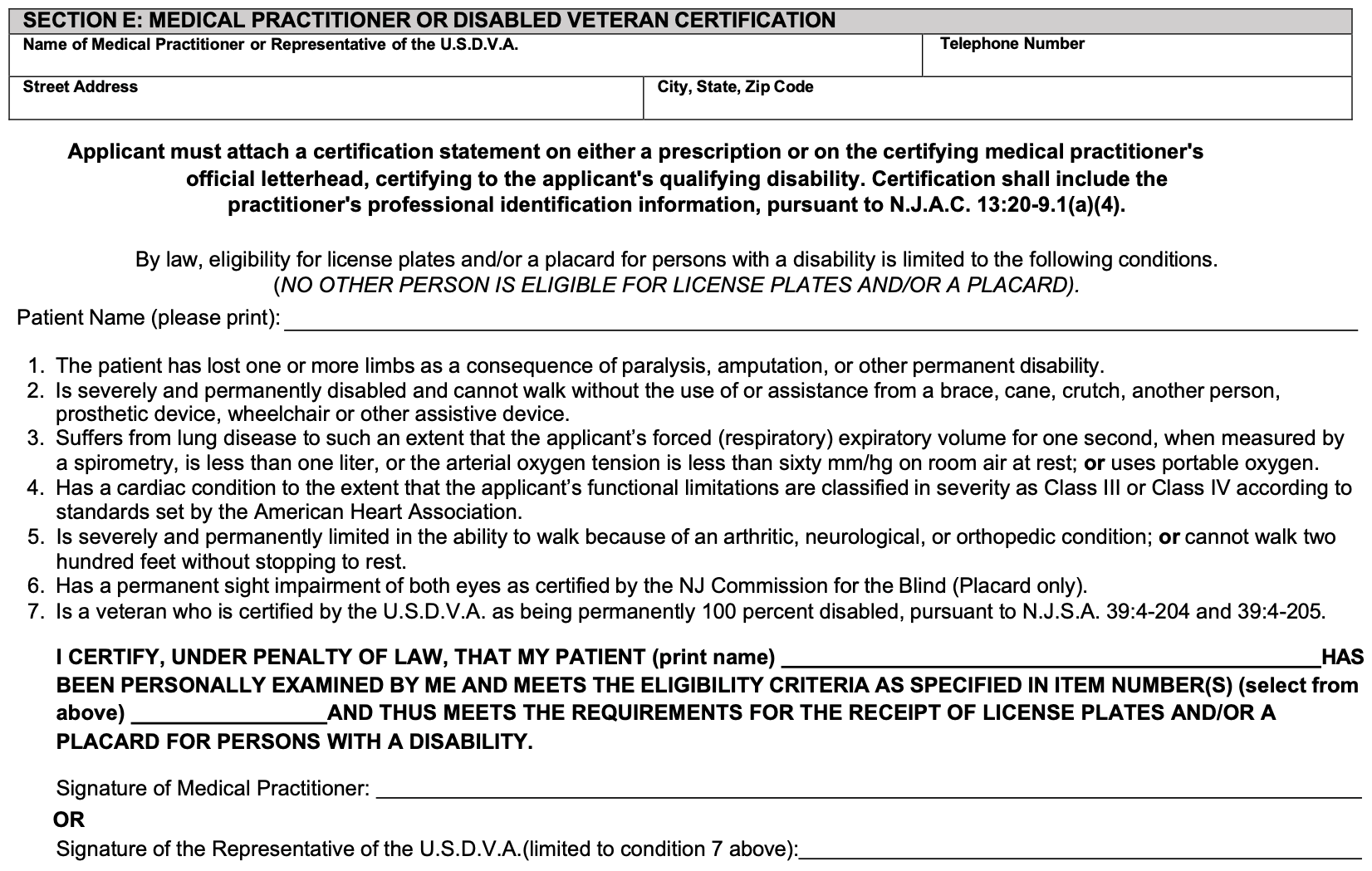
- Form
- SP-41, Application for Vehicle License Plates and/or Placard for Persons with a Disability
- Issued by
- New Jersey Motor Vehicle Commission
- Blank form
- SP-41 PDF on nj.gov
- Revision
- R7/25
- Checklist
- Form SP-41A on nj.gov
- Rule
- N.J.A.C. 13:20-9.1; N.J.S.A. 39:4-204 to 39:4-206
- Valid
- three years; your certification must be dated within 60 days of the application
- Temporary
- a different form, the SP-68, from the local chief of police
Key points
- Your certification is a signed letter or prescription that the patient attaches to the SP-41.
- You also fill out and sign Section E on page 2 of the SP-41.
- A physician, PA, NP, podiatrist or chiropractor licensed in New Jersey or a bordering state may sign.
- Write in the item number, 1 to 6. Item 5’s walking limit is 200 feet.
- Date the letter within 60 days of filing, and give the patient the original.
- A temporary placard is a different form, the SP-68, for up to six months.
Before you start: in New Jersey, your part is a letter
In many states the clinician’s certification is simply a section of the placard application. New Jersey works differently. The SP-41 is your patient’s application, and what the Motor Vehicle Commission relies on is a separate statement from you, written on a prescription blank or on your letterhead, that your patient attaches to it. So the thing you are really being asked for is a short signed letter.
The SP-41 does still have a part for you, Section E on page 2, with lines for your name, address and telephone number, the item number of the qualifying condition, and your signature. My understanding is that the Commission wants both, the signed Section E and the attached letter. What I would do is fill out Section E and write the letter at the same sitting, so they say the same thing and carry the same date.
The rule: N.J.A.C. 13:20-9.1(a)(4); N.J.S.A. 39:4-205; Form SP-41, Section E; Form SP-41A, Section E.
Who may write it
My understanding is that New Jersey accepts the certification from five kinds of licensee, a physician, a podiatrist, a chiropractic physician, a physician assistant or a nurse practitioner, each licensed in New Jersey or in a state that borders it, and that for a physician the statute means a plenary license to practice medicine and surgery. My understanding is also that a physician stationed at a military or naval installation in New Jersey may sign with a license from any state.
Physical therapists and optometrists, who may sign in some other states, are not on New Jersey’s list.
The rule: N.J.S.A. 39:4-204 and 39:4-205; N.J.A.C. 13:20-9.1(a)(4)(i); Form SP-41A, Section E.
What the letter has to say
New Jersey gives you no template. My understanding is that the statement must be signed by you, must say that your patient meets New Jersey’s definition of a person with a disability, and must carry your name, your address and what the rule calls your professional identification information, and that the statute lets the Commission ask for your National Provider Identifier (NPI) or your state license number. The form does not say which, so I would put both on the letter.
It also has to be dated. My understanding is that the statement must be signed and dated no more than 60 days before the complete application reaches the Commission. If your patient plans to file next month rather than this week, a letter dated today could run out first.
The checklist adds that the letter must be the original, because photocopies are not accepted, so a faxed or scanned copy will probably not do. It also says a practitioner who cannot write prescriptions writes a letter with the same information that would appear on a prescription for the condition. I read that as asking you to name the condition, not only to say that your patient qualifies.
So the letter I would write names my patient as the application does, says that I personally examined them, gives the item number or numbers from Section E with the condition in the form’s own words, names the diagnosis in a line, and ends with my license number and the state that issued it, my NPI, my signature and the date.
The rule: N.J.A.C. 13:20-9.1(a)(4); N.J.S.A. 39:4-205; Form SP-41, Section E; Form SP-41A, Sections E and F.
Section E of the SP-41, box by box
Your name, telephone number and address. The top two rows are yours. Use the same name and practice address as on the letter.
The bold instruction. The sentence under your address tells the applicant to attach the certification statement on a prescription or on your letterhead, with your professional identification. That is the letter, and this is the only place on the SP-41 that asks for it.
Patient name. Print your patient’s name as it appears on page 1.
The certification sentence. The paragraph in capitals asks for your patient’s name again and has a blank for the item number or numbers from the list above it. The checklist says the item number, 1 to 6, must be written in. The label says number(s), so if two items apply, such as 3 and 4 for a patient on home oxygen with heart failure, write both.
Your signature. Sign on the line for the medical practitioner. The line after the word OR is only for item 7, which is not yours to sign. Section E has no line for a date or a license number, so those go on the letter.
The conditions, in New Jersey’s words
Section E says that by law eligibility is limited to the listed conditions, and that no other person is eligible. My understanding is that the list follows the statute and the rule, so a condition that is not on it does not qualify, however hard walking is for the patient. Items 1 to 6, as the form prints them:
- “The patient has lost one or more limbs as a consequence of paralysis, amputation, or other permanent disability.”
- “Is severely and permanently disabled and cannot walk without the use of or assistance from a brace, cane, crutch, another person, prosthetic device, wheelchair or other assistive device.”
- “Suffers from lung disease to such an extent that the applicant’s forced (respiratory) expiratory volume for one second, when measured by a spirometry, is less than one liter, or the arterial oxygen tension is less than sixty mm/hg on room air at rest; or uses portable oxygen.”
- “Has a cardiac condition to the extent that the applicant’s functional limitations are classified in severity as Class III or Class IV according to standards set by the American Heart Association.”
- “Is severely and permanently limited in the ability to walk because of an arthritic, neurological, or orthopedic condition; or cannot walk two hundred feet without stopping to rest.”
- “Has a permanent sight impairment of both eyes as certified by the NJ Commission for the Blind (Placard only).”
The walking distance is in item 5. New Jersey’s line is 200 feet without stopping to rest, and on its own it is enough, without the arthritic, neurological or orthopedic wording in the first half of the item.
Three items are worth a second look. Item 1 says “lost one or more limbs”, but the statute and the Commission’s qualifications page say lost the use of one or more limbs. My understanding is that the statute’s wording is the one that counts, and the item’s own mention of paralysis, which takes away a limb’s use rather than the limb, points the same way. Item 3 ends with a third route, portable oxygen, which needs no spirometry or blood gas. And item 6 depends on the state’s Commission for the Blind having certified the sight impairment, and it gives a placard only, not plates.
There is a seventh item, for a New Jersey veteran who has been rated permanently 100 percent disabled. My understanding is that a representative of the federal veterans’ agency signs for that route in place of a clinician, so it is not one you certify.
The rule: N.J.S.A. 39:4-204 and 39:4-205; N.J.A.C. 13:20-9.1(a)(5); Form SP-41, Section E.
Permanent, temporary and renewal
The SP-41 is for a lasting disability. My understanding is that the identification card and placard it produces are good until the last day of the 36th month after they are issued, and that your patient then files a full application again, no more than 90 days early, with a new certification that the condition still exists. Your new letter still has to be dated within 60 days of that filing. Wheelchair symbol license plates renew every year with the registration, but their medical recertification is also every three years.
A temporary placard is a different form and a different office. It is the SP-68, the Application for Temporary Placard, and your patient files it with the local police department for the municipal chief of police. My understanding is that a temporary placard costs $4, lasts no more than six months, and can be renewed once, for no more than six months more. The SP-68 limits it to persons who “have temporarily lost the use of one or more limbs, are temporarily disabled so as to be unable to ambulate without the aid of an assisting device, or whose mobility is otherwise temporarily limited.”
On the SP-68 your part is Section B of the form itself, not a letter, and it marks your NPI as required. So a patient recovering from a hip replacement probably needs the SP-68, and the SP-41 is for a condition you do not expect to improve. The Commission’s answers page also says a temporary placard cannot be used to bridge the wait for a permanent one.
The rule: N.J.S.A. 39:4-205 and 39:4-206; N.J.A.C. 13:20-9.1(a)(6) and (7), and 13:20-9.6; Form SP-68 (R4/13).
Your signature, and the penalty
The sentence you sign in Section E opens “I certify, under penalty of law”, and says your patient has been personally examined by you. If you have not seen the patient for a while, or the condition may have changed, what I would do is see them before signing rather than certify from an old note.
Section F of the form prints the penalty. My understanding is that making a false statement or giving misinformation on an application to obtain or facilitate the receipt of disability plates or a placard is a fourth-degree crime in New Jersey, with a fine of up to $10,000 and up to 18 months in prison. The word “facilitate” is why I read it as reaching the person who certifies, not only the applicant.
The rule: N.J.S.A. 2C:21-4(a), 2C:43-3 and 2C:43-6, as printed in Form SP-41, Section F.
Where it goes
The application and your letter travel together. Your patient can take them to any Motor Vehicle Commission agency, where the Commission says the application can be processed the same day, or mail them to the Special Plate Unit, 225 East State Street, PO Box 015, Trenton, NJ 08666-0015, which the Commission says takes about four to six weeks. My understanding is that there is no fee for the placard or for recertifying, and wheelchair symbol plates cost nothing beyond the normal plate fee.
One thing to mention to a patient who holds a commercial driver’s license (CDL) is that the application asks them to acknowledge that it may lead to a medical review that could affect that license.
The rule: N.J.S.A. 39:4-206; Form SP-41, page 1 and Section A; Form SP-41A.
What New Jersey’s checklist says your part must have
I have not seen a New Jersey source that lists the usual reasons an application is not accepted, so I won’t guess. The Commission’s checklist, the SP-41A, says an application that is not complete, accurate and legible may be delayed, and it names these requirements for the practitioner’s part.
- The item number, 1 to 6, of the qualifying condition, written in.
- The prescription or letter attached, as an original, not a photocopy.
- Your signature and the date, within 60 days of when the application is submitted.
- A signer from the checklist’s list of practitioners.
PatientPapers makes completing the New Jersey placard letter faster and easier
I created PatientPapers to make this paperwork faster and easier, because as a physician I know how much of it lands on us. It is my own product, built through the same company as this site, so weigh this accordingly. For New Jersey it writes the certification letter that goes with the SP-41, stating your credential and license details and the conditions you choose from items 1 to 6, with their item numbers. You still fill out and sign Section E of the SP-41 yourself, and the temporary placard form is not included. The pricing and the full description are on the PatientPapers site.
Open PatientPapers