The Pennsylvania handicap placard form, the doctor’s part of the MV-145A
Your patient with COPD now brings a portable oxygen tank to every visit, and his wife has handed the front desk a Pennsylvania MV-145A with Section A already filled in. Your part is the box marked B in the middle of the front page. It asks for a number from a list on the back, your details and your signature. There is no notary and no fee, so this is one of the shorter placard forms I sign.
- Form
- MV-145A, Person with Disability Parking Placard Application
- Issued by
- Pennsylvania Department of Transportation (PennDOT)
- Blank form
- MV-145A PDF on pa.gov
- Revision
- MV-145A (6-25)
- Rule
- 75 Pa.C.S. § 1338 (the Vehicle Code)
- Temporary
- up to six months, not extended
- Filed with
- PennDOT’s Bureau of Motor Vehicles, by mail, by your patient
Key points
- Your part is Section B, in the middle of page 1.
- You write a reason code from the back, not a diagnosis.
- Reason code 3 is 200 feet without stopping to rest.
- No notary, and no fee for the placard.
- Temporary lasts up to six months and is never extended.
- Licensees from Pennsylvania and its six neighbors may sign.
Before you start: a code, your details and a signature
The MV-145A is a single sheet, front and back. The front has five lettered sections. Section A is your patient’s name and address, Section B is yours, Section C is an alternative where a police officer certifies instead of you, Section D is a separate route for a disabled veteran’s placard, and Section E is your patient’s signed declaration. The back holds the instructions and the list of eligibility requirements, which the form calls “Reason Codes”.
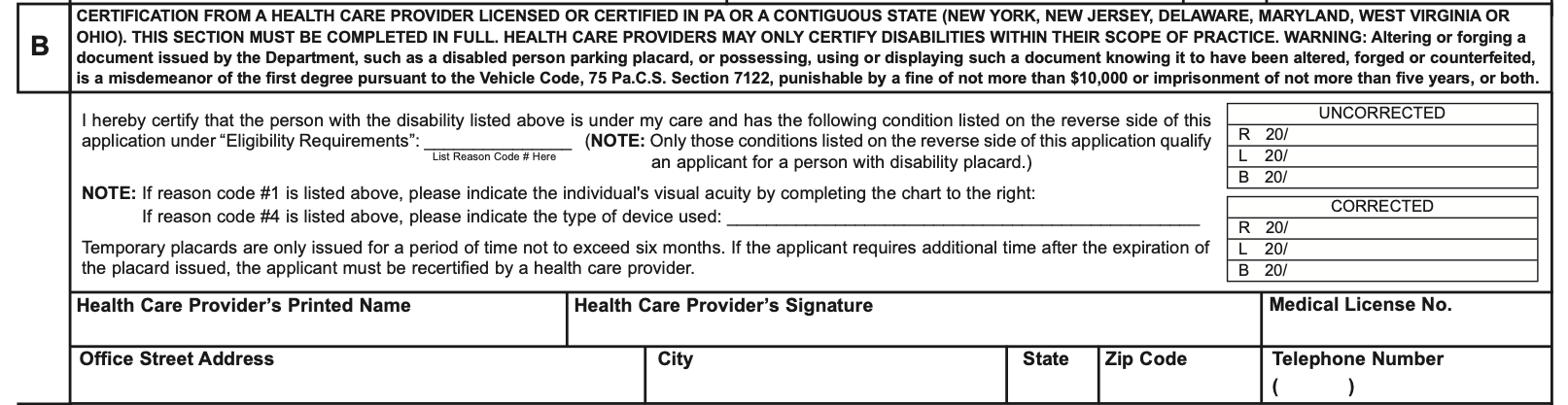
Section B does not ask for a diagnosis and has no condition boxes to check. You certify that your patient is under your care and has one of the conditions on the back, and you write that condition’s number on a short line. Then you add your name, signature, license number, office address and phone number. There is no notary block anywhere on the form, and the top of page 1 says “NO FEE REQUIRED”.
The form says Section B “MUST BE COMPLETED IN FULL”, so a blank box in your section is the thing I would check for before it leaves the room.
The rule: 75 Pa.C.S. § 1338(c); Section B and the instructions on the back of Form MV-145A.
Who may sign
The back of the form defines a health care provider as “a physician, chiropractor, optometrist, podiatrist, physician assistant, or a certified registered nurse practitioner licensed or certified in Pennsylvania or a contiguous state.” The heading of Section B names the contiguous states, and there are six of them: New York, New Jersey, Delaware, Maryland, West Virginia and Ohio. So a physician licensed only in, say, Virginia cannot sign it, even though Virginia is close by.
The form adds one limit that matters in practice. Health care providers “may only certify disabilities within their scope of practice.” An optometrist certifying blindness fits that, and so does a podiatrist certifying a walking problem from the foot. My understanding is that the statute behind the form, section 1338 of the Vehicle Code, lists the same six kinds of clinician and the same states, and that it defines a chiropractor and a podiatrist as acting within the scope of their own practice acts.
Section C lets a police officer sign instead of you, but only to say that your patient is blind or “does not have full use of a leg or both legs”, and only for a permanent placard. The instructions say that “Only licensed health care providers” may certify for a temporary placard. If you complete Section B, the form tells your patient to skip Section C.
The rule: 75 Pa.C.S. § 1338(c)(1) and (3) and (e); the heading of Section B, Section C and the instructions on the back of Form MV-145A.
The eight reason codes, in Pennsylvania’s own words
The back of the form lists eight conditions under “Eligibility Requirements”. Your patient qualifies if they meet one. In the form’s words, the applicant
- is blind.
- does not have full use of an arm or both arms.
- cannot walk 200 feet without stopping to rest.
- cannot walk without the use of, or assistance from, a brace, cane, crutch, another person, prosthetic device, wheelchair or other assistive device.
- is restricted by lung disease to such an extent that the person’s forced (respiratory) expiratory volume for one second, when measured by spirometry, is less than one liter or the arterial oxygen tension is less than 60 MM/HG on room air at rest.
- uses portable oxygen.
- has a cardiac condition to the extent that the person’s functional limitations are classified in severity as Class III or Class IV according to the standards set by the American Heart Association.
- is severely limited in their ability to walk due to an arthritic, neurological or orthopedic condition.
The walking test is code 3, 200 feet without stopping to rest. That is about twenty parking spaces side by side, so a patient who has to stop on the way in from the lot may well meet it. Codes 5 and 7 rest on a number or a class you can point to in the chart, and code 6 is met by portable oxygen in use, which is the code I would write for the patient in the opening example. Code 8 is the broad one and rests on your judgment.
Code 2 is worth knowing about because it is not about walking at all. A patient who has lost the use of an arm qualifies even if they walk normally. Code 1 says only “is blind”, with no number attached, and the form handles that by asking you for the eyesight measurements in a chart, which the next section covers.
My understanding is that the statute adds three more categories after these eight, a person in loco parentis, a parent and a spouse of someone who meets one of codes 1 to 8. Those are about who may apply on the patient’s behalf, not about the patient’s condition, and Section A has its own lines for them. The code you write is always one of 1 to 8.
The rule: 75 Pa.C.S. § 1338(a), printed as the Eligibility Requirements on the back of Form MV-145A.
Section B, line by line
The certifying sentence. It reads “I hereby certify that the person with the disability listed above is under my care and has the following condition listed on the reverse side of this application under ‘Eligibility Requirements’”, with a short line marked “List Reason Code # Here”. Write the number, not words. The patient’s name is not in this sentence, because “listed above” points to Section A, so I would glance at Section A to make sure it names the right person. If more than one code fits, the form does not say whether it wants one or several. I would write each one that applies, separated by commas, since the line is short and a code is only one digit.
The eyesight chart, for code 1 only. If you write code 1, the form asks you to “indicate the individual’s visual acuity by completing the chart to the right.” The chart has an uncorrected block and a corrected block, each with rows for R, L and B (right eye, left eye and both eyes), and each row is printed as “20/” for you to finish. I would fill all six rows, and if an eye cannot read a chart at all, write what you measured, such as count fingers or light perception, rather than leave it blank.
The device line, for code 4 only. If you write code 4, the form asks for “the type of device used”. Name it plainly, such as walker, cane or wheelchair.
The temporary note. The last lines of the box are not a question. They say temporary placards last no more than six months and that after that your patient must be recertified by a health care provider. The section on permanent and temporary below covers it.
Printed name, signature and medical license number. Your name, your own signature, and your license number. The form does not ask which state issued the license or what kind of license it is, so I would make sure the number is one PennDOT could look up in the state that issued it.
Office street address, city, state, ZIP code and telephone number. These are your office’s, not your patient’s.
Section B has no date line, which surprised me. The only signing date on the front of the form is in your patient’s declaration in Section E. Everything else on the page, including the request boxes at the top, Sections A and E, and the police and veteran sections, belongs to someone else.
The rule: Section B of Form MV-145A.
Permanent or temporary, and what happens at renewal
Here the MV-145A works differently from many placard forms. There is no permanent or temporary box in your section. The choice is made in the request boxes at the very top of page 1, where whoever completes the application checks “Permanent Placard” or “Temporary Placard”. So what I would do is ask my patient which one they are applying for, and make sure that box matches what I would certify.
A temporary placard, in the form’s words, lasts “for a period up to six months and may not be extended for an additional period of time.” If your patient still needs it, they fill out a new MV-145A, you certify again in Section B, and they list the number of the placard that is running out. A patient recovering from a knee replacement is the kind of case temporary is for. My understanding is that the six-month limit comes from the form and from PennDOT’s own pages, and that section 1338 does not mention temporary placards at all.
A permanent placard, according to PennDOT’s placard questions page, is valid for five years. The instructions say a renewal needs only Sections A and E, so your patient renews without a new certification from you, and PennDOT also lets them renew online. That makes permanent a decision that does not come back to you. If I could not say whether a condition would improve, what I would do is support a temporary placard and see my patient again before it runs out, since a permanent one renews for years without a clinician looking again.
A replacement for a lost, stolen or defaced placard also needs only Sections A and E, so that does not come back to you either.
The rule: the request boxes on page 1 and the instructions on the back of Form MV-145A; PennDOT’s placard questions page.
When the placard is handed over in the clinic
Some patients will tell you they were given a temporary placard on the spot after surgery. PennDOT runs a program that lets hospitals, medical specialist centers and physical therapy centers enroll, keep a locked supply of temporary placards, and issue one to a qualifying patient at the visit. Those facilities use a different form, the MV-145H, which PennDOT gives only to authorized facilities, with the same reason codes. The facility then emails a scanned copy to PennDOT.
A facility enrolls on Form MV-145P. If your practice is not enrolled, nothing changes for you, and your patient mails the MV-145A and waits for the placard to arrive.
The rule: PennDOT Publication 748, Health Care Provider Requirements and Issuing Guidelines; Form MV-145P.
The warning over your section
The heading of Section B carries a warning that altering or forging a placard, or using one you know to be forged, “is a misdemeanor of the first degree pursuant to the Vehicle Code, 75 Pa.C.S. Section 7122, punishable by a fine of not more than $10,000 or imprisonment of not more than five years, or both.” Read closely, that warning is about the placard itself, not about your certification. The declaration under penalty of perjury on the front of the form is in Section E, and it is your patient’s, not yours. I won’t guess at what other law might apply to the clinician who signs Section B.
PennDOT sees your code, not your patient. What I would do is sign only when I can point to the code in my note, something like “code 3, stopped twice to rest walking from the waiting room”, and see my patient first if the last examination was long enough ago that the answer may have changed.
The rule: the heading of Section B and Section E of Form MV-145A.
License plates: the MV-145
A patient who wants disability license plates instead of, or as well as, a placard uses a different form, the MV-145. Your part there is Section C, and it is close to Section B of the placard form. It uses the same eight reason codes, the same six neighboring states, and the same printed name, signature, license number, office address and phone.
Three things differ. You write your patient’s name into the certifying sentence itself. The sentence lets you certify a hearing impairment instead of a reason code, which is for a separate hearing impaired plate that the form says carries “No Special Parking Privileges”. And there is no eyesight chart. The plates also carry a fee, set in PennDOT’s fee schedule, where the placard is free.
My understanding is that plates are for a permanent disability, that PennDOT renews them yearly like any other registration, and that the statute says your patient “need not submit a certification for subsequent renewals” once you have certified them. PennDOT says a person may hold two permanent placards, or one permanent placard and one set of plates.
The rule: 75 Pa.C.S. § 1338(a) and (c)(2); Section C of Form MV-145 (2-26); PennDOT’s placard questions page.
Where it goes, and what your patient pays
Your patient sends it in, not your office. The completed MV-145A is mailed to PennDOT’s Bureau of Motor Vehicles in Harrisburg, at the address printed on the form, and the placard comes back by mail. There is no fee for the placard. If your patient lists an address outside Pennsylvania in Section A, the form says they must also complete and attach Form MV-8.
The bottom of the form says “THIS APPLICATION MAY BE DUPLICATED”, so a photocopied blank is fine. The PennDOT disabled parking page links to the current MV-145A and MV-145 and to the online renewal service for permanent placards.
The rule: the front and back of Form MV-145A; PennDOT’s placard questions page.
What the form says must be there
I have not seen a Pennsylvania source that lists the usual reasons an MV-145A is not accepted, so I won’t guess. What the form does say must be there is short, and these are the things I would look at before your patient leaves with it.
- Section B complete, since the form says it must be completed in full.
- A reason code from 1 to 8, because only those conditions qualify.
- With code 1, the eyesight chart completed. With code 4, the type of device.
- A signer licensed or certified in Pennsylvania or one of the six neighboring states, certifying within their own scope of practice.
- For a temporary placard, a health care provider’s certification rather than a police officer’s, and on a repeat application, the previous placard number.
- Your patient’s signature in Section E.
PatientPapers makes completing the Pennsylvania MV-145A faster and easier
I created PatientPapers to make this paperwork faster and easier, because as a physician I know how much of it lands on us. It is my own product, built through the same company as this site, so weigh this accordingly. It keeps your name, license number, office address and phone number on file, asks which of the eight reason codes apply, and asks for the eyesight chart only when you choose code 1 and the device only when you choose code 4. It then fills in Section B on Pennsylvania’s own MV-145A for you to review and sign, with your patient’s name in Section A, and leaves the request boxes and the declaration for your patient. For plates it does the same for Section C of the MV-145. The pricing and the full description are on the PatientPapers site.
Open PatientPapers